Loading market data...
Tue, 20 Oct 2026
05:54:18 pm
Tue, 20 Oct 2026
05:54:18 pm
Synopsis
India Stock Market Crash 2026: Discover why foreign investors are pulling billions out of Indian equities while AI stocks surge globally. Explore the impact on Nifty, Sensex, IT stocks, AI infrastructure opportunities, and India's long-term market outlook.
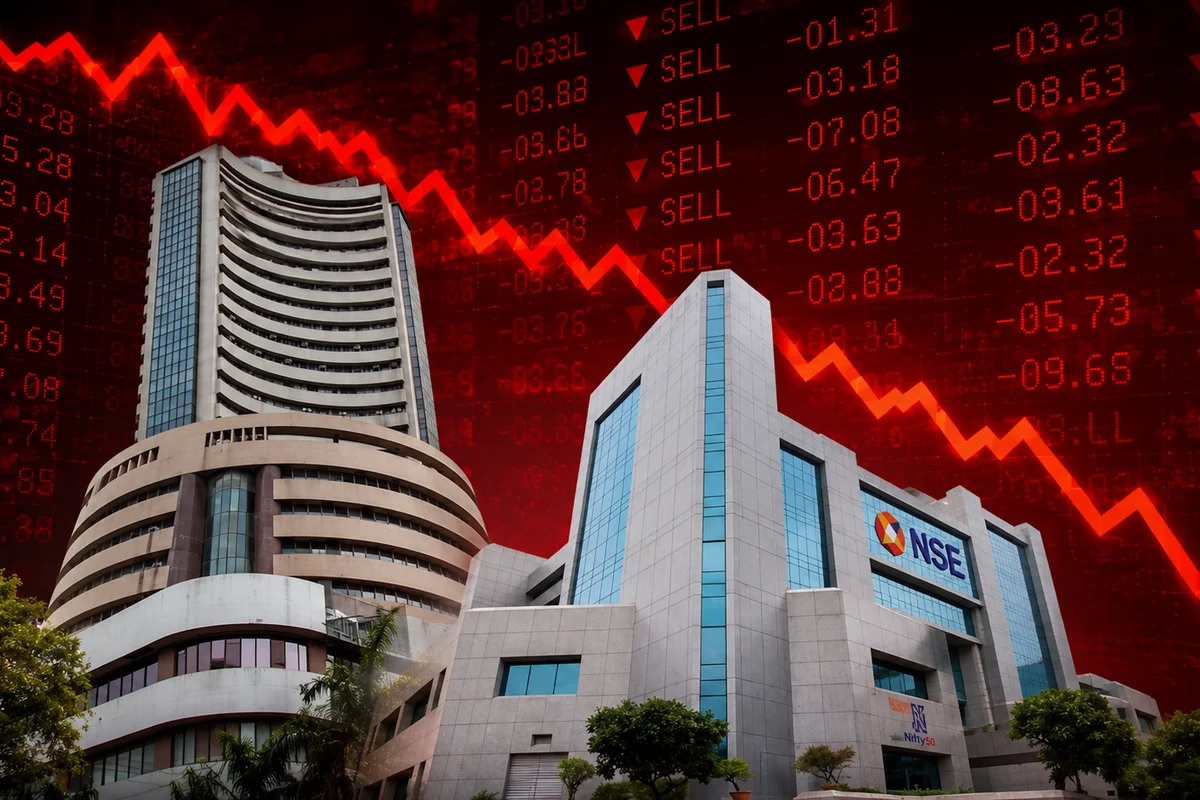
India's stock market is facing one of its most challenging periods in recent years as foreign investors continue pulling billions of dollars from domestic equities while global capital aggressively flows into AI-driven markets such as the United States, Taiwan, and South Korea. The divergence has become increasingly visible in 2026, with India's benchmark indices underperforming many global peers despite the country's strong long-term economic growth story.
The shift is not merely a short-term market correction. Instead, it reflects a major global capital rotation toward artificial intelligence, semiconductors, advanced computing infrastructure, and AI-linked technology companies that are currently driving the next phase of global market leadership.
As foreign institutional investors reassess portfolios and prioritize AI-heavy markets, India's relative lack of direct exposure to the semiconductor and AI hardware boom has resulted in significant outflows, weaker market sentiment, and pressure on several large-cap sectors.
One of the biggest concerns for Indian equities in 2026 has been the scale of foreign portfolio outflows. Global investors have been reducing exposure to Indian stocks and reallocating capital toward markets benefiting directly from the artificial intelligence boom.
While India remains one of the fastest-growing major economies globally, investors are increasingly focusing on countries that sit at the center of the AI supply chain. Semiconductor manufacturers, memory chip producers, AI server companies, cloud infrastructure providers, and advanced hardware suppliers have become the primary beneficiaries of global investment flows.
| Metric | 2026 Trend |
|---|---|
| Foreign Investor Flows | Significant Outflows |
| Market Sentiment | Weak to Neutral |
| Large-Cap Performance | Under Pressure |
| IT Sector Performance | Weak |
| Global Capital Allocation | Shifting Toward AI Markets |
| Valuation Premium | Compressing |
The result has been lower liquidity, weaker momentum, and increasing volatility across several segments of the Indian stock market.
Artificial intelligence has emerged as the defining investment theme of 2026.
Technology giants across the world are investing hundreds of billions of dollars into AI infrastructure, cloud computing, large language models, advanced chips, and data center expansion. This has created enormous demand for semiconductor manufacturers and AI hardware suppliers.
Investors are increasingly chasing companies positioned directly within this ecosystem.
| Growth Driver | Impact |
|---|---|
| AI Chip Demand | Massive Revenue Growth |
| Data Center Expansion | Infrastructure Spending Surge |
| Cloud Computing Growth | Increased Hardware Demand |
| Enterprise AI Adoption | Long-Term Growth Visibility |
| Semiconductor Shortages | Higher Pricing Power |
| AI Software Deployment | Strong Earnings Momentum |
This trend has transformed AI from a technology story into a major capital markets story, driving valuations higher across multiple global exchanges.
South Korea and Taiwan have emerged as some of the biggest beneficiaries of the global AI investment cycle.
Both markets host world-leading semiconductor companies and critical suppliers to the AI ecosystem. As demand for advanced chips continues to grow, global investors have aggressively increased exposure to these markets.
| Market | Primary Growth Driver |
|---|---|
| India | Domestic Consumption, Financials, Infrastructure |
| Taiwan | Semiconductor Manufacturing |
| South Korea | Memory Chips & AI Hardware |
| United States | AI Software, Cloud & Semiconductors |
| Japan | Advanced Electronics & Automation |
The contrast explains why foreign capital has increasingly moved toward AI-linked economies while reducing exposure to markets with limited direct participation in the AI hardware supply chain.
Several factors are contributing to India's relative underperformance.
Corporate earnings growth has slowed in several sectors compared with previous years. Investors generally accept premium valuations when earnings growth remains strong. When earnings moderate, valuations come under pressure.
Unlike Taiwan and South Korea, India's market composition is heavily weighted toward financials, consumer companies, industrials, and traditional IT services rather than semiconductor manufacturing and AI hardware.
Institutional investors continuously rebalance portfolios based on expected returns. In 2026, AI-related assets have become the preferred destination for global capital.
Despite recent corrections, many international investors continue viewing Indian equities as relatively expensive compared to several emerging market alternatives.
Not every sector is affected equally.
| Sector | Current Outlook | Key Reason |
|---|---|---|
| Information Technology | Under Pressure | Slower Earnings Growth |
| Financial Services | Stable | Domestic Demand Support |
| Consumer Stocks | Moderately Positive | Consumption Growth |
| Infrastructure | Positive | Government Spending |
| Data Centers | Emerging Opportunity | AI Infrastructure Demand |
| Power Utilities | Positive | AI Energy Demand |
| Semiconductors | Limited Exposure | Small Domestic Ecosystem |
| Pharma | Mixed | Export Dependence |
Although India lacks large-scale semiconductor champions comparable to Taiwan or South Korea, the country is not entirely absent from the AI story.
Many analysts believe India's biggest opportunity lies in supporting AI infrastructure rather than manufacturing advanced chips.
| Theme | Opportunity |
|---|---|
| Data Centers | Massive Capacity Expansion |
| Power Infrastructure | Rising Electricity Demand |
| Cooling Systems | AI Facility Requirements |
| Cloud Services | Enterprise Adoption |
| Digital Infrastructure | Long-Term Growth |
| Telecom Networks | AI Data Transmission |
This "picks and shovels" approach could allow India to benefit indirectly from the AI boom even without dominating semiconductor manufacturing.
Despite current challenges, many analysts remain constructive on India's long-term outlook.
Several factors could support a market recovery:
India continues to possess one of the strongest structural growth stories among major economies, supported by demographics, digital adoption, manufacturing expansion, and infrastructure development.
The next phase of the market will likely depend on several critical factors.
| Trigger | Potential Impact |
|---|---|
| Foreign Investor Flows | Market Direction |
| Corporate Earnings | Valuation Support |
| AI Infrastructure Investments | Sector Rotation |
| RBI Policy Decisions | Liquidity Conditions |
| Global Interest Rates | Risk Appetite |
| U.S.-India Trade Developments | Export Growth |
Investors should closely monitor whether foreign selling begins to slow and whether India's earnings cycle starts improving during the second half of 2026.
India's stock market is not experiencing a traditional crash driven by economic weakness. Instead, it is facing a period of relative underperformance as global investors rotate capital toward the artificial intelligence supercycle unfolding across semiconductor-heavy markets.
The biggest winners of 2026 have been AI chipmakers, cloud infrastructure providers, memory manufacturers, and technology companies directly benefiting from the global AI boom. India's challenge is that it currently participates more indirectly through infrastructure, power, digital services, and data centers rather than advanced semiconductor manufacturing.
While foreign investors continue reallocating capital toward AI-driven opportunities, India's long-term growth story remains intact. The key question for investors is whether India can build stronger participation in the AI ecosystem and reignite earnings growth before the next major global investment cycle emerges.
Foreign investors are shifting capital toward AI-focused markets such as Taiwan, South Korea, and the United States, where semiconductor and AI-related companies are experiencing stronger growth and investor demand.
India is experiencing relative underperformance rather than a full-scale market crash. The weakness is largely driven by foreign outflows, weaker earnings growth, and global capital rotation toward AI-related sectors.
AI stocks are benefiting from massive investments in semiconductors, cloud computing, data centers, AI infrastructure, and enterprise AI adoption, creating strong revenue and earnings growth expectations.
Data centers, power utilities, digital infrastructure, cloud services, cooling systems, and telecom infrastructure are among the sectors that could indirectly benefit from rising AI adoption.
Yes. Strong domestic demand, infrastructure spending, policy support, improving earnings growth, and increased participation in AI-related infrastructure could help Indian markets recover over the medium to long term.

Financial journalist specializing in market analysis, stock research, and investment trends. Dedicated to providing accurate, timely insights for informed decision-making.
Credentials: Experienced financial journalist with expertise in equity markets and economic analysis
The information provided in this article is for educational and informational purposes only and should not be construed as financial, investment, or legal advice. welomoney does not provide personalized investment recommendations.
For detailed terms and conditions, please read our Disclaimer and Terms of Service.

Diwali Muhurat Trading 2026 is scheduled for November 8 from 2:20 PM to 3:30 PM. See NSE and BSE timings, pre-open session and market schedule.

Sugar stocks fell up to 5.79% after the government barred sugarcane juice and syrup for FY27 ethanol procurement. Analysts flag earnings pressure.

NSE indices on October 16, 2026: Nifty IT rises 3.12%, Nifty 50 gains 0.49%, while Nifty FMCG, Capital Market and Bank indices decline.
India-US trade deal could influence Sensex, Nifty 50 and export stocks. Explore five sectors to watch and the key factors investors should track.

India agricultural growth may approach zero as El Niño threatens crops, with output potentially falling 4%.