Loading market data...
Tue, 20 Oct 2026
06:01:56 pm
Tue, 20 Oct 2026
06:01:56 pm

Rudransh Sangwan
Published at: July 17, 2026, 9:39 AM
Synopsis
India has reportedly signed a $1.2 billion deal to acquire 300 Russian R-37M 'AWACS Killer' missiles for Su-30MKI fighter jets. Know the missile's range, specifications, strategic importance, and how it strengthens the Indian Air Force.
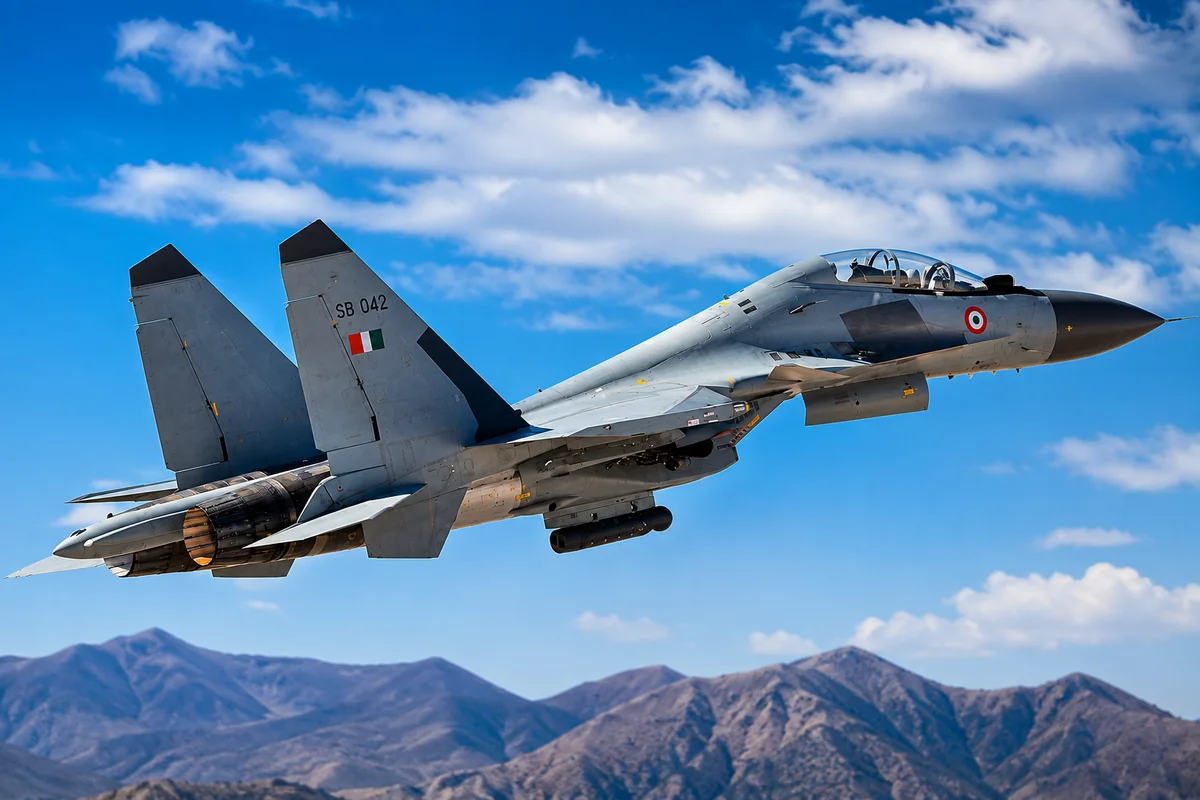
India-Russia Defence Deal: India has reportedly signed a $1.2 billion (around ₹10,000 crore) agreement to procure nearly 300 Russian R-37M very-long-range air-to-air missiles, often referred to by defence analysts as the "AWACS Killer." The advanced missiles will be integrated with the Indian Air Force's Su-30MKI fighter jets, significantly enhancing India's long-range aerial combat capabilities against high-value airborne targets such as AWACS aircraft, aerial refuelling tankers, and electronic warfare platforms. The acquisition comes amid increasing regional security challenges and is expected to narrow the long-range missile capability gap with China and Pakistan.
| Particular | Details |
|---|---|
| Missile | R-37M (NATO: AA-13 Axehead) |
| Estimated Deal Value | Around $1.2 Billion |
| Number of Missiles | Approximately 300 |
| Launch Platform | Su-30MKI Fighter Aircraft |
| Expected Deliveries | Within 12–18 Months |
| Maximum Claimed Range | Up to 400 km |
| Effective Range on Su-30MKI | Around 300–350 km |
| Top Speed | Nearly Mach 6 |
| Warhead | 60 kg High-Explosive Fragmentation |
| Primary Targets | AWACS, Tankers, Electronic Warfare Aircraft |
The Indian Air Force has long faced a capability gap in very-long-range air-to-air combat. While neighbouring countries, particularly China, have inducted long-range missiles such as the PL-15 and PL-17, India's frontline Su-30MKI fleet lacked an equivalent weapon capable of engaging high-value airborne assets at extended distances.
The induction of the R-37M is expected to significantly strengthen India's Beyond Visual Range (BVR) combat capability by allowing fighter aircraft to engage enemy support platforms before they can influence the battlefield.
The purchase is also viewed as an interim capability enhancement until India's indigenous Astra Mk2 and Astra Mk3 long-range missile programmes become fully operational.
Unlike conventional air to air missiles designed primarily for fighter engagements, the R-37M has been specifically developed to destroy large, high-value airborne assets that coordinate modern air operations.
These include:
Neutralising these assets can significantly reduce an adversary's situational awareness, communication, and operational effectiveness during combat.
| Feature | Details |
|---|---|
| Missile Length | Approximately 4.2 metres |
| Weight | Around 600 kg |
| Maximum Speed | Nearly Mach 6 |
| Maximum Claimed Range | 400 km |
| Operational Range (Su-30MKI) | Around 300–350 km |
| Guidance System | Inertial Navigation + Mid-Course Datalink + Active Radar Seeker |
| Warhead | 60 kg High-Explosive Fragmentation |
The missile follows a high-altitude flight profile before diving toward its target, allowing it to conserve energy and maximize engagement range.
The R-37M uses a three-stage guidance mechanism to improve accuracy against distant targets.
| Guidance Stage | Function |
|---|---|
| Inertial Navigation | Guides the missile after launch |
| Mid-Course Datalink | Receives updated target information from the launching aircraft |
| Active Radar Homing | Locks onto the target during the terminal phase |
This allows the launching fighter to disengage after launch while the missile independently tracks and destroys its target.
The acquisition significantly enhances India's air dominance strategy, particularly along the northern and western borders.
Key strategic advantages include:
| Strategic Benefit | Impact |
|---|---|
| Longer Engagement Range | Ability to strike before enemy aircraft can respond |
| Counter to Chinese PL-15 & PL-17 | Narrows India's long-range missile capability gap |
| Better Protection of Airspace | Improves deterrence in contested regions |
| Greater Threat to High-Value Assets | Enables engagement of AWACS and tanker aircraft |
| Enhanced Su-30MKI Capability | Strengthens India's largest fighter fleet |
The missile is expected to improve India's ability to maintain air superiority during potential high-intensity conflicts.
The reported procurement comes at a time when regional air combat capabilities are rapidly evolving. China's induction of advanced long-range air-to-air missiles and continued modernization of its air force have increased pressure on India to upgrade its own aerial strike capabilities.
The R-37M provides the Indian Air Force with an immediate long-range solution while indigenous next-generation missile programmes continue to mature.
Deliveries of the missiles are reportedly expected to begin within 12 to 18 months, after which the Indian Air Force will integrate them into its Su-30MKI fleet. Defence observers will closely monitor integration timelines, operational testing, pilot training, and future indigenous missile developments such as Astra Mk2 and Astra Mk3.
The R-37M is a Russian very-long-range air-to-air missile designed to engage high-value airborne targets such as AWACS aircraft, aerial refuelling tankers, and electronic warfare platforms.
The missile is optimized to destroy Airborne Warning and Control System (AWACS) aircraft, which play a crucial role in directing modern air combat operations.
India is reportedly acquiring approximately 300 R-37M missiles under a deal valued at around $1.2 billion.
The missiles are expected to be integrated with the Indian Air Force's Su-30MKI fighter aircraft.
Russian sources claim a maximum range of around 400 km, while analysts estimate an effective operational range of approximately 300–350 km when launched from the Su-30MKI.
Financial journalist specializing in market analysis, stock research, and investment trends. Dedicated to providing accurate, timely insights for informed decision-making.
Credentials: Experienced financial journalist with expertise in equity markets and economic analysis
The information provided in this article is for educational and informational purposes only and should not be construed as financial, investment, or legal advice. welomoney does not provide personalized investment recommendations.
For detailed terms and conditions, please read our Disclaimer and Terms of Service.

Diwali Muhurat Trading 2026 is scheduled for November 8 from 2:20 PM to 3:30 PM. See NSE and BSE timings, pre-open session and market schedule.

Sugar stocks fell up to 5.79% after the government barred sugarcane juice and syrup for FY27 ethanol procurement. Analysts flag earnings pressure.
NSE indices on October 16, 2026: Nifty IT rises 3.12%, Nifty 50 gains 0.49%, while Nifty FMCG, Capital Market and Bank indices decline.

India-US trade deal could influence Sensex, Nifty 50 and export stocks. Explore five sectors to watch and the key factors investors should track.

India agricultural growth may approach zero as El Niño threatens crops, with output potentially falling 4%.