Loading market data...
Tue, 20 Oct 2026
04:43:16 pm
Tue, 20 Oct 2026
04:43:16 pm
Synopsis
Indian stock markets may open sharply lower after fresh US-Iran missile escalation pushed Brent crude near $100 and triggered a 260-point crash in GIFT Nifty overnight.
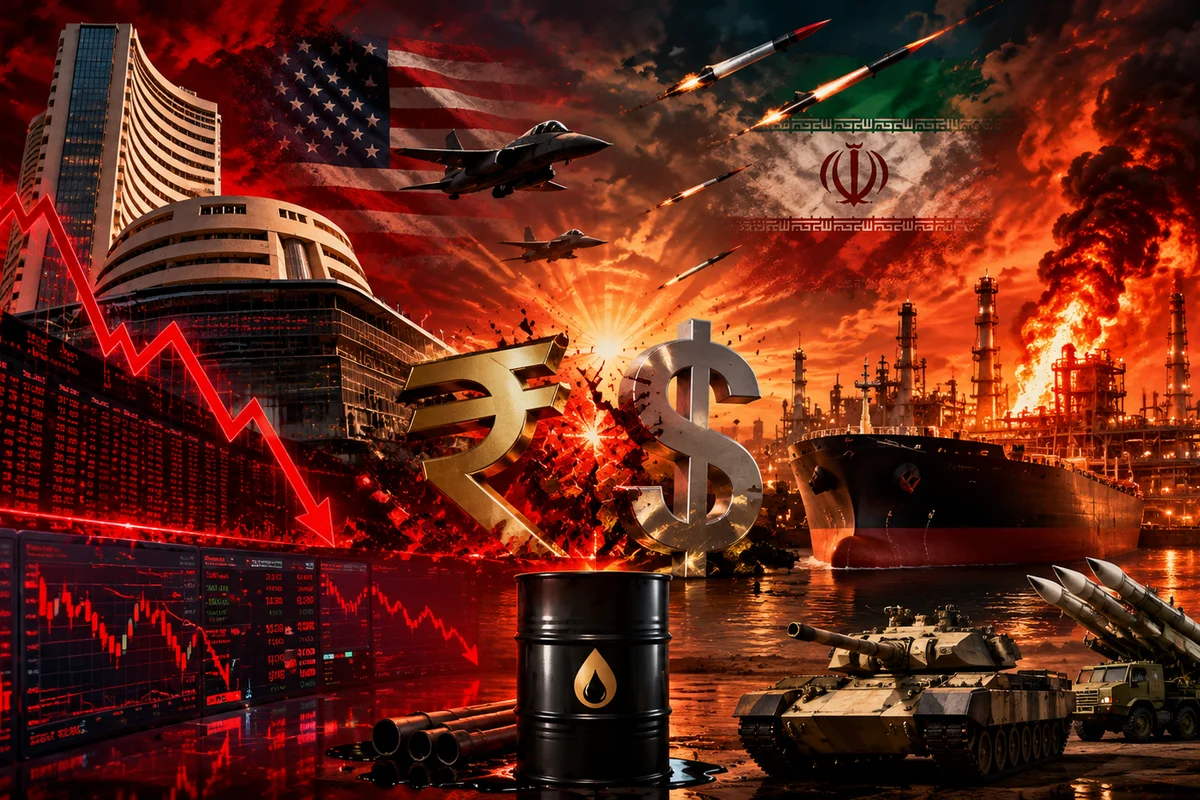
Indian stock markets are staring at a potentially brutal gap-down opening on Friday, May 29, 2026, after a dramatic overnight escalation between the United States and Iran triggered panic across global financial markets. The renewed military confrontation near Bandar Abbas and retaliatory missile actions toward Kuwait have sharply increased fears of a wider Middle East conflict, causing crude oil prices to surge and global risk sentiment to deteriorate rapidly.
The GIFT Nifty is already signaling heavy weakness with a decline of more than 260 points, while Brent crude is once again racing toward the psychologically critical $100-per-barrel zone. The geopolitical shock is expected to trigger aggressive selling across banking, aviation, paints, tyres, oil marketing companies, and other crude-sensitive sectors, while defence, upstream oil exploration, and export-focused IT companies could emerge as relative safe havens during the volatility.
Global markets witnessed a sharp deterioration in sentiment after reports emerged that US forces carried out fresh strikes near Iran’s strategically important Bandar Abbas region. Iran later responded with retaliatory missile actions linked to a US military installation near Kuwait, significantly escalating fears of broader regional instability.
The development has effectively shattered hopes of sustained peace in the region and reignited concerns around possible disruptions near the Strait of Hormuz, one of the world’s most important oil transit chokepoints. Investors across global markets immediately shifted toward defensive positioning, causing sharp moves across commodities, equities, currencies, and safe-haven assets.
The crisis is now evolving beyond a regional geopolitical confrontation and is increasingly becoming a global macroeconomic risk event capable of influencing inflation, energy security, central-bank policy, and emerging-market stability.
| Indicator | Current Status |
|---|---|
| GIFT Nifty | -261 Points |
| Brent Crude | Near $98–100 |
| WTI Crude | Above $92 |
| Global Sentiment | Strong Risk-Off |
| INR Outlook | Weakening Pressure |
| Expected Nifty Opening | Sharp Gap-Down |
India remains one of the world’s most oil-sensitive major economies because it imports nearly 85% of its crude oil requirements. Whenever global crude prices spike sharply, the impact spreads rapidly across the broader economy through fuel inflation, logistics costs, currency pressure, and reduced corporate profitability.
This latest geopolitical shock creates a dangerous combination for Dalal Street because it simultaneously affects:
As a result, multiple sectors are likely to witness immediate selling pressure at the opening bell.
The aviation sector is expected to be among the worst-hit segments during Friday’s opening session as rising crude oil prices immediately increase Aviation Turbine Fuel costs, which form one of the largest operating expenses for airlines.
The situation becomes even more dangerous because potential Gulf-region airspace restrictions and rerouting requirements could increase fuel consumption and operational costs for long-haul international flights. Investors are likely to aggressively reduce exposure to aviation counters due to fears of margin compression and earnings pressure.
InterGlobe Aviation, which operates IndiGo, and SpiceJet are expected to remain under heavy pressure as traders react to the sudden rise in energy costs and geopolitical uncertainty.
| Company | Key Risk Factor |
|---|---|
| IndiGo | ATF Cost Surge |
| SpiceJet | Margin Pressure |
| Aviation Sector | Gulf Route Disruptions |
| Airline Industry | Fuel Inflation |
Crude-linked manufacturing industries including paints, tyres and specialty chemicals are also expected to face strong selling pressure as investors factor in rising raw material costs.
These businesses depend heavily on petroleum derivatives, solvents, synthetic rubber and chemical feedstocks. A sudden spike in crude oil prices usually compresses operating margins because companies cannot immediately pass higher costs to consumers.
Market participants are likely to remain cautious on companies such as Asian Paints, Berger Paints, Kansai Nerolac, Apollo Tyres, MRF and CEAT.
| Sector | Stocks in Focus |
|---|---|
| Paints | Asian Paints, Berger Paints |
| Tyres | MRF, Apollo Tyres, CEAT |
| Chemicals | Specialty Chemical Companies |
The broader market concern is that prolonged crude strength could negatively affect quarterly profitability across these sectors.
Although higher crude oil prices generally support upstream energy producers, downstream oil marketing companies often suffer during sharp oil rallies because domestic retail fuel prices remain politically sensitive.
Companies such as IOC, BPCL and HPCL may face fears of marketing losses if global crude prices continue rising faster than domestic fuel price revisions.
This creates a difficult environment for investors, especially as the government may hesitate to allow aggressive fuel-price hikes during a politically sensitive inflationary phase.
| Company | Primary Concern |
|---|---|
| IOC | Marketing Margin Pressure |
| BPCL | Fuel Pricing Risk |
| HPCL | Inventory Cost Pressure |
Banking and financial stocks are expected to become the primary drag on benchmark indices as foreign institutional investors shift capital toward safer global assets.
Historically, banking heavyweights witness some of the strongest selling during geopolitical risk events because they are among the most liquid and heavily owned emerging-market assets.
A rising crude oil environment also increases concerns around inflation, bond yields and delayed RBI rate cuts, which negatively impacts banking sentiment.
| Bank | Expected Impact |
|---|---|
| HDFC Bank | FII Selling Pressure |
| ICICI Bank | Risk-Off Positioning |
| Axis Bank | Liquidity Outflows |
| SBI | Index Drag Risk |
Defence companies may become one of the few sectors attracting buying interest during the broader market selloff as geopolitical instability increases focus on military technology and strategic infrastructure.
Indian defence stocks have consistently shown relative outperformance during periods of global conflict due to rising government spending expectations and strong order books.
Companies such as HAL, BEL and Bharat Dynamics may attract defensive institutional flows.
| Company | Key Segment |
|---|---|
| HAL | Aerospace & Defence |
| BEL | Defence Electronics |
| BDL | Missile Systems |
Unlike oil refiners and retailers, upstream exploration companies directly benefit when global crude prices rise because their realizations improve significantly.
ONGC and Oil India may witness relative strength as investors rotate toward energy producers benefiting from elevated oil prices.
| Company | Positive Trigger |
|---|---|
| ONGC | Higher Crude Realizations |
| Oil India | Revenue Expansion |
These stocks could outperform broader indices if Brent crude sustains above current levels.
Information technology exporters may emerge as defensive plays because a weakening Indian Rupee improves the value of their dollar-denominated revenues.
Large-cap IT names such as TCS, Infosys, HCLTech and Wipro often outperform during periods of rupee weakness and global volatility.
| Company | Key Benefit |
|---|---|
| TCS | Dollar Revenue Advantage |
| Infosys | FX Translation Gains |
| HCLTech | Export Earnings Support |
| Wipro | Defensive Positioning |
LIC is expected to remain one of the most actively traded stocks during Friday’s session because May 29 marks the ex-date for its 1:1 bonus issue.
The stock price will automatically adjust lower as the number of outstanding shares doubles. However, the lower adjusted share price could attract strong retail participation and unusually high trading activity despite broader market weakness.
Adani Power’s recent announcement regarding the acquisition of a stake in Jaiprakash Power Ventures is expected to create sharp stock-specific movement within the Adani group ecosystem.
Traders are likely to closely monitor Adani-related counters for aggressive intraday swings and elevated volume action.
The sharp fall in GIFT Nifty suggests that Nifty 50 could immediately test critical support levels during opening trade.
| Level | Importance |
|---|---|
| 23,750 | Immediate Support |
| 23,550 | Major Breakdown Zone |
| 24,000 | Psychological Resistance |
| 23,300 | Panic Selling Region |
A decisive breakdown below 23,750 could intensify market-wide selling pressure.
Professional traders and institutional desks are expected to remain highly cautious during the opening hour because of extreme overnight volatility.
Many analysts are advising investors to avoid aggressively buying the initial dip until the market stabilizes and institutional buying patterns become visible.
| Factor | Market Impact |
|---|---|
| US-Iran Conflict | Strongly Negative |
| Crude Oil Rally | Inflationary |
| FII Flows | Bearish |
| Rupee Weakness | Negative for Markets |
| Defence Sector | Relatively Bullish |
The fresh US-Iran military escalation has transformed global financial sentiment overnight and created the conditions for one of the sharpest risk-off openings in Indian markets in recent weeks.
The situation is especially dangerous because it combines:
into a single market event.
If Brent crude sustains above the $100 zone and Middle East tensions continue escalating, Indian equities could witness prolonged volatility across banking, aviation, manufacturing and consumer-facing sectors.
At the same time, defence, upstream energy and export-oriented IT sectors may continue attracting defensive institutional flows as investors reposition portfolios toward safer segments of the market.
The next direction for Dalal Street will largely depend on:
Until geopolitical tensions cool materially, traders and investors should expect elevated volatility, rapid sector rotation and aggressive headline-driven market moves across Indian equities.
GIFT Nifty is falling after fresh US-Iran military escalation triggered panic across global financial markets.
India imports nearly 85% of its crude oil requirements, making the economy highly sensitive to oil inflation.
Aviation, banking, paints, tyres and oil marketing companies could face heavy pressure.
Foreign investors often sell highly liquid banking stocks during global risk-off events.
ONGC and Oil India may benefit due to higher oil-price realizations.
Geopolitical tensions generally improve sentiment for defence manufacturing and military technology companies.
A weaker rupee increases the value of export earnings generated in US dollars.
LIC’s 1:1 bonus issue ex-date falls on May 29, leading to price adjustment and strong retail activity.
Traders are closely watching the 23,750 and 23,550 support zones.
Many analysts recommend waiting for market stabilization before taking aggressive positions.

Financial journalist specializing in market analysis, stock research, and investment trends. Dedicated to providing accurate, timely insights for informed decision-making.
Credentials: Experienced financial journalist with expertise in equity markets and economic analysis
The information provided in this article is for educational and informational purposes only and should not be construed as financial, investment, or legal advice. welomoney does not provide personalized investment recommendations.
For detailed terms and conditions, please read our Disclaimer and Terms of Service.
Diwali Muhurat Trading 2026 is scheduled for November 8 from 2:20 PM to 3:30 PM. See NSE and BSE timings, pre-open session and market schedule.
Sugar stocks fell up to 5.79% after the government barred sugarcane juice and syrup for FY27 ethanol procurement. Analysts flag earnings pressure.
NSE indices on October 16, 2026: Nifty IT rises 3.12%, Nifty 50 gains 0.49%, while Nifty FMCG, Capital Market and Bank indices decline.

India-US trade deal could influence Sensex, Nifty 50 and export stocks. Explore five sectors to watch and the key factors investors should track.

India agricultural growth may approach zero as El Niño threatens crops, with output potentially falling 4%.