Loading market data...
Fri, 24 Apr 2026
11:07:35 am
Fri, 24 Apr 2026
11:07:35 am
Rudransh Sangwan
Published at: April 24, 2026, 8:18 AM
Sensex and Nifty fell sharply again as global tensions, rising oil prices, and weak earnings hit markets. Here’s a deep analysis of the key triggers.
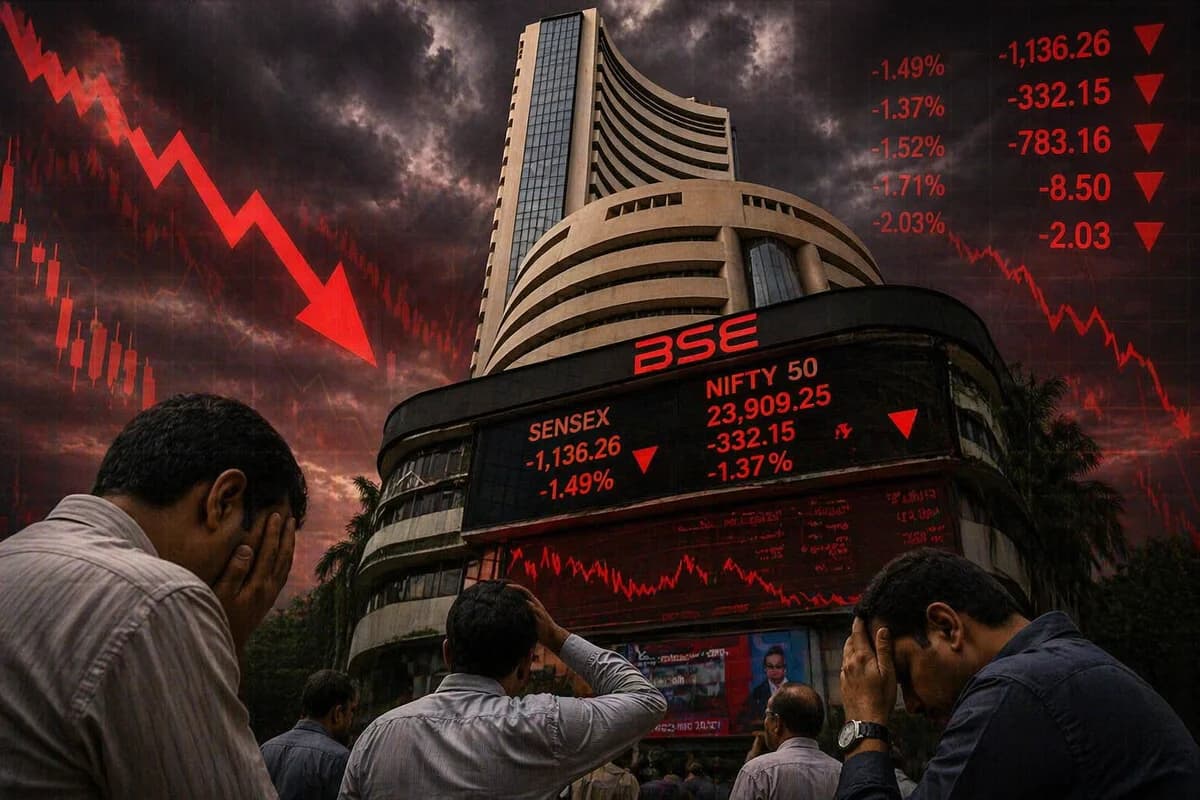
The Indian stock market witnessed another sharp decline, with the BSE Sensex falling over 1,100 points and the Nifty 50 slipping below 23,900. Nearly ₹6 lakh crore in market capitalisation was wiped out in a single session, reflecting a strong risk-off sentiment across investors. While the fall appears sudden, the underlying triggers are deeply interconnected, combining global geopolitics, macroeconomic stress, and domestic market factors.
The current market decline is not driven by a single event but by multiple factors aligning simultaneously. Rising geopolitical tensions, especially involving Iran and the United States, have pushed crude oil prices sharply higher. This is critical for India, which relies heavily on oil imports.
Data suggests rising oil prices and geopolitical stress This leads to inflation concerns and currency weakness Which results in heavy selling across equities
At the same time, weak earnings from key sectors and continued foreign investor outflows have amplified the downside.
| Indicator | Movement |
|---|---|
| Sensex Decline | -1,100+ points |
| Nifty Decline | -300+ points |
| Market Cap Loss | ~₹6 lakh crore |
| India VIX | +3% |
| Rupee | Weakens to ~94.25 |
The spike in volatility index shows rising fear levels in the market.
The conflict involving Iran and the United States has escalated, with disruptions near the Strait of Hormuz, a critical global oil route. This has significantly increased uncertainty in global markets.
Oil prices have crossed the $100 per barrel mark again, which is a major concern for India. Higher oil prices increase import bills, fuel inflation, and pressure corporate margins.
The Indian rupee has fallen to around 94.25 against the US dollar. Currency depreciation increases costs for import-dependent sectors and signals capital outflows.
Foreign institutional investors have remained net sellers, offloading over ₹3,000 crore worth of equities recently. This sustained selling weakens market sentiment.
Global markets remain mixed to negative, with Asian and US markets showing signs of weakness. This reduces risk appetite for emerging markets like India.
US bond yields have climbed above 4.3 percent, making fixed-income investments more attractive compared to equities. This shift in capital allocation pressures stock markets.
Stocks like Infosys declined after disappointing earnings outlook, dragging the IT sector lower. IT stocks are heavyweight components of indices, amplifying the impact.
While multiple factors are at play, the most critical variable is crude oil. India’s economy is highly sensitive to oil price movements.
Higher oil prices lead to:
• Rising inflation
• Pressure on fiscal deficit
• Weakening currency
• Reduced corporate profitability
This makes oil the single most important driver of current market sentiment.
Many investors believe market crashes are purely panic-driven. In reality, this fall is largely macro-driven with strong fundamental triggers.
Another misconception is that all sectors are falling equally. Data shows selective resilience in sectors like cement and capital goods, indicating rotation rather than complete weakness.
Despite the fall in benchmark indices, midcap and smallcap stocks have shown relative resilience. This suggests that domestic liquidity remains strong and the correction is concentrated in large-cap heavyweights.
This indicates that the market is not collapsing but adjusting.
| Index | Support Range | Resistance Range |
|---|---|---|
| Nifty | 23,600 – 23,500 | 24,650 – 24,800 |
| Sensex | 76,500 – 75,800 | 78,500 – 79,000 |
The index is currently in a consolidation phase after a sharp rally of over 2,400 points in recent weeks.
The market direction will depend on:
• Outcome of geopolitical developments
• Movement in crude oil prices
• FII flow trends
• Earnings season performance
If tensions ease, markets could see a sharp rebound. If not, volatility may persist.
Investors should focus on discipline rather than reacting to short-term panic.
• Avoid leveraged positions
• Accumulate quality stocks on dips
• Focus on sectors with strong fundamentals
• Maintain proper risk management
Short-term traders should remain cautious, while long-term investors can use corrections to build positions.
The current fall in BSE Sensex and Nifty 50 is a result of a complex mix of global and domestic factors, with crude oil emerging as the dominant driver. While the near-term outlook remains volatile, the broader market structure is not broken. Investors who understand the underlying triggers and maintain a disciplined approach are better positioned to navigate this phase.
The crash is driven by rising geopolitical tensions, higher oil prices, FII selling, and weak earnings from key sectors like IT.
It appears to be a corrective phase rather than a structural crash, as broader markets still show some resilience.
Investors should avoid panic selling, focus on fundamentally strong stocks, and use market dips as buying opportunities with proper risk management.

Financial journalist specializing in market analysis, stock research, and investment trends. Dedicated to providing accurate, timely insights for informed decision-making.
Credentials: Experienced financial journalist with expertise in equity markets and economic analysis
The information provided in this article is for educational and informational purposes only and should not be construed as financial, investment, or legal advice. welomoney does not provide personalized investment recommendations.
For detailed terms and conditions, please read our Disclaimer and Terms of Service.
Indian stock market declines as Sensex falls 350 points and Nifty slips below 24,100. Here’s a detailed analysis of key triggers and what investors...

SP Group plans a ₹25,400 crore debt raise at high interest rates. Here’s a deep analysis of why it’s happening and what it means for markets.

Renewable energy is now outpacing global electricity demand growth. Here is a deep analysis of solar, wind, coal decline, and future energy trends.

PhonePe crossed 10 billion UPI transactions in March 2026. Here’s a deep analysis of growth drivers, market share, competition, and future outlook.

Gift Nifty indicates a weak opening for Indian markets as geopolitical tensions rise. Here are key Nifty levels, triggers, and trading strategy for...

