Loading market data...
Sun, 06 Sept 2026
02:42:36 pm
Sun, 06 Sept 2026
02:42:36 pm

Rudransh Sangwan
Published at: April 24, 2026, 4:09 AM
Synopsis
Indian stock market declines as Sensex falls 350 points and Nifty slips below 24,100. Here’s a detailed analysis of key triggers and what investors should watch.
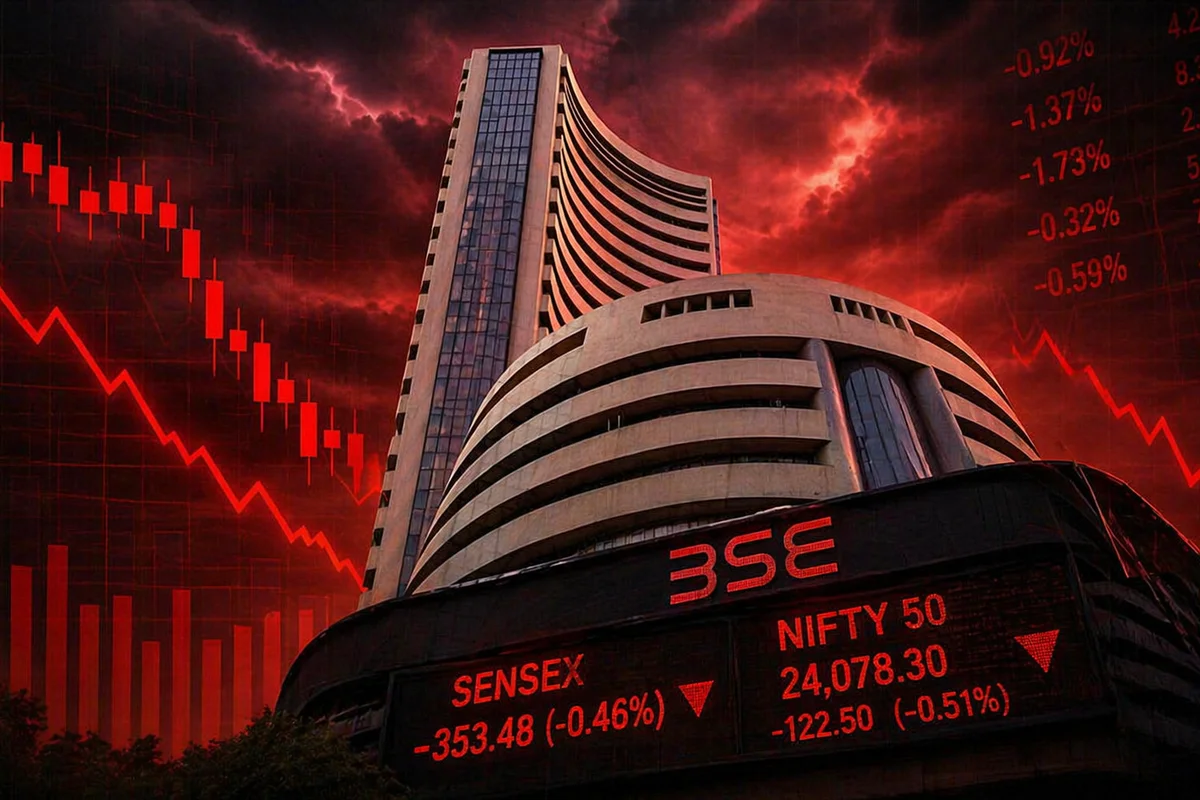
The Indian stock market opened under pressure as benchmark indices extended their losing streak for the third consecutive session, reflecting growing global uncertainty and risk-off sentiment. The BSE Sensex slipped over 350 points while the Nifty 50 fell below the crucial 24,100 level, signaling weakening momentum after a recent recovery phase. The decline is being driven by a combination of rising crude oil prices, geopolitical tensions, and cautious institutional flows, creating a fragile near-term outlook for equities.
The primary trigger behind the decline is escalating geopolitical tension between the United States and Iran, which has pushed crude oil prices higher and increased global risk aversion. Higher oil prices directly impact India due to its import dependency, leading to concerns around inflation, currency pressure, and fiscal stability.
Data suggests rising crude prices and geopolitical stress This leads to inflationary pressure and weaker currency Which results in selling pressure in equities
Additionally, foreign institutional investors have remained cautious, with flows turning volatile amid global uncertainty.
Heavyweight stocks like HCL Technologies and Sun Pharmaceutical Industries declined around 2 percent each, contributing significantly to the index fall.
The IT sector is facing pressure due to slowing global demand and delayed deal conversions, while pharma stocks are seeing profit booking after recent gains.
Interestingly, while headline indices are falling, broader markets have shown relative resilience. Midcap and smallcap stocks continue to see selective buying, indicating that investor interest has not completely faded.
Global markets are also reflecting mixed sentiment:
| Region | Trend |
|---|---|
| US Futures | Slightly Positive |
| Japan | Mild Gains |
| Australia | Decline |
| Hong Kong | Weak |
| Europe Futures | Negative |
This divergence highlights uncertainty rather than a clear directional trend.
The Indian rupee has weakened toward the 94.20 level against the US dollar, reflecting pressure from rising oil prices and capital outflows.
At the same time, bond yields are moving higher, indicating tightening liquidity conditions and expectations of sustained inflation.
These signals typically precede cautious equity market behavior.
While headlines focus on index movements, the deeper driver is crude oil. With prices moving toward the $100 per barrel mark, concerns are rising around:
• Imported inflation
• Higher fiscal burden
• Pressure on corporate margins
This makes oil the most critical variable for market direction in the near term.
A common mistake is assuming that market corrections are purely technical. In reality, current weakness is largely macro-driven.
Another misconception is that falling indices indicate broad market weakness. Data shows that selective sectors and stocks continue to outperform, suggesting rotation rather than collapse.
Despite the negative sentiment, corrections often create entry opportunities in fundamentally strong stocks. Markets rarely move in a straight line, and periods of fear can offer better risk-reward setups.
If geopolitical tensions ease even slightly, markets could see a sharp rebound driven by short covering and renewed buying.
| Level Type | Range |
|---|---|
| Support | 23,500 to 23,300 |
| Resistance | 24,300 to 24,600 |
| Level Type | Range |
|---|---|
| Support | 76,500 to 75,800 |
| Resistance | 78,000 to 79,000 |
Holding above support levels will be crucial to maintain bullish structure.
Investors and traders should focus on disciplined execution rather than reacting to headlines.
• Avoid aggressive buying during high volatility • Focus on stocks with strong fundamentals • Use dips for gradual accumulation • Maintain strict stop losses
Short-term traders should remain agile, while long-term investors can use corrections to build positions.
The current market decline reflects a combination of global uncertainty, rising oil prices, and cautious investor sentiment rather than a structural breakdown. While the near-term outlook remains volatile, the broader trend is still dependent on macro developments, especially geopolitical stability and crude oil movement. Investors who stay disciplined and avoid emotional decisions are likely to navigate this phase more effectively.
The decline is driven by rising geopolitical tensions, higher crude oil prices, and cautious investor sentiment, which have led to selling pressure in key sectors.
IT and pharma stocks are currently under pressure, while broader markets like midcaps are showing relative resilience.
Volatility remains high, so investors should avoid lump-sum buying and instead accumulate quality stocks gradually during dips.
Financial journalist specializing in market analysis, stock research, and investment trends. Dedicated to providing accurate, timely insights for informed decision-making.
Credentials: Experienced financial journalist with expertise in equity markets and economic analysis
The information provided in this article is for educational and informational purposes only and should not be construed as financial, investment, or legal advice. welomoney does not provide personalized investment recommendations.
For detailed terms and conditions, please read our Disclaimer and Terms of Service.

Gland Pharma, Tata Technologies and Nexus Select Trust remain in focus as major investors and shareholders make significant market transactions.

Ola Electric opens partner dealerships across India and plans a wider sales and service network as the company expands its electric scooter business.
Indian stock market today update covering Nifty 50, Sensex, Bank Nifty, FinNifty, Midcap Nifty, gold, silver, crude oil and top gainers and losers.

Wipro employee monitoring and TimeScope tracking are drawing attention as workplace activity, laptop usage and employee privacy come under discussion.
Indian stock market today update covering Nifty 50, Sensex, Bank Nifty, FinNifty, gold, silver, crude oil and top gainers and losers.