Loading market data...
Tue, 29 Sept 2026
11:39:28 pm
Tue, 29 Sept 2026
11:39:28 pm

Rudransh Sangwan
Published at: May 12, 2026, 7:18 AM
Synopsis
Indian stock markets extended losses as the Sensex dropped nearly 1,000 points and Nifty slipped below 23,900 amid rising crude oil prices, record-low rupee levels, persistent FII selling, and escalating geopolitical tensions in the Middle East.
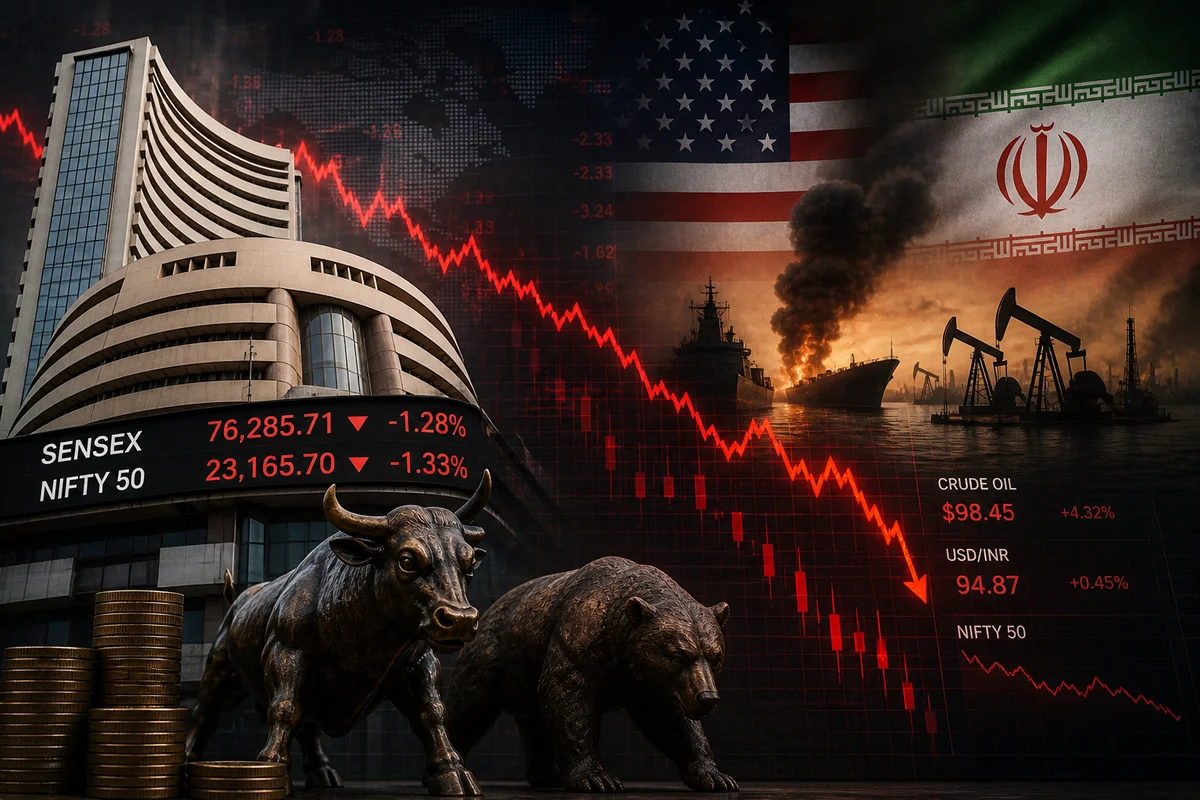
Indian stock markets witnessed another sharp correction on Tuesday as benchmark indices extended losses amid rising crude oil prices, a record-low rupee, persistent foreign investor selling, and escalating geopolitical tensions in the Middle East.
NIFTY 50 slipped below the crucial 23,900 mark while BSE SENSEX dropped nearly 1,000 points during intraday trade, reflecting growing nervousness across global financial markets.
The broader market weakness comes as investors continue reacting to multiple macroeconomic pressures simultaneously, including crude oil prices above $100 per barrel, rising US bond yields, weakening emerging market currencies, and uncertainty surrounding US-Iran negotiations.
The sell-off intensified across sectors as investor sentiment weakened sharply during morning trade.
| Index / Asset | Movement |
|---|---|
| Sensex | Fell nearly 1,000 points |
| Nifty 50 | Slipped below 23,900 |
| India VIX | Moved higher |
| Rupee | Hit record low levels |
| Brent Crude | Crossed $100/barrel |
The decline erased several lakh crore rupees in investor wealth as broader market participation also weakened significantly.
One of the biggest triggers behind today’s market fall remains the sharp rise in global crude oil prices.
| Factor | Impact |
|---|---|
| Middle East tensions | Supply disruption fears |
| US-Iran uncertainty | Geopolitical risk premium |
| Strait of Hormuz concerns | Shipping route disruption |
| OPEC supply risks | Higher global oil prices |
Brent crude prices surged above $100 per barrel as fears of prolonged geopolitical conflict intensified.
For India, which imports the majority of its crude oil requirements, rising energy prices create serious macroeconomic risks.
Oil-sensitive sectors such as aviation, paints, chemicals, logistics, and auto companies often face pressure during periods of elevated crude prices.
The Indian rupee weakened sharply against the US dollar, touching fresh all-time low levels.
| Driver | Effect |
|---|---|
| Rising oil imports | Higher dollar demand |
| FII outflows | Capital pressure |
| Strong US dollar | Emerging market weakness |
| Global uncertainty | Risk-off sentiment |
A weaker rupee increases imported inflation and raises costs for businesses dependent on imported raw materials.
Currency weakness also impacts investor confidence because it reflects broader macroeconomic stress.
Foreign Institutional Investors (FIIs) remained aggressive sellers in Indian equities, adding further pressure on benchmark indices.
Persistent FII selling has become one of the key reasons behind recent weakness in large-cap stocks, especially banking and financial names.
Domestic Institutional Investors (DIIs) continue absorbing some of the selling pressure, but broader sentiment remains cautious.
The IT sector emerged among the worst-performing segments during today’s session.
| Concern | Impact |
|---|---|
| Weak global demand outlook | Slower revenue growth |
| AI disruption fears | Pressure on traditional services |
| US slowdown concerns | Lower tech spending |
| Valuation pressure | Reduced investor appetite |
Investors are increasingly concerned that rapid AI adoption could disrupt traditional outsourcing models and reduce long-term growth visibility for legacy IT services businesses.
Banking and financial stocks remained under pressure amid heavy foreign investor selling and concerns over rising macroeconomic stress.
Large private banking stocks witnessed broad-based selling during the session.
| Sector | Reason for Weakness |
|---|---|
| IT | AI concerns and weak demand outlook |
| Banking & Financials | FII selling |
| Auto | Rising fuel price concerns |
| Aviation | Higher ATF costs |
| Paints & Chemicals | Crude-linked raw material inflation |
Meanwhile, select oil exploration and energy-related companies witnessed relatively better performance due to higher crude prices.
The current correction highlights how global macroeconomic risks are once again dominating investor sentiment.
Markets are currently reacting more to geopolitical and macroeconomic developments than company-specific earnings fundamentals.
India remains highly sensitive to crude oil price spikes because of its heavy import dependence.
| Risk Area | Possible Impact |
|---|---|
| Inflation | Higher consumer prices |
| Fiscal Deficit | Increased subsidy burden |
| Currency | Rupee depreciation |
| Corporate Margins | Cost pressure |
| Consumer Spending | Reduced discretionary demand |
Sustained oil prices above $100 could create broader economic challenges if geopolitical tensions continue escalating.
Analysts expect market volatility to remain elevated in the near term as uncertainty surrounding the Middle East conflict continues.
Any signs of easing geopolitical tensions could provide short-term relief to markets, while further escalation may intensify risk-off sentiment globally.
During periods of high macroeconomic uncertainty, investors often rotate toward relatively defensive sectors.
Defensive sectors generally witness more stable earnings compared to cyclical industries during volatile market phases.
Technical analysts believe immediate support and resistance levels will remain important for short-term traders.
| Index | Support | Resistance |
|---|---|---|
| Nifty 50 | 23,500 | 24,000 |
| Sensex | 75,000 | 76,500 |
Market experts suggest volatility may remain elevated until clarity emerges around crude oil prices and geopolitical developments.
Indian stock markets witnessed another sharp correction as rising crude oil prices, a record-low rupee, continued FII selling, and escalating Middle East tensions weakened investor sentiment.
The broader market reaction highlights how vulnerable emerging markets remain to global macroeconomic shocks, especially during periods of geopolitical uncertainty and commodity price spikes.
While domestic liquidity continues providing some support, investors are expected to remain cautious as long as crude oil prices stay elevated and global tensions persist.
The coming sessions will likely depend heavily on geopolitical developments, rupee stability, oil price movement, and foreign investor activity.
The Sensex fell due to rising crude oil prices, weak rupee, FII selling, and escalating Middle East tensions.
India imports most of its crude oil, so higher prices increase inflation, fiscal pressure, and currency weakness.
The rupee is weakening because of rising oil imports, strong dollar demand, foreign investor outflows, and global uncertainty.
IT, banking, financials, auto, aviation, and paint stocks witnessed significant selling pressure.
Investors are worried about weak global demand and the long-term impact of AI disruption on traditional IT services.
Foreign Institutional Investors continue aggressively selling Indian equities amid global risk-off sentiment.
Yes. Analysts expect volatility to remain high until geopolitical tensions and crude oil prices stabilize.
Defensive sectors such as pharmaceuticals, FMCG, and utilities may remain relatively resilient during volatility.
Financial journalist specializing in market analysis, stock research, and investment trends. Dedicated to providing accurate, timely insights for informed decision-making.
Credentials: Experienced financial journalist with expertise in equity markets and economic analysis
The information provided in this article is for educational and informational purposes only and should not be construed as financial, investment, or legal advice. welomoney does not provide personalized investment recommendations.
For detailed terms and conditions, please read our Disclaimer and Terms of Service.

Nifty briefly slid up to 2.2% and Bank Nifty lost 1,100 points on F&O expiry as CAS-driven price swings put SEBI’s settlement framework under review...
FIIs sold Rs 5,353 crore on Monday as the Nifty fell to 22,780, while DIIs bought Rs 5,189 crore amid broad market weakness and heavy selling.

India-France defence ties deepen as Lt Gen Dominique Tardif backs Atmanirbhar Bharat and outlines Tarang Shakti 2026, AI, space and defence industry...
Bank Nifty fell 1.9% as Brent crude reached $106.7, while Yes Bank, Union Bank and IDFC First Bank led banking stock losses.

Nifty 50 is about 2,900 points below its 26,340 peak. See how crude oil, Hormuz risks and easing energy costs could shape an Indian market rebound in...