Loading market data...
Tue, 20 Oct 2026
03:28:37 pm
Tue, 20 Oct 2026
03:28:37 pm

Rudransh Sangwan
Published at: October 8, 2026, 6:16 PM
Synopsis
Sensex fell as crude hit $104.09 and the RBI tightened policy. Nifty touched a 52 week low, while BSE listed stocks lost about Rs 10 lakh crore.
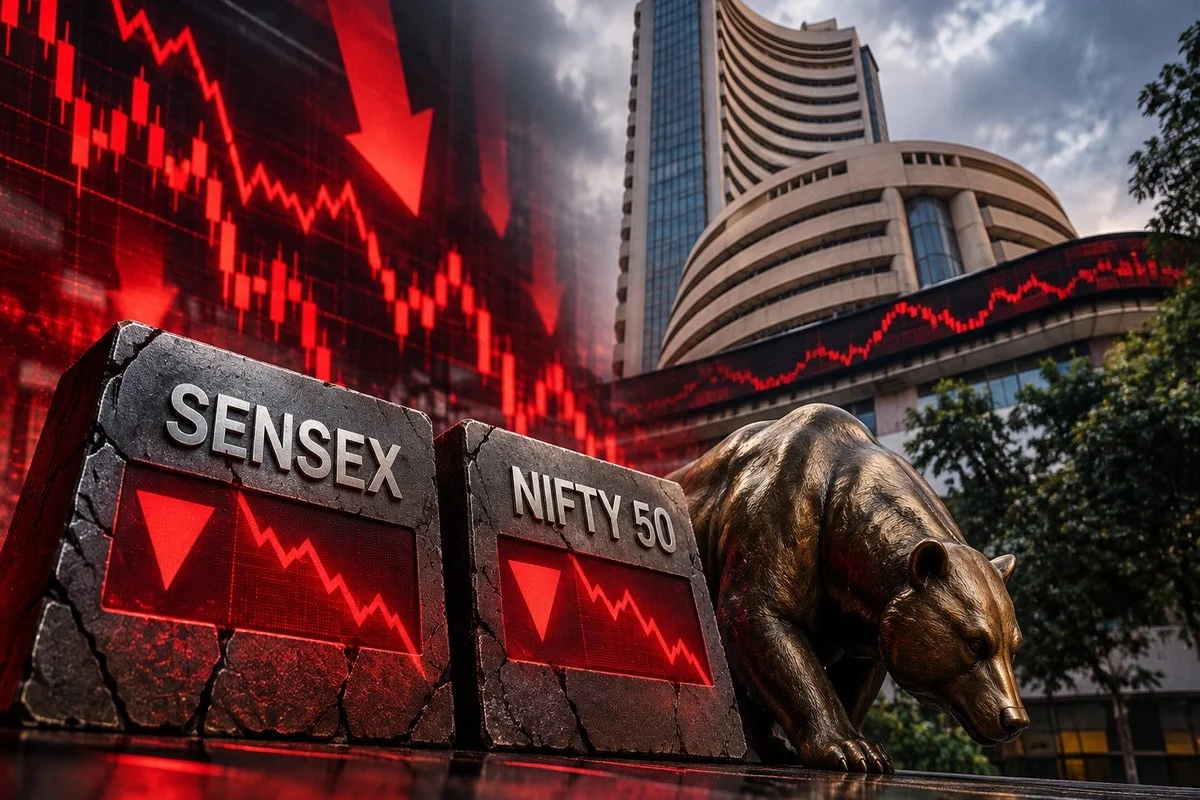
Indian equity markets came under heavy selling pressure on Thursday, with the Sensex falling 1,045 points and the Nifty dropping 371 points by the close. The decline deepened sharply after a weak opening as investors reacted to higher crude prices, weak global cues and the Reserve Bank of India's shift towards a "calibrated tightening" stance.
The Sensex had opened about 150 points lower and the Nifty was down 70 points. Selling increased through the session. By 2:50 pm, the Sensex was down about 1,120 points and the Nifty had fallen 387 points.
The fall also erased about Rs 10 lakh crore in market value during the session. The total market capitalisation of BSE listed companies fell from Rs 4,70,98,931 crore on Wednesday to about Rs 4,60,97,839 crore at Thursday's close.
The benchmark indices moved from a mildly weak opening to a broad market selloff. The Nifty also touched a new 52 week low of 22,181 during the session.
| Market indicator | Thursday close |
|---|---|
| Sensex | Down 1,045 points |
| Nifty 50 | Down 371 points |
| Nifty 52 week low | 22,181 |
| BSE listed company market cap | About Rs 4,60,97,839 crore |
| Market value lost | About Rs 10 lakh crore |
The scale of the move marked a sharp change from the previous session. Nifty 50 had closed Wednesday at 22,603.05, down 173 points, after the RBI raised the repo rate by 25 basis points to 5.50% and changed its policy stance from neutral to calibrated tightening.
The latest fall adds to the weakness seen in recent sessions. Earlier Indian stock market weakness amid Middle East tensions had also been linked to pressure from oil prices and the rupee.
Higher crude prices were one of the main pressures on Indian equities. Brent crude rose 3.9% to an intraday high of $104.09 per barrel as concerns about Middle East supply continued.
India imports a large share of its crude oil requirement, so sustained increases in international oil prices can raise concerns about imported inflation. Higher energy costs can also put pressure on companies and consumers if the increase continues.
The second factor was weak global market sentiment. US stocks ended lower on Wednesday, adding to the cautious tone across Asian markets. Higher US Treasury yields and a stronger dollar also remained part of the broader global market backdrop.
The third factor was the RBI's policy stance. The central bank raised the repo rate by 25 basis points to 5.50% and moved from a neutral stance to calibrated tightening. That shift signalled greater caution around inflation and future monetary policy.
These factors came together as Indian stocks were already trading under pressure.
The market selloff resulted in a sharp fall in the combined value of BSE listed companies. At Wednesday's close, the market capitalisation stood at Rs 4,70,98,931 crore. It fell to about Rs 4,60,97,839 crore by Thursday's close.
The decline had already become visible earlier in the session. At 1:40 pm, the market capitalisation had fallen to Rs 4,62,55,625 crore from the previous close.
| Time or point | Market capitalisation |
|---|---|
| Wednesday close | Rs 4,70,98,931 crore |
| Thursday, 1:40 pm | Rs 4,62,55,625 crore |
| Thursday close | Rs 4,60,97,839 crore |
| Approximate decline | Rs 10 lakh crore |
The figures show how quickly market value fell as selling intensified through the day.
The RBI's 25 basis point rate increase took the repo rate to 5.50%. The policy stance also changed to calibrated tightening.
The rate decision matters for equity markets because higher interest rates can increase borrowing costs for companies and households. Rate sensitive sectors such as real estate can face additional pressure when financing costs rise.
Anil Pharande, Founder of Pharande Spaces and President of CREDAI, said the higher policy rate could create some caution among buyers who are sensitive to borrowing costs. He also said the effect could differ across parts of the housing market depending on employment, consumer demand and financial capacity.
The RBI's policy shift is therefore being watched alongside oil prices and the wider inflation outlook.
The Indian market decline also came against a weaker global backdrop. The Dow fell 0.66% on Wednesday, while the S&P 500 and Nasdaq each fell 0.22%.
Asian markets were also trading lower amid concerns about global funding conditions, higher Treasury yields and pressure on technology stocks.
The dollar remained firm, adding pressure to the rupee. USD INR spot quotes were around 96.76 to 96.81, close to the reported all time low of 96.96 set in May.
For Indian equities, the combination of a weaker rupee and expensive crude is being watched because both can add pressure to the domestic inflation outlook.
A previous stock market crash alert linked to US Iran tensions had also highlighted the risk that Middle East developments could affect Indian market sentiment through oil prices.
The immediate focus is likely to remain on crude prices, the rupee and the RBI's policy direction. These factors can influence inflation expectations and the outlook for interest rates.
Technical levels are also being watched closely. Axis Direct's Hemang Gor placed immediate Nifty support around 22,500, with the 52 week low near 22,180. He said a break below 22,300 could extend pressure, while a move above 22,800 could improve the near term setup.
Vaishali Patel of Jainam placed a stronger support zone around 22,460 to 22,440 and resistance around 22,700 to 22,750, followed by 22,800.
These levels are analyst views and do not represent investment recommendations.
The market will also remain sensitive to changes in Middle East supply risks. A sustained rise in Brent crude could keep inflation concerns elevated, while any easing in oil prices could reduce some of that pressure.
The Sensex fell 1,045 points on Thursday because of higher crude prices, weak global market cues and the RBI's shift to a calibrated tightening stance. Brent crude reached $104.09 per barrel during the session as Middle East supply concerns persisted.
Indian equities lost about Rs 10 lakh crore in market value during Thursday's selloff. Total BSE listed company market capitalisation fell from Rs 4,70,98,931 crore on Wednesday to about Rs 4,60,97,839 crore at Thursday's close.
The Nifty fell 371 points by Thursday's close. During the session, the index also touched a new 52 week low of 22,181.
Higher crude oil prices can increase India's import costs and add pressure to inflation. Brent crude rose 3.9% to an intraday high of $104.09 per barrel on Thursday as Middle East supply concerns continued.
The RBI raised the repo rate by 25 basis points to 5.50% and changed its policy stance from neutral to calibrated tightening. The change added to market concerns about inflation and future borrowing costs.
Analysts cited support around 22,500 and the 22,180 area, while 22,800 was identified as an important resistance level. A break below support or a move above resistance could influence the near term market direction.
Financial journalist specializing in market analysis, stock research, and investment trends. Dedicated to providing accurate, timely insights for informed decision-making.
Credentials: Experienced financial journalist with expertise in equity markets and economic analysis
The information provided in this article is for educational and informational purposes only and should not be construed as financial, investment, or legal advice. welomoney does not provide personalized investment recommendations.
For detailed terms and conditions, please read our Disclaimer and Terms of Service.

Diwali Muhurat Trading 2026 is scheduled for November 8 from 2:20 PM to 3:30 PM. See NSE and BSE timings, pre-open session and market schedule.
Sugar stocks fell up to 5.79% after the government barred sugarcane juice and syrup for FY27 ethanol procurement. Analysts flag earnings pressure.

NSE indices on October 16, 2026: Nifty IT rises 3.12%, Nifty 50 gains 0.49%, while Nifty FMCG, Capital Market and Bank indices decline.

India-US trade deal could influence Sensex, Nifty 50 and export stocks. Explore five sectors to watch and the key factors investors should track.

India agricultural growth may approach zero as El Niño threatens crops, with output potentially falling 4%.