Loading market data...
Tue, 20 Oct 2026
03:30:43 pm
Tue, 20 Oct 2026
03:30:43 pm

Rudransh Sangwan
Published at: October 19, 2026, 2:25 PM
Synopsis
Diwali Muhurat Trading 2026 is scheduled for November 8 from 2:20 PM to 3:30 PM. See NSE and BSE timings, pre-open session and market schedule.
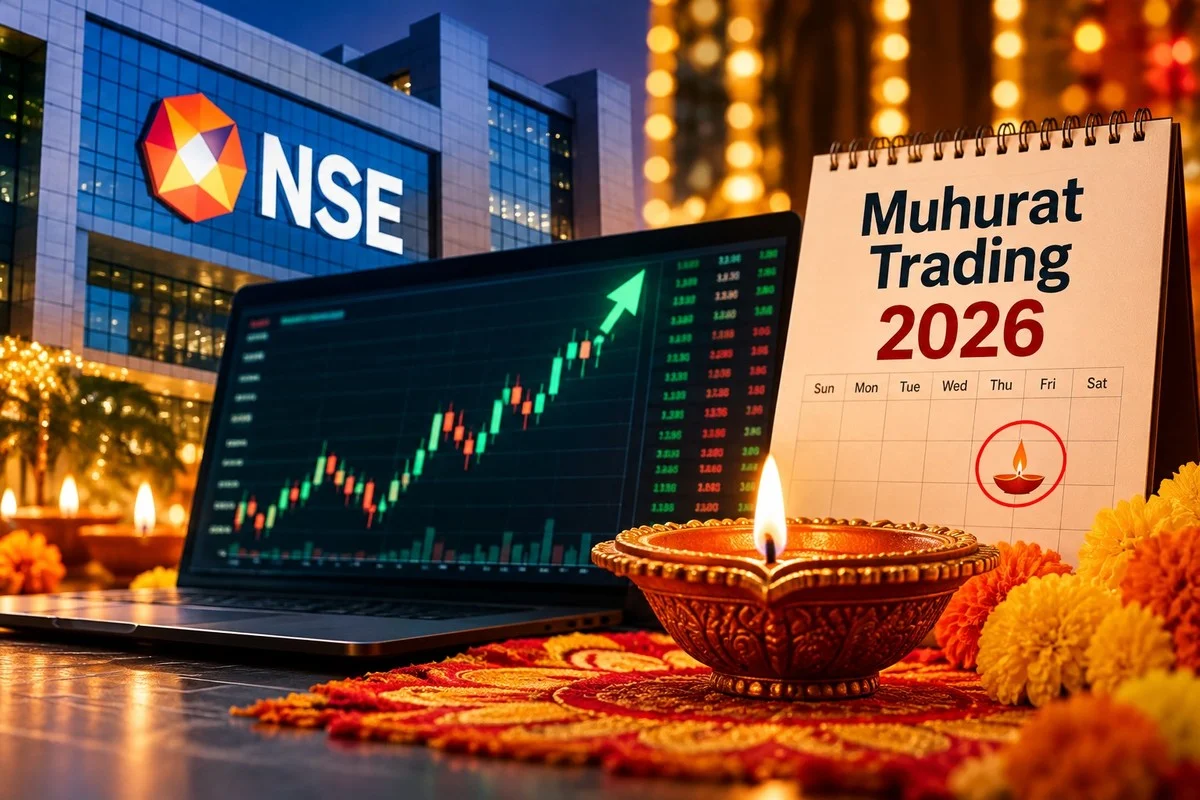
The short version
India's stock exchanges have scheduled the annual Diwali Muhurat trading session for Sunday, November 8, 2026, with continuous trading set to run for 70 minutes. The National Stock Exchange (NSE) and BSE announced the schedule through separate circulars.
Muhurat trading is a special market session held around Diwali to mark the beginning of the new Hindu calendar year. Retail investors, traders and institutions participate in the session, which is associated with prosperity and good fortune in Indian market tradition.
Unlike a regular trading day, when equity markets generally operate from 9:15 am to 3:30 pm, the special session follows a shorter timetable. Trading will be available across several segments, including equities, commodity derivatives, currency derivatives, equity futures and options, and securities lending and borrowing.
The exchanges have set separate timings for member logins, block deals, pre opening activity, continuous trading and closing procedures. Investors should distinguish the main trading window from the other scheduled activities because the entire session runs beyond the continuous trading period.
| Activity | Date and time |
|---|---|
| Trading member login | 1:15 pm to 1:50 pm |
| Block deal window | 1:50 pm to 2:05 pm |
| Pre opening session | 2:05 pm to 2:20 pm |
| Continuous trading | 2:20 pm to 3:30 pm |
| Periodic call auction | 2:25 pm to 3:20 pm |
| Closing auction activities | 3:15 pm to 3:35 pm |
| Closing session for non CAS securities | 3:30 pm to 3:50 pm |
| Closing buffer for CAS securities | 3:35 pm to 3:50 pm |
| Post closing session | 3:50 pm to 4:00 pm |
The continuous trading window is the main period during which regular orders can be executed in the special session. However, the schedule includes overlapping activities, such as the periodic call auction and closing auction procedures. Trading members and investors should check the applicable exchange circular for segment specific instructions before placing orders.
Muhurat trading is not limited to the cash equity market. The exchange circulars cover multiple segments, giving eligible market participants access to different instruments during the special session.
The listed segments include:
The availability of these segments does not mean every instrument will have the same liquidity or trading activity. The session is shorter than a normal trading day, and participation can vary across instruments. Investors should also check their broker's instructions for order placement, settlement and segment availability.
Muhurat trading is an annual special trading session organised by Indian stock exchanges around Diwali. The word "muhurat" refers to an auspicious time, and many market participants consider the session a symbolic beginning to the new Hindu calendar year.
Some investors use the occasion to make small investments or begin a new portfolio allocation. Traders and institutions can also participate, although the session has a ceremonial aspect that distinguishes it from ordinary market activity.
Trading volumes are generally lower than on regular market days. As a result, the price movement of an individual share during Muhurat trading may not necessarily indicate how it will perform during subsequent sessions. The shorter trading window and participation patterns can affect market activity.
Investors following individual shares can also track developments such as Tata Motors PV share price movements and CG Power's stock performance to understand how company specific news can influence share prices outside a ceremonial trading session.
Historical performance has generally been positive for India's benchmark indices during the Diwali session. Over the 18 years covered by the available figures, the benchmark indices closed higher on 15 occasions.
This record indicates that positive closes have been more common than negative ones during the period. It does not establish that the market will rise in every future Muhurat session. A ceremonial session's outcome can differ from the broader market trend over the following days and months.
In 2025, Muhurat trading took place on October 21, and the benchmark indices ended marginally higher. The session's performance was therefore positive, but the gains were limited.
An earlier session during the global financial crisis produced a much larger move. On October 28, 2008, benchmark indices rose nearly 6% during Muhurat trading, recording their highest gains during the ceremonial session in the historical account provided.
| Historical detail | Figure |
|---|---|
| Period covered | 18 years |
| Positive closes | 15 occasions |
| Muhurat trading in 2025 | October 21 |
| 2025 market close | Marginally higher |
| Notable session during the financial crisis | October 28, 2008 |
| Gain during the 2008 session | Nearly 6% |
These figures provide historical context for the annual event. They should not be treated as a forecast for November 8, 2026, because past returns do not determine the direction of the next session.
Investors planning to participate should confirm the trading arrangements with their broker and check the official exchange circulars for any updates. Since the session takes place on a Sunday, participants should pay particular attention to the special schedule rather than assume that normal weekday market hours apply.
A few practical details are worth checking before the session:
The shorter session can mean less time to respond to price movements than on a regular trading day. Investors should also distinguish between a customary Diwali purchase and a decision based on a company's financial performance, valuation or business outlook.
The next date to note is November 8, 2026, when the exchanges are scheduled to conduct the special session. Any subsequent changes to the timetable or segment arrangements should be checked against official NSE and BSE notices.
Muhurat trading in 2026 is scheduled for Sunday, November 8, according to the NSE and BSE circulars. Continuous trading will run from 2:20 pm to 3:30 pm, following a 15 minute pre opening session.
The main continuous trading window is scheduled from 2:20 pm to 3:30 pm on November 8, 2026. The pre opening session will run from 2:05 pm to 2:20 pm, while other exchange activities will extend until 4:00 pm.
Yes, NSE and BSE have scheduled special Muhurat trading sessions for November 8, 2026. The exchanges have published separate circulars covering the session timetable and trading arrangements.
The scheduled segments include equities, commodity derivatives, currency derivatives, equity futures and options, and securities lending and borrowing. Participants should confirm availability and applicable rules with their broker and the relevant exchange.
Benchmark indices closed higher on 15 occasions over the 18 year period covered by the historical figures. In 2025, the indices ended marginally higher, while the October 28, 2008, session recorded gains of nearly 6%.
No, a positive Muhurat trading close does not guarantee gains in subsequent sessions. Historical data shows that benchmark indices closed higher on 15 of 18 occasions in the period covered, but future performance can differ.
Financial journalist specializing in market analysis, stock research, and investment trends. Dedicated to providing accurate, timely insights for informed decision-making.
Credentials: Experienced financial journalist with expertise in equity markets and economic analysis
The information provided in this article is for educational and informational purposes only and should not be construed as financial, investment, or legal advice. welomoney does not provide personalized investment recommendations.
For detailed terms and conditions, please read our Disclaimer and Terms of Service.

Sugar stocks fell up to 5.79% after the government barred sugarcane juice and syrup for FY27 ethanol procurement. Analysts flag earnings pressure.
NSE indices on October 16, 2026: Nifty IT rises 3.12%, Nifty 50 gains 0.49%, while Nifty FMCG, Capital Market and Bank indices decline.
India-US trade deal could influence Sensex, Nifty 50 and export stocks. Explore five sectors to watch and the key factors investors should track.

India agricultural growth may approach zero as El Niño threatens crops, with output potentially falling 4%.

Indian IT stocks rose as TCS and HCLTech gained on the AI spending outlook. See Accenture's guidance, technical levels and FPI flows.