Loading market data...
Wed, 07 Oct 2026
09:12:27 am
Wed, 07 Oct 2026
09:12:27 am
Synopsis
India is investing $100 billion to modernise its power grid as solar capacity reaches 154 GW. Learn how transmission upgrades, battery storage, and domestic manufacturing are driving India's renewable energy boom.
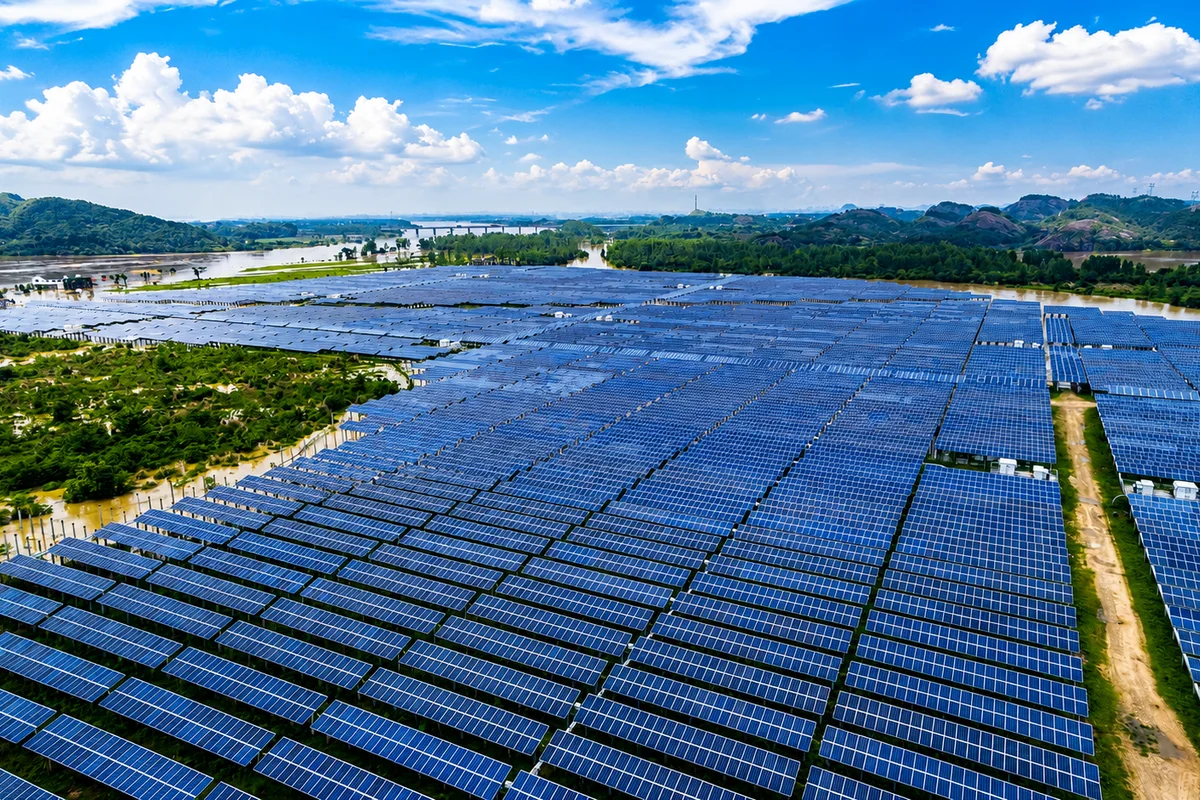
India is rapidly emerging as a global clean energy powerhouse, backed by an ambitious $100 billion (around ₹8.6 lakh crore) investment to strengthen its power transmission infrastructure and energy storage network. The massive investment comes as the country experiences record solar capacity additions, accelerates domestic solar manufacturing, and moves closer to becoming the world's second-largest solar growth market after China.
India added a record 44 GW of solar capacity during FY2025-26, taking its total installed solar capacity to 154 GW. The rapid expansion has transformed India into one of the fastest-growing renewable energy markets globally. However, transmission bottlenecks and grid congestion have prevented a significant portion of solar power from reaching consumers, prompting the government to launch one of the world's largest electricity grid expansion programs.
India's renewable energy transition has accelerated significantly over the past few years. Supported by government incentives, declining solar panel costs, and rising electricity demand, the country has become the world's second-largest market for annual solar capacity additions, behind only China.
During FY2025-26, India installed 44 GW of new solar capacity, taking the country's cumulative installed solar capacity to 154 GW, making it the third-largest solar power producer globally after China and the United States.
Industry estimates suggest India's solar installations are growing at nearly 40% CAGR, with installed capacity expected to double again before the end of this decade.
| Particulars | Details |
|---|---|
| Solar Capacity Added (FY26) | 44 GW |
| Total Installed Solar Capacity | 154 GW |
| Global Ranking | Third Largest |
| Annual Solar Growth Rate | Around 40% CAGR |
| Expected Solar Demand Growth | Capacity expected to double by 2030 |
While solar generation has expanded rapidly, India's electricity transmission network has struggled to keep pace.
Large solar parks located in states such as Rajasthan and Gujarat often generate more electricity than existing transmission infrastructure can carry, resulting in significant power curtailment during peak sunlight hours.
To address this challenge, the government is investing nearly $100 billion in expanding and modernising the national electricity grid by 2032.
The investment will focus on:
The objective is to transport renewable energy efficiently from generation hubs to industrial and urban demand centres while improving overall grid stability.
India is also rapidly expanding its domestic solar manufacturing ecosystem to reduce dependence on imports.
Government initiatives such as the Production Linked Incentive (PLI) Scheme and the Approved List of Models and Manufacturers (ALMM) have encouraged manufacturers to increase local production of high-efficiency solar modules and cells.
The country's annual solar cell manufacturing capacity has now reached approximately 30 GW, with further expansion expected over the coming years.
These initiatives aim to strengthen India's renewable energy supply chain while supporting exports and reducing reliance on imported equipment.
One of India's biggest renewable energy projects is the Khavda Renewable Energy Park in Gujarat.
Spread across nearly 726 square kilometres, the project is expected to become the world's largest solar park, with a planned generation capacity of 30 GW.
Once fully operational, the project will be capable of generating enough electricity to power millions of households while significantly contributing to India's clean energy targets.
Recognising that solar generation is available primarily during daylight hours, India is simultaneously investing heavily in large-scale energy storage.
Among the major initiatives:
Energy storage will allow surplus daytime solar electricity to be supplied during evening peak demand, improving overall grid efficiency.
Although coal currently contributes nearly 70% of India's electricity generation, renewable energy is steadily increasing its share.
Industry forecasts indicate coal's contribution could decline to below 50% by 2035 as solar capacity continues expanding and renewable electricity becomes increasingly cost competitive.
The International Energy Agency (IEA) expects solar energy to meet nearly half of India's incremental electricity demand growth through 2030, highlighting the sector's strategic importance.
India's renewable energy sector is entering a structural growth phase supported by strong policy backing, rising domestic electricity demand, and large-scale infrastructure investments. The combination of solar manufacturing expansion, transmission upgrades, and energy storage development is expected to strengthen the country's energy security while creating significant opportunities across the renewable energy value chain.
Companies involved in solar modules, power transmission, battery storage, engineering, EPC services, and grid infrastructure could benefit from the government's long-term clean energy investment plans. Successful execution of transmission projects will also be crucial in reducing renewable energy curtailment and improving project economics.
Investors should closely monitor the progress of India's transmission expansion projects, battery storage deployments, domestic solar manufacturing capacity additions, renewable energy policy support, and execution of large-scale solar parks. Grid modernisation and storage infrastructure are expected to remain key enablers of India's next phase of renewable energy growth.
| Highlights | Details |
|---|---|
| Grid Investment | $100 Billion |
| Solar Capacity Added (FY26) | 44 GW |
| Installed Solar Capacity | 154 GW |
| Solar Cell Manufacturing Capacity | 30 GW |
| World's Largest Solar Park | Khavda (30 GW Planned) |
| Battery Storage Project | 5 GW (Rajasthan) |
| Pumped Hydro Target | 100 GW by 2047 |
| Grid Expansion Timeline | By 2032 |
The investment aims to expand transmission infrastructure, improve grid flexibility, integrate renewable energy, and reduce solar power curtailment.
India installed a record 44 GW of new solar capacity during FY2025-26.
India's total installed solar capacity has reached 154 GW, making it the world's third-largest solar market.
Khavda in Gujarat is being developed as the world's largest solar park with a planned capacity of 30 GW.
Government initiatives such as the Production Linked Incentive (PLI) Scheme and the Approved List of Models and Manufacturers (ALMM) are driving domestic solar manufacturing growth.

Financial journalist specializing in market analysis, stock research, and investment trends. Dedicated to providing accurate, timely insights for informed decision-making.
Credentials: Experienced financial journalist with expertise in equity markets and economic analysis
The information provided in this article is for educational and informational purposes only and should not be construed as financial, investment, or legal advice. welomoney does not provide personalized investment recommendations.
For detailed terms and conditions, please read our Disclaimer and Terms of Service.

Petrol prices rise by ₹5 and diesel by ₹3 per litre as crude oil prices climb, raising concerns over fuel costs, transport expenses and inflation.

India’s Rafale plan could create a second fighter jet production line, expand local manufacturing and continue alongside the indigenous Tejas Mk1A...

Cabinet approves higher MSPs for six Rabi crops, an AI-based traffic system for Delhi and Green Energy Corridor Phase 3 to expand renewable power...

ITC buys the remaining Yoga Bar stake for ₹645 crore, taking full ownership of Sproutlife Foods. Here's what the acquisition means.

Explore the 8-week losing streak, FPI selling, crude oil prices, US bond yields, rupee weakness and key market factors.