Loading market data...
Tue, 28 Jul 2026
11:25:37 pm
Tue, 28 Jul 2026
11:25:37 pm

Rudransh Sangwan
Published at: April 25, 2026, 7:10 AM
Synopsis
AI chipmakers are reshaping global equity markets, pushing Taiwan and South Korea ahead of Europe as semiconductor demand fuels massive capital flows and valuation shifts.
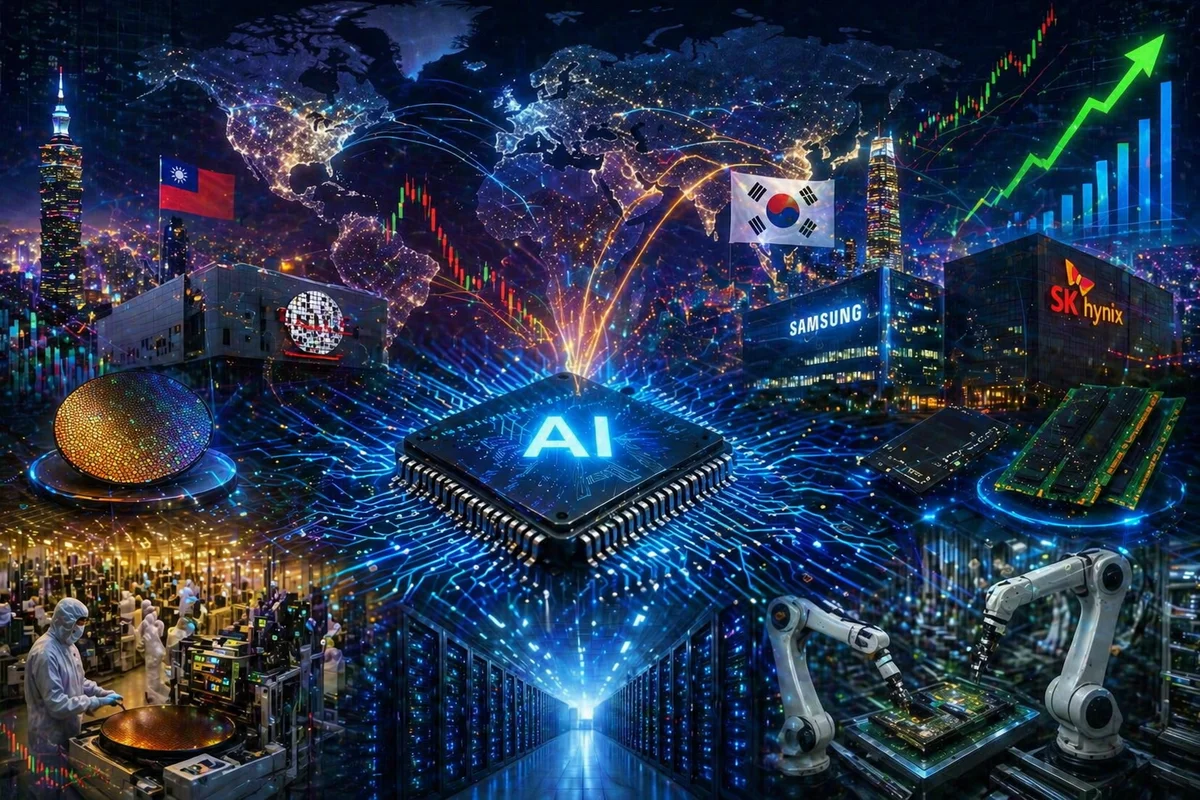
The global equity landscape is undergoing a structural transformation, and at the center of this shift are AI chipmakers. What appears on the surface as a technology rally is actually a deeper reallocation of global capital toward semiconductor powerhouses. Markets like Taiwan and South Korea are not just outperforming, they are redefining global rankings, driven by a surge in demand for artificial intelligence infrastructure. This creates a new economic hierarchy where chip manufacturing is becoming as critical as energy once was, fundamentally altering how investors evaluate global markets.
The rise of AI has turned semiconductors into the most critical input for modern economic activity. Countries with strong chip ecosystems are now seeing disproportionate gains in market capitalization.
Taiwan’s stock market has reached nearly $4.3 trillion, surpassing the United Kingdom, while South Korea is rapidly closing the gap. This shift is not driven by broad economic expansion but by the explosive growth of a few dominant semiconductor companies.
Data suggests AI investment is accelerating demand for advanced chips This leads to massive capital inflows into chipmakers Which results in disproportionate gains in their national stock markets
This dynamic explains why tech-heavy markets are outperforming traditional economies dominated by financial or industrial sectors.
The transformation is largely concentrated around a few key companies that dominate global AI chip supply chains.
The world’s largest chip foundry has become the backbone of global AI infrastructure. It manufactures advanced chips for companies like NVIDIA, making it indispensable to the AI ecosystem.
With a market capitalization of around $1.8 trillion and stock gains exceeding 40 percent this year, TSMC represents the core of the semiconductor value chain. Its dominance lies in cutting-edge manufacturing technology that few competitors can replicate.
Samsung is a global leader in memory chips, which are essential for AI workloads. High-bandwidth memory used in AI servers is one of its fastest-growing segments.
The company’s stock has surged more than 80 percent, reflecting strong demand for memory solutions driven by data-intensive AI applications.
SK Hynix has emerged as a key supplier of advanced memory chips used in AI systems. Its focus on high-performance memory products has positioned it as a critical player in the AI supply chain.
Like Samsung, its shares have seen gains exceeding 80 percent, highlighting investor confidence in the long-term demand for AI infrastructure.
Companies like MediaTek and Delta Electronics are also gaining traction, indicating that the AI boom is spreading across the broader supply chain rather than remaining concentrated at the top.
| Company | Market Cap | Key Role in AI | Stock Performance |
|---|---|---|---|
| TSMC | ~$1.8 trillion | Advanced chip manufacturing | +40% |
| Samsung Electronics | ~$900 billion+ | Memory chips | +80% |
| SK Hynix | ~$600 billion+ | AI memory solutions | +80% |
These companies collectively represent trillions in market value, exceeding entire sectors in some regions.
One of the least discussed aspects of this shift is the oligopolistic nature of advanced chip manufacturing. Only a handful of companies globally have the capability to produce cutting-edge semiconductors.
This creates pricing power, high margins, and strong entry barriers. Unlike traditional industries, where competition erodes profitability, semiconductor leaders benefit from limited competition and rising demand simultaneously.
This structural advantage is what is driving sustained investor interest and long-term capital flows.
A common misconception is that the AI boom is primarily driven by software companies. While software captures attention, the real value creation is happening at the hardware level.
Without advanced chips, AI models cannot function. This makes semiconductor companies the foundational layer of the entire ecosystem.
Another misunderstanding is that this growth is temporary. In reality, AI infrastructure investment is expected to continue for years, making this a long-term structural trend rather than a short-term cycle.
While the growth story is strong, there is an increasing concentration risk in these markets. In South Korea, Samsung and SK Hynix together account for over 40 percent of the Kospi index. Similarly, TSMC holds a dominant weight in Taiwan’s index.
This means that market performance is heavily dependent on a few companies. Any slowdown in the semiconductor cycle could have an outsized impact on entire national markets.
European markets have lagged because they are heavily weighted toward financials and traditional industries. Even leading tech firms like ASML Holding are smaller compared to Asian chip giants.
The total market value of tech stocks in Europe remains lower than the combined valuation of top Asian semiconductor companies. This highlights a structural gap in innovation and sector composition.
The next phase of growth will come from the expansion of the AI ecosystem. As AI adoption spreads across industries, demand will extend beyond chipmakers to include software, cloud infrastructure, and applications.
However, chipmakers will remain at the center of this ecosystem because they control the foundational layer of computing power.
Key future drivers include
• Continued AI infrastructure investment
• Expansion of data centers globally
• Growth in AI-driven applications
• Supply chain diversification
Investors should recognize that semiconductor companies are no longer cyclical plays but structural growth assets tied to the future of computing.
A strategic approach could include
• Exposure to leading chipmakers for core growth
• Diversification into supply chain players
• Monitoring valuation levels due to rapid price appreciation
Avoid overconcentration in a single market, given the high index dependency on a few stocks.
AI chipmakers are not just benefiting from a technology trend; they are redefining global capital flows and market leadership. The shift toward Taiwan and South Korea reflects a deeper transformation where control over semiconductor manufacturing equates to economic influence. As AI continues to scale, these companies will remain at the center of global markets, shaping not only technology but the very structure of global investing.
AI chipmakers produce the hardware required to run artificial intelligence systems. Their dominance in supply chains makes them critical to global technology infrastructure and drives strong investor interest.
Key players include TSMC, Samsung Electronics, and SK Hynix, which dominate advanced chip manufacturing and memory solutions used in AI systems.
The rally is supported by long-term demand for AI infrastructure. However, high valuations and market concentration risks mean investors should approach with a balanced strategy.
Financial journalist specializing in market analysis, stock research, and investment trends. Dedicated to providing accurate, timely insights for informed decision-making.
Credentials: Experienced financial journalist with expertise in equity markets and economic analysis
The information provided in this article is for educational and informational purposes only and should not be construed as financial, investment, or legal advice. welomoney does not provide personalized investment recommendations.
For detailed terms and conditions, please read our Disclaimer and Terms of Service.
More than 11 years after entering North America, a major smartphone brand is exiting the US market.
Former GitHub CEO Thomas Dohmke has launched Entire's India Git region, enabling local repository hosting, faster Git operations, improved data...

Nothing has denied reports of shutting down operations in multiple markets and carrying out massive layoffs.

OnePlus has officially ended new product launches in North America and Europe after 11 years.

Looking for the best Friendship Day gift? Here are the top smartphones to gift on Friendship Day 2026, including Samsung Galaxy S26 Ultra, OnePlus...