Loading market data...
Wed, 02 Sept 2026
04:55:20 am
Wed, 02 Sept 2026
04:55:20 am

Rudransh Sangwan
Published at: April 17, 2026, 3:52 AM
Synopsis
India falls to 6th position among global economies as IMF data reflects currency impact and GDP revision. Here is what it means for growth, markets, and future rankings.
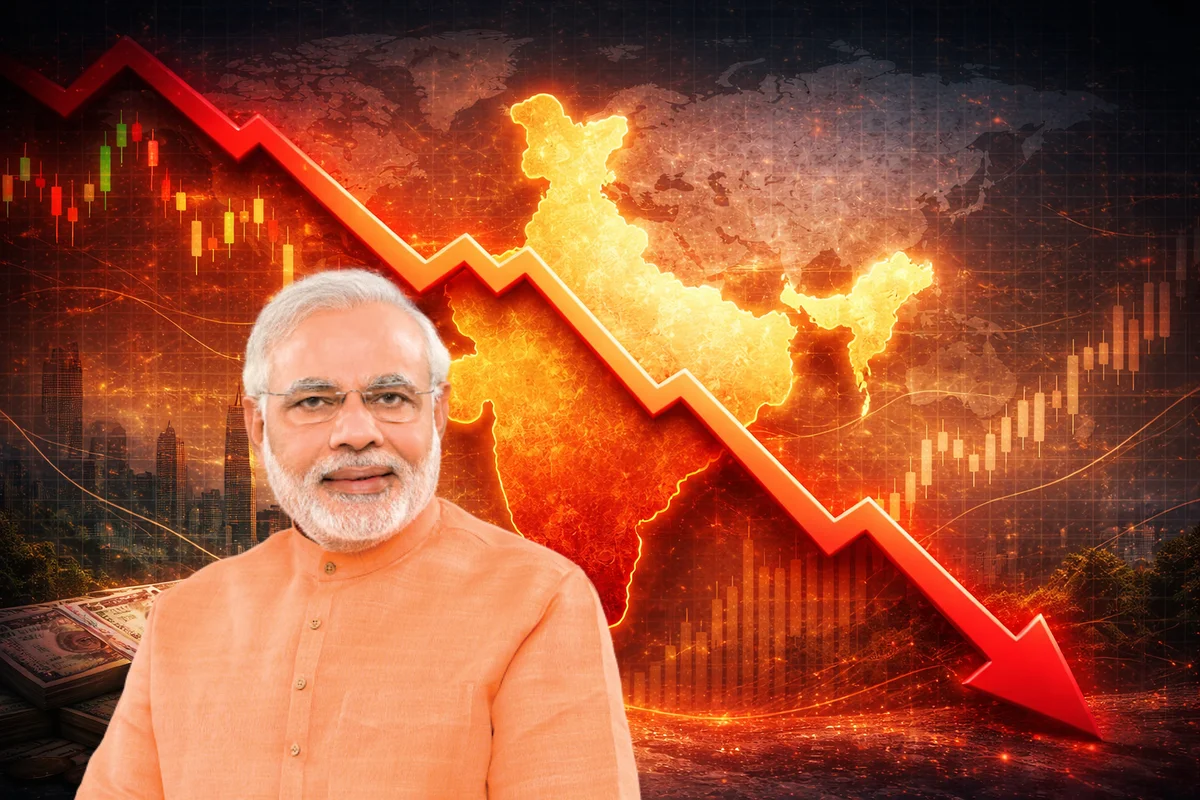
India’s drop to the sixth-largest economy has triggered debate, but the reality is more nuanced than the headline suggests. While the ranking shift reflects a decline in nominal dollar GDP, the underlying growth story remains intact. The move highlights how currency fluctuations and statistical revisions can temporarily alter global standings even when economic momentum remains strong.
The shift in India’s global ranking is primarily driven by two technical factors rather than a structural slowdown. First, the depreciation of the Indian rupee against the US dollar has reduced the country’s GDP when measured in dollar terms. Second, a revision in the GDP base year has recalibrated nominal output estimates downward.
India’s GDP is now estimated at around $4.15 trillion, placing it behind the UK at approximately $4.26 trillion and Japan at $4.38 trillion. This does not mean India’s economy has shrunk in real terms. Instead, it reflects how exchange rates and methodology changes influence international comparisons.
Data suggests that nominal GDP rankings are highly sensitive to currency movements. This leads to short-term ranking shifts, which results in volatility in global economic positioning even when domestic growth remains stable.
The latest IMF estimates show a clear hierarchy among the world’s largest economies, with developed nations still dominating in nominal terms.
| Rank | Country | GDP (Approx) |
|---|---|---|
| 1 | United States | $32.3 trillion |
| 2 | China | $20.8 trillion |
| 3 | Germany | $5.4 trillion |
| 4 | Japan | $4.38 trillion |
| 5 | United Kingdom | $4.26 trillion |
| 6 | India | $4.15 trillion |
Despite slipping one position, India remains close to overtaking both the UK and Japan again, indicating that the gap is narrow and sensitive to external variables.
The decline in ranking is linked to two measurable shifts in economic data.
At the same time, India’s real GDP growth remains strong at around 6.5 percent, making it the fastest-growing major economy globally.
This creates an important contrast where real growth is strong, but nominal rankings appear weaker due to external adjustments.
One underappreciated factor is how exchange rates dominate global comparisons. Countries with stable or strengthening currencies often move up rankings even if their real growth is slower.
India’s rupee depreciation has amplified the drop in dollar GDP, even though domestic consumption, investment, and production remain robust.
This means that global rankings are not purely a reflection of economic strength but also of currency dynamics and global capital flows.
A common misconception is that India’s fall in ranking signals economic weakness or slowdown. This interpretation is misleading.
The ranking is based on nominal GDP in dollar terms, not purchasing power or real growth. India continues to expand faster than most large economies, and its domestic demand remains strong.
Another misunderstanding is that rankings change linearly. In reality, small currency shifts can move countries up or down positions without any major change in underlying fundamentals.
While headlines focus on rankings, markets often prioritize growth, earnings, and liquidity. From an investment perspective, India’s strong growth trajectory may matter more than its nominal position.
In fact, a weaker currency can sometimes support exports and corporate earnings in sectors like IT and manufacturing. This creates a situation where a lower ranking does not necessarily translate into weaker market performance.
Looking ahead, India is still expected to cross the $5 trillion mark within the next few years if growth momentum sustains.
Key triggers that could influence future rankings include
If these factors align, India could regain its position and potentially move into the top four economies over the medium term.
For investors and market participants, the key takeaway is to focus on underlying trends rather than headline rankings.
India’s economic trajectory remains strong, and the current shift appears more cyclical than structural.
India’s move to the sixth-largest economy is a reminder that global rankings can change due to technical factors rather than real economic weakness. The combination of currency depreciation and statistical revision has temporarily altered its position, but the core growth story remains intact. For long-term observers and investors, the focus should remain on structural growth drivers rather than short-term ranking shifts.
India’s ranking dropped mainly due to rupee depreciation and a revision in GDP calculation methodology, which reduced its nominal dollar GDP without affecting real growth significantly.
No, India continues to be the fastest-growing major economy with projected growth around 6.5 percent, indicating strong underlying economic momentum.
Yes, if the rupee stabilizes and growth remains strong, India is likely to move back up in rankings and potentially become one of the top four economies in the coming years.
Financial journalist specializing in market analysis, stock research, and investment trends. Dedicated to providing accurate, timely insights for informed decision-making.
Credentials: Experienced financial journalist with expertise in equity markets and economic analysis
The information provided in this article is for educational and informational purposes only and should not be construed as financial, investment, or legal advice. welomoney does not provide personalized investment recommendations.
For detailed terms and conditions, please read our Disclaimer and Terms of Service.

Azim Premji Scholarship 2026 registration ends today, August 31. Check eligibility, ₹30,000 scholarship amount, documents required, apply online...
Nepal flash floods kill 162, with over 750 people missing, including Indian nationals. Check the latest Nepal flood updates, rescue efforts and...

Nearly 3 million China-made Tesla vehicles face a recall over hidden door-handle safety concerns.
Iran discovers 7.5 trillion cubic feet of natural gas in Fars Province as US sanctions and blockade pressure energy exports, oil markets and the...