Loading market data...
Sat, 03 Oct 2026
04:59:58 am
Sat, 03 Oct 2026
04:59:58 am
Synopsis
India’s EV sector is witnessing rapid growth in 2026, driven by battery localization, charging infrastructure, and rising EV adoption. This detailed comparison analyzes top EV stocks in India including Tata Motors, SAMIL, Bosch, Hero MotoCorp, and Bharat Forge based on revenue growth, margins, market share, expansion plans, and long-term investment potential.
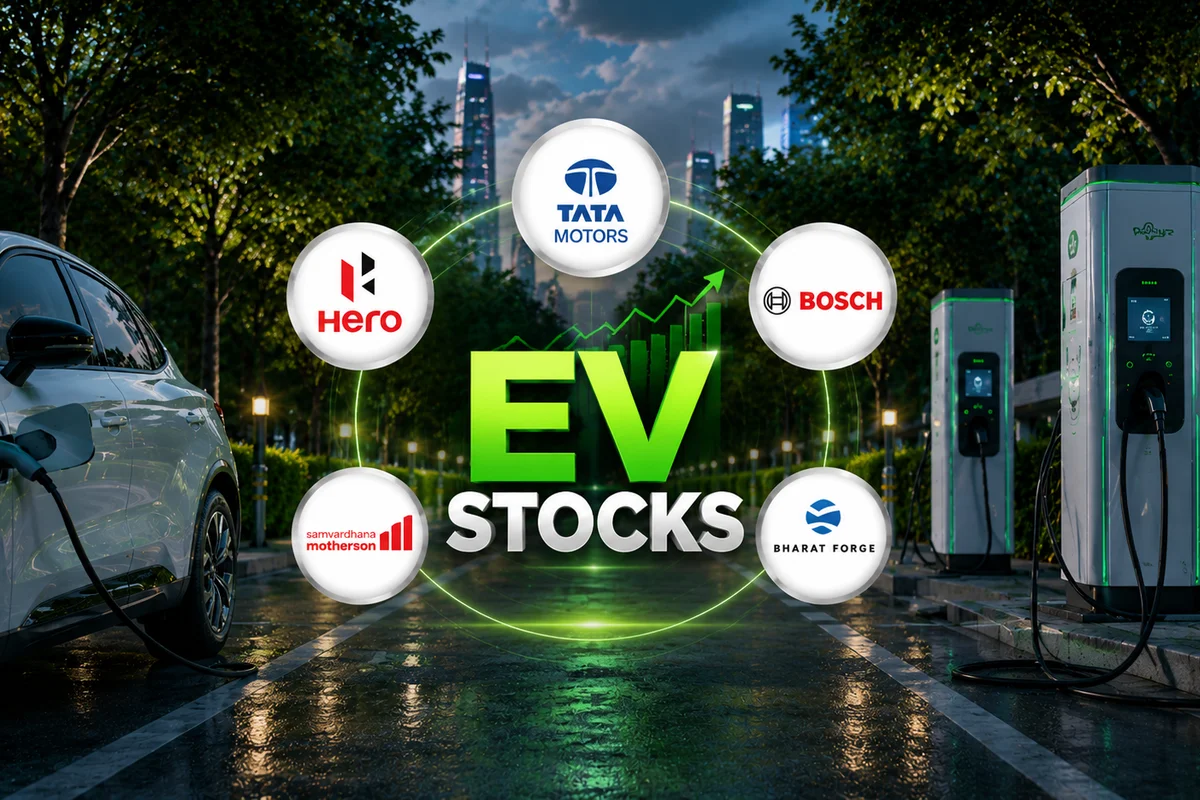
India’s electric vehicle (EV) industry is entering one of the biggest structural growth cycles in its automotive history. After years of policy support, infrastructure spending, localization incentives, and battery manufacturing expansion, the Indian EV market crossed a major milestone during FY2025–26.
According to industry retail data, India recorded 24.52 lakh EV sales during FY26, representing a strong 24.6% year-on-year growth. Monthly EV registrations also reached a historic high of 2,79,530 units in March 2026, signaling accelerating consumer adoption across passenger vehicles, two-wheelers, commercial EVs, and fleet mobility.
The Indian government’s aggressive push toward clean mobility, battery localization, EV manufacturing, charging infrastructure, and energy transition is now reshaping the country’s industrial ecosystem.
At the center of this transformation are a handful of listed companies building leadership positions across:
This deep research article analyzes the top EV stocks in India in 2026, comparing their financial growth, operating margins, market positioning, EV expansion strategies, and long-term investment potential.
India’s EV ecosystem is rapidly transitioning from basic vehicle assembly into a full-scale integrated manufacturing model.
The biggest structural shift is happening in:
The government-backed 50 GWh ACC PLI Scheme is becoming a major catalyst for domestic battery production and long-term energy security.
Several companies are now investing billions into:
This creates a multi-decade growth runway for leading EV-focused companies.
Samvardhana Motherson International Ltd (SAMIL) has become one of the strongest indirect EV plays in India due to its global automotive component dominance.
Unlike pure EV manufacturers, SAMIL benefits from rising EV adoption globally regardless of vehicle brand because it supplies critical components across multiple OEM platforms.
Its EV-focused product portfolio includes:
The company is increasingly benefiting from rising content-per-vehicle opportunities in electric platforms.
SAMIL reported its strongest-ever quarterly performance during Q3 FY26.
| Metric | Value |
|---|---|
| Consolidated Revenue | ₹31,409.39 Cr |
| Revenue Growth YoY | 13.5% |
| Net Profit (PAT) | ₹1,023.70 Cr |
| PAT Growth YoY | 16.51% |
| EBITDA Margin | 9.76% |
| Net Debt-To-Equity | 1.1x |
The company’s improving operating margin signals rising operating leverage despite ongoing global expansion.
One of the biggest investment strengths for SAMIL is its enormous global order visibility.
$88 Billion+ Booked Business Value
425+ Manufacturing Facilities Worldwide
Strong Presence Across:
The company spends approximately 1.5%–2% of revenue on R&D, focusing heavily on next-generation EV systems.
SAMIL’s business model is attractive because it does not depend on the success of a single EV brand.
Instead, it benefits from the global expansion of:
Its diversified global customer base reduces concentration risk while positioning it to benefit from worldwide EV adoption.
Tata Motors Passenger Vehicles remains the undisputed leader in India’s electric passenger vehicle market with over 40% market share.
The company gained a first-mover advantage through aggressive EV launches, charging infrastructure expansion, and early ecosystem investments.
Its EV leadership is currently driven by:
Tata Motors is now transitioning toward a more advanced native EV platform strategy.
| Metric | Value |
|---|---|
| Q4 FY26 Revenue | ₹1,05,400 Cr |
| Q4 EBIT | ₹8,900 Cr |
| FY26 Sales Volume | 6.4 Lakh Units |
| EV Volume FY26 | 92,000+ Units |
| EV Growth YoY | 43% |
| Net Debt | ₹30,700 Cr |
The company has steadily improved its balance sheet while simultaneously scaling EV production.
Tata Motors is preparing for the next phase of India’s EV growth cycle through a broad product pipeline.
| Upcoming Tata EVs |
|---|
| Harrier EV |
| Curvv EV |
| Sierra EV |
| Avinya Native EV Series |
The company is aggressively investing in:
Tata Motors currently enjoys multiple competitive advantages:
Its shift toward native EV architecture could further strengthen long-term market leadership.
Bosch Ltd is transforming from a traditional ICE-focused auto technology company into a major EV systems supplier.
Its focus areas include:
The company is positioning itself as a critical technology backbone for India’s EV ecosystem.
| Metric | Value |
|---|---|
| Quarterly Revenue | ₹4,885.6 Cr |
| Revenue Growth YoY | 9.4% |
| Net Profit | ₹532.6 Cr |
| PAT Growth YoY | 16.11% |
| EBITDA Margin | 12.53% |
One of Bosch’s biggest catalysts is its 50:50 joint venture with Tata AutoComp Systems.
The JV focuses on:
The manufacturing rollout is expected to accelerate from mid-2026 onward.
Bosch’s competitive advantage lies in its technology leadership and deep automotive expertise.
The company operates:
Its transition into software-defined mobility and EV architecture could unlock long-term structural growth.
Hero MotoCorp is rapidly scaling its electric two-wheeler business through the VIDA electric scooter platform.
The company is leveraging its unmatched nationwide dealership network to expand EV penetration in India’s mass-market two-wheeler segment.
| Metric | Value |
|---|---|
| Q4 FY26 Revenue | ₹12,797 Cr |
| Revenue Growth YoY | 28.8% |
| Q4 Net Profit | ₹1,401 Cr |
| EBITDA | ₹1,856 Cr |
| FY26 Revenue | ₹47,400 Cr |
| FY26 Net Income | ₹5,740 Cr |
Hero MotoCorp has rapidly expanded its EV market share.
| Metric | Value |
|---|---|
| EV Market Share | 10.3% |
| Annual Retail Volumes | 1.51 Lakh Units |
| YoY Growth | ~190% |
The company plans to invest ₹1,500 crore in FY27 to significantly expand production capacity.
Hero’s biggest advantage remains its enormous distribution ecosystem and rural market penetration.
Its EV roadmap focuses on:
The launch of sub-₹1 lakh EV scooters could significantly expand adoption.
Bharat Forge Ltd is becoming an increasingly important EV component supplier through Kalyani Powertrain.
The company is developing:
| Metric | Value |
|---|---|
| Q4 FY26 Revenue | ₹4,528.04 Cr |
| Revenue Growth YoY | 17.53% |
| FY26 Revenue | ₹16,811 Cr |
| FY26 Net Profit | ₹1,079.6 Cr |
| EBITDA Margin | 17.81% |
| Net Debt-To-Equity | 0.41x |
One of Bharat Forge’s biggest strengths is diversification.
The company has a massive presence in:
This reduces earnings volatility while allowing long-term EV investments.
The company is expected to benefit from:
Its diversified business model provides downside protection compared to pure-play EV manufacturers.
| Company | Market Cap | EV Focus Area | Key Growth Driver |
|---|---|---|---|
| SAMIL | ₹1.33 Lakh Cr | EV Components | $88 Billion Global Order Book |
| Tata Motors | ₹1.24 Lakh Cr | Passenger EVs | 40%+ EV Market Share |
| Bosch Ltd | ₹1.07 Lakh Cr | eAxles & ADAS | Tata AutoComp EV JV |
| Hero MotoCorp | ₹99,946 Cr | Electric Two-Wheelers | VIDA EV Expansion |
| Bharat Forge | ₹93,031 Cr | EV Components | Kalyani Powertrain Scaling |
Despite strong long-term potential, investors should closely monitor several industry risks.
Large-scale investments into:
can temporarily compress profitability.
Companies failing to meet localization norms could lose access to:
Fluctuating prices of:
can impact margins.
The EV market is becoming increasingly crowded with:
India’s EV ecosystem is rapidly evolving into a massive industrial transformation opportunity.
The combination of:
is expected to drive sustained long-term EV adoption.
Companies with:
could emerge as long-term winners in India’s rapidly expanding electric mobility revolution.
Some of the leading EV-related stocks in India in 2026 include Tata Motors, Samvardhana Motherson International (SAMIL), Bosch Ltd, Hero MotoCorp, and Bharat Forge due to their strong EV expansion plans, manufacturing capabilities, and revenue growth.
Tata Motors Passenger Vehicles currently holds the largest share in India’s electric passenger vehicle segment with over 40% market share.
SAMIL benefits from the global EV transition through its large-scale supply of high-voltage wiring harnesses, thermal management systems, and lightweight EV components to multiple automotive manufacturers worldwide.
Hero MotoCorp is expanding aggressively through its VIDA electric scooter platform, increasing manufacturing capacity and targeting affordable mass-market electric two-wheelers.
Bosch is building localized eAxle systems, electric drivetrains, ADAS technologies, and EV software systems, making it a major EV technology and mobility solutions player.
Bharat Forge is focusing on EV drivetrain systems, lightweight components, and electric mobility solutions through Kalyani Powertrain while benefiting from diversification into defense and aerospace.
Key growth drivers include:
Major risks include:
The highest long-term growth potential is currently seen in:
EV ancillary companies are becoming critical because every EV manufacturer requires:
This creates long-term opportunities for component manufacturers.

Financial journalist specializing in market analysis, stock research, and investment trends. Dedicated to providing accurate, timely insights for informed decision-making.
Credentials: Experienced financial journalist with expertise in equity markets and economic analysis
The information provided in this article is for educational and informational purposes only and should not be construed as financial, investment, or legal advice. welomoney does not provide personalized investment recommendations.
For detailed terms and conditions, please read our Disclaimer and Terms of Service.
India’s Rafale plan could create a second fighter jet production line, expand local manufacturing and continue alongside the indigenous Tejas Mk1A...

Cabinet approves higher MSPs for six Rabi crops, an AI-based traffic system for Delhi and Green Energy Corridor Phase 3 to expand renewable power...
ITC buys the remaining Yoga Bar stake for ₹645 crore, taking full ownership of Sproutlife Foods. Here's what the acquisition means.

Explore the 8-week losing streak, FPI selling, crude oil prices, US bond yields, rupee weakness and key market factors.

Nifty briefly slid up to 2.2% and Bank Nifty lost 1,100 points on F&O expiry as CAS-driven price swings put SEBI’s settlement framework under review...