Loading market data...
Tue, 28 Jul 2026
11:13:30 am
Tue, 28 Jul 2026
11:13:30 am

Rudransh Sangwan
Published at: April 26, 2026, 4:46 AM
Synopsis
Flipkart is preparing to launch a standalone app for its quick commerce service, Flipkart Minutes, ahead of the Big Billion Days sale, signaling a major push into India’s fast-growing instant delivery market. With rapid dark store expansion and rising competition from players like Zepto and Amazon, the move reflects a strategic shift toward high-frequency, convenience-driven commerce.
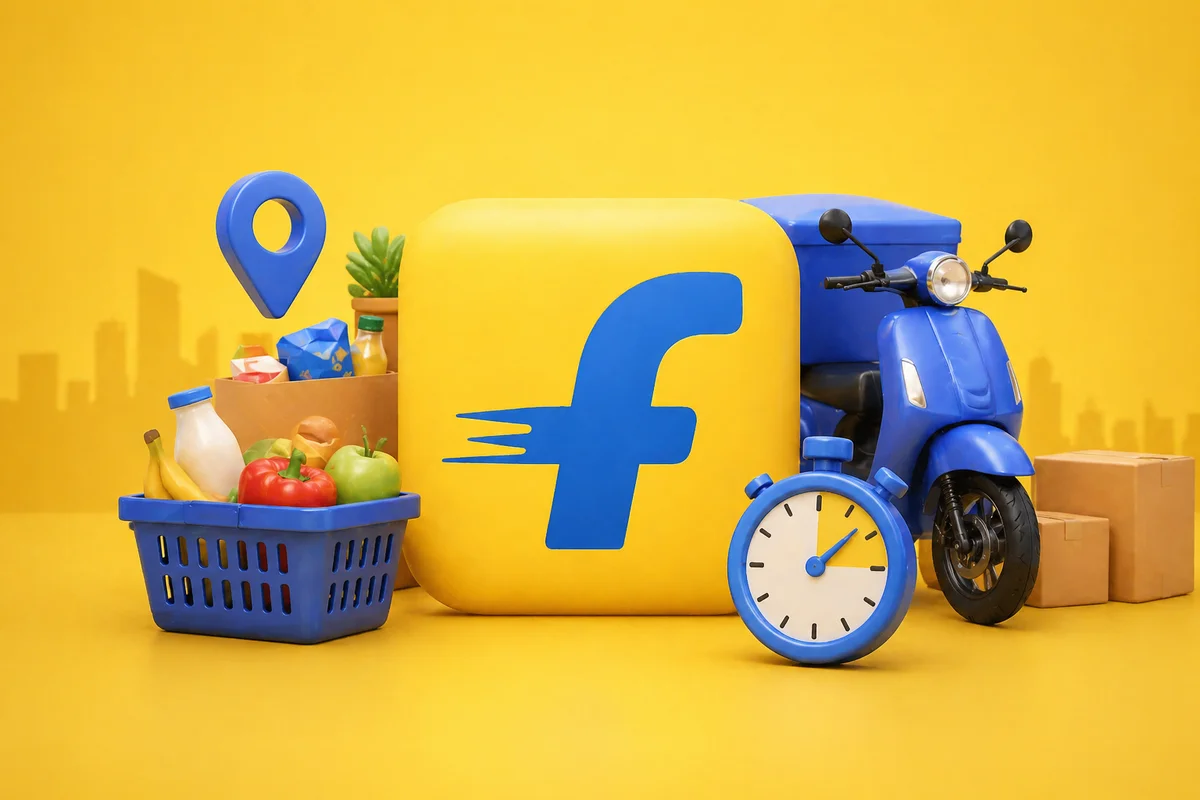
The move by Flipkart to spin off its quick commerce service into a standalone app signals a deeper shift in India’s digital commerce landscape. What appears to be a product-level change is actually a strategic repositioning to compete in one of the fastest-growing segments of online retail. As the battle for instant delivery intensifies, separating quick commerce from traditional e-commerce is becoming a necessity rather than an option.
Flipkart’s quick commerce arm, Flipkart Minutes, is currently integrated within its main app. However, the company now plans to launch it as a standalone platform ahead of its flagship Big Billion Days sale. This shift is designed to create a focused user experience tailored specifically for ultra-fast deliveries.
The logic behind this move is rooted in user behavior. Quick commerce customers expect speed, simplicity, and minimal friction. A separate app allows Flipkart to optimize for these expectations without being constrained by the broader e-commerce interface.
Key strategic objectives include:
• Faster checkout and reduced app clutter
• Better targeting of high-frequency users
• Dedicated supply chain optimization
• Stronger brand positioning in quick commerce
Flipkart has aggressively scaled its quick commerce infrastructure since launching Minutes in 2024. The company is rapidly expanding its dark store network, which is critical for enabling fast deliveries.
| Metric | Current Status |
|---|---|
| Dark Stores | 750 to 800 |
| Monthly Additions | ~100 stores |
| Target by June | 1,200 stores |
| City Expansion Goal | 250 cities |
| Launch Year | 2024 |
This rapid expansion indicates that Flipkart is not treating quick commerce as an experiment but as a core growth pillar.
Data suggests higher dark store density improves delivery speed This leads to better customer retention Which results in higher order frequency and revenue growth
The quick commerce market in India is becoming increasingly competitive, with multiple players investing heavily.
| Company | Strategy Focus | Strength |
|---|---|---|
| Zepto | Ultra-fast delivery | Strong urban penetration |
| Swiggy Instamart | Integrated ecosystem | High user base |
| Amazon Now | Logistics strength | Capital and scale |
| Reliance Industries JioMart | Retail integration | Offline + online network |
Flipkart’s standalone app strategy mirrors moves by competitors who have already separated quick commerce into dedicated platforms. This indicates a broader industry trend toward specialization.
India’s quick commerce market is projected to reach $40 billion by 2030, driven by urbanization, changing consumer habits, and demand for instant gratification.
Several factors are accelerating growth:
• Increasing smartphone penetration
• Rising disposable incomes
• Shift toward convenience-driven consumption
• Expansion into tier 2 and tier 3 cities
This makes quick commerce one of the most attractive segments in India’s digital economy.
A key insight often overlooked is that quick commerce is not about high-value orders but about frequency. Unlike traditional e-commerce, where customers shop occasionally, quick commerce users order multiple times a week.
Higher order frequency leads to:
• Better unit economics over time
• Stronger customer retention
• Increased lifetime value
This is why companies are investing heavily in infrastructure despite thin margins in the short term.
A common misconception is that quick commerce is simply faster e-commerce. In reality, it requires a completely different operational model, including:
• Micro-warehousing through dark stores
• Hyperlocal inventory management
• Real-time logistics optimization
Another misunderstanding is that profitability depends on large orders. The model is actually built around repeat purchases and efficient supply chains.
While launching a separate app improves focus, it also carries risks. Fragmenting users across multiple apps can reduce engagement if not executed properly.
Some potential challenges include:
• Increased customer acquisition cost
• App fatigue among users
• Dependency on marketing to drive downloads
This means success will depend on how well Flipkart integrates its ecosystem across platforms.
The standalone quick commerce app could play a critical role in Flipkart’s long-term strategy, especially as the company prepares for a potential IPO.
Key growth triggers include:
• Expansion into new cities and categories
• Integration with payment and loyalty ecosystems
• Entry into adjacent segments like food delivery and ticketing
• Improvement in logistics efficiency
If executed well, quick commerce could become a major revenue driver alongside Flipkart’s core marketplace.
For investors and industry watchers:
• Track dark store expansion and city penetration
• Monitor order frequency trends and user retention
• Evaluate competitive positioning against Zepto and Amazon
For businesses:
• Explore partnerships with quick commerce platforms
• Optimize supply chains for faster delivery cycles
For consumers:
• Expect faster deliveries and wider product availability
• Watch for aggressive pricing and discount strategies
Flipkart moving toward a standalone quick commerce app reflects a deeper structural shift in how digital commerce is evolving in India. The battle is no longer just about selection or price but about speed, convenience, and frequency. If Flipkart successfully executes this strategy, it could strengthen its position in a market that is rapidly redefining consumer expectations and reshape the competitive dynamics of India’s e-commerce ecosystem.
A standalone app allows better optimization for speed, user experience, and logistics, which are critical for quick commerce success.
The market is expected to reach around $40 billion by 2030, driven by rising demand for instant delivery and urban consumption patterns.
Yes, but success will depend on execution, supply chain efficiency, and user acquisition strategies in an increasingly competitive market.
Financial journalist specializing in market analysis, stock research, and investment trends. Dedicated to providing accurate, timely insights for informed decision-making.
Credentials: Experienced financial journalist with expertise in equity markets and economic analysis
The information provided in this article is for educational and informational purposes only and should not be construed as financial, investment, or legal advice. welomoney does not provide personalized investment recommendations.
For detailed terms and conditions, please read our Disclaimer and Terms of Service.
The Reserve Bank of India's recent forex measures have attracted nearly $32 billion, largely through FCNR(B) deposits, while foreign investors...

The Indian Air Force has initiated Software Defined Radio (SDR) integration on 36 MiG 29 aircraft, including 29 fighter jets and 7 trainers.
Union Minister Pralhad Joshi has been given additional charge of the Ministry of Education after President Droupadi Murmu accepted Dharmendra...
Flipkart is set to enter India's food delivery market with a pilot launch in Bengaluru. The Walmart-owned company is reportedly exploring a...
FIIs increased their stake in MTAR Technologies, Groww operator Billionbrains Garage Ventures, HFCL, Motisons Jewellers and several other companies...