Loading market data...
Mon, 14 Sept 2026
12:49:03 pm
Mon, 14 Sept 2026
12:49:03 pm

Rudransh Sangwan
Published at: July 31, 2026, 5:13 AM
Synopsis
Why did Hyundai Motor India shares jump 8% despite a 35% drop in Q1 FY27 profit? Explore the reasons behind the rally, quarterly results, management guidance, upcoming SUV and EV launches, and what investors should watch next.
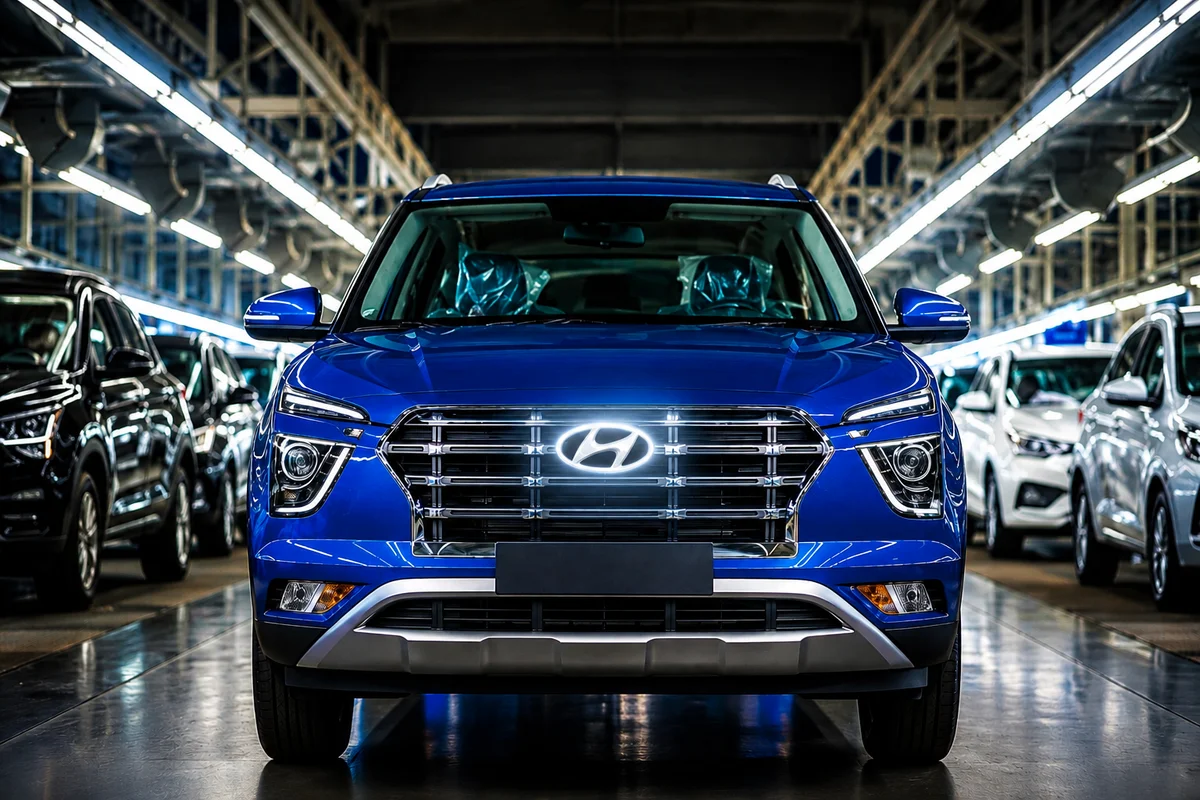
Hyundai Motor India Ltd. surprised the stock market on Friday after its shares climbed nearly 8%, even though the automaker reported a sharp 35.1% year-on-year decline in net profit for the June quarter (Q1 FY27). While falling profits typically weigh on investor sentiment, the market chose to focus on the company's long-term growth outlook rather than its short-term earnings weakness.
The rally was driven by management's decision to retain its full-year guidance despite temporary operational challenges, including a supplier fire, softer export demand and higher input costs. Investors also welcomed Hyundai's plans to launch new products, expand manufacturing capacity and strengthen its position in India's rapidly growing electric vehicle and SUV markets. Together, these developments reinforced confidence that the weak first quarter may prove to be temporary.
Loading chart...
| Particulars | Q1 FY27 | Q1 FY26 | YoY Change |
|---|---|---|---|
| Net Profit | ₹889 Crore | ₹1,369 Crore | -35.1% |
| Revenue | ₹16,335 Crore | ₹16,413 Crore | -0.5% |
| EBITDA | ₹1,512 Crore | ₹2,186 Crore | -30.8% |
| EBITDA Margin | 9.3% | 13.3% | -400 bps |
Although profitability declined significantly, Hyundai's quarterly performance largely matched market expectations. Revenue remained broadly stable and EBITDA came in close to analyst estimates, reducing concerns about a major earnings miss. As a result, investors shifted their attention from historical numbers to the company's outlook for the remaining quarters of the financial year.
Management indicated that several challenges affecting the June quarter were temporary. Production disruptions caused by a supplier fire have largely been resolved, while the company expects stronger demand and improved operational efficiency during the second half of FY27.
The biggest reason behind Friday's rally was Hyundai's decision to maintain its full-year guidance. The company continues to expect 8% to 10% volume growth for FY27 while retaining its operating margin guidance of 11% to 14%, signalling confidence that business conditions will improve in the coming months.
Investors also responded positively to management's recovery strategy. With production returning to normal and manufacturing capacity set to increase, the market expects Hyundai's earnings to improve in the second half of the financial year. This optimism outweighed the weak quarterly profit numbers and supported a sharp rise in the company's share price.
| Growth Driver | Impact on Investor Sentiment |
|---|---|
| FY27 guidance maintained | Improved confidence in future earnings |
| Production disruption easing | Recovery expected in H2 FY27 |
| New SUV launches | Supports domestic sales growth |
| First mass-market EV | Expands presence in electric vehicles |
| Third shift at Pune plant | Higher production capacity |
Hyundai has lined up several important product launches for the second half of FY27, which investors see as potential growth catalysts. The company plans to introduce a new mid-size SUV along with its first mass-market electric vehicle in India, strengthening its portfolio in two of the country's fastest-growing automotive segments.
In addition to expanding its product lineup, Hyundai is preparing to start an early third production shift at its Pune manufacturing facility. The additional capacity is expected to improve production efficiency, reduce waiting periods and support higher sales volumes as demand recovers.
Despite weaker overall profitability, Hyundai continued to witness healthy demand for several of its popular models. The all-new Venue recorded its highest-ever quarterly domestic sales, reflecting continued strength in the compact SUV segment, which remains one of the fastest-growing categories in the Indian passenger vehicle market.
Alternative fuel vehicles also delivered encouraging performance during the quarter. CNG-powered models accounted for 18% of Hyundai's overall sales, with the Aura recording 95% CNG penetration and the Exter achieving 32% CNG penetration. The increasing acceptance of CNG vehicles highlights changing consumer preferences as buyers look for more fuel-efficient and economical mobility solutions.
| Metric | Performance |
|---|---|
| Highest Quarterly Domestic Sales | All-New Venue |
| CNG Contribution | 18% of Total Sales |
| Aura CNG Penetration | 95% |
| Exter CNG Penetration | 32% |
| Upcoming Launches | Mid-size SUV & Mass-market EV |
The strong performance of Hyundai's SUV and CNG portfolio demonstrates that customer demand remains resilient despite a challenging operating environment. As the company expands into electric mobility alongside its existing SUV and alternative fuel offerings, it is positioning itself to benefit from multiple growth trends within India's passenger vehicle market.
The decline in quarterly earnings was primarily driven by short-term operational challenges rather than a significant slowdown in consumer demand. A temporary supplier fire disrupted production during the quarter, while weaker export volumes and rising operating expenses also weighed on profitability. These factors reduced EBITDA margins even though overall revenue remained relatively stable.
Management believes these headwinds are unlikely to persist through the remainder of the financial year. With manufacturing operations returning to normal and new product launches scheduled over the coming months, the company expects business momentum to improve during the second half of FY27.
Hyundai's latest quarterly results highlight the difference between short-term financial performance and long-term business expectations. Although earnings declined sharply, the company's confidence in achieving its annual guidance, combined with new product launches and higher manufacturing capacity, convinced investors that growth could accelerate in the coming quarters.
Going forward, investors will closely monitor the launch of Hyundai's new SUV and electric vehicle, recovery in export demand, improvement in operating margins and execution at the Pune manufacturing facility. If these initiatives deliver the expected results, Hyundai Motor India could strengthen its competitive position in the Indian automobile market despite the temporary weakness seen during the June quarter.
| Period | Performance |
|---|---|
| Intraday (July 31) | +7% to +8% |
| Net Profit (Q1 FY27) | ₹889 Crore (-35.1% YoY) |
| Revenue | ₹16,335 Crore (-0.5% YoY) |
| EBITDA Margin | 9.3% |
Hyundai Motor India shares surged nearly 8% because investors focused on the company's positive long-term outlook rather than its weak quarterly earnings. Management maintained its FY27 growth guidance, announced new product launches, and expressed confidence about business recovery in the second half of the financial year.
Hyundai Motor India reported a consolidated net profit of ₹889 crore for the quarter ended June 30, 2026, compared with ₹1,369 crore in the corresponding quarter last year, representing a 35.1% year-on-year decline.
The company reported revenue of ₹16,335 crore during Q1 FY27, compared with ₹16,413 crore in the same quarter of the previous financial year.
The decline in profit was mainly due to a temporary supplier fire, softer export demand, higher operating costs, and lower operating margins during the June quarter.
Hyundai has maintained its 8% to 10% volume growth guidance and 11% to 14% operating margin guidance for the full financial year, indicating confidence in business recovery.
The company plans to launch a new mid-size SUV and its first mass-market electric vehicle (EV) in India during the second half of FY27.
CNG vehicles contributed 18% of Hyundai's total sales during the quarter. The Aura recorded 95% CNG penetration, while the Exter achieved 32% CNG penetration, reflecting growing demand for alternative fuel vehicles.
Hyundai plans to introduce an early third production shift at its Pune manufacturing facility, which is expected to increase production capacity, improve supply, and support future sales growth.
Investors will closely monitor Hyundai's upcoming SUV and EV launches, recovery in exports, production normalization, margin improvement, and execution of its FY27 growth strategy to assess the company's long-term growth potential.
Key factors include the success of new product launches, improvement in domestic demand, export recovery, operating margin expansion, EV sales growth, production ramp-up at the Pune plant, and the company's ability to achieve its FY27 guidance.
Financial journalist specializing in market analysis, stock research, and investment trends. Dedicated to providing accurate, timely insights for informed decision-making.
Credentials: Experienced financial journalist with expertise in equity markets and economic analysis
The information provided in this article is for educational and informational purposes only and should not be construed as financial, investment, or legal advice. welomoney does not provide personalized investment recommendations.
For detailed terms and conditions, please read our Disclaimer and Terms of Service.

Raymond shares hit a fresh high of ₹1,024.50 after the company announced a ₹214.71 crore preferential warrant issue.

Airline, OMC, paint and tyre stocks fell as Brent crude approached $110 a barrel. See why SpiceJet, IndiGo, HPCL and BPCL are under pressure while...
ASM Technologies shares hit a record ₹6,990 after its board approved a ₹525.99 crore preferential issue involving SBI Mutual Fund and entities linked...
Dilip Buildcon emerged as the successful bidder for an LPG pipeline from Paradip to Raipur. The project includes three years of construction and 25...
Enviro Infra Engineers shares rose 2.72% to ₹211.50 after Suyog Urja received a ₹224.19 crore Tata Power Renewable Energy order.