Loading market data...
Tue, 28 Jul 2026
11:23:53 pm
Tue, 28 Jul 2026
11:23:53 pm

Rudransh Sangwan
Published at: April 27, 2026, 5:57 AM
Synopsis
Infosys has fallen out of India’s top 10 most valuable companies after losing over ₹2 lakh crore in market value, driven not by weak earnings but by slowing growth expectations and cautious client spending. The company’s muted FY27 guidance and structural changes in the IT sector, especially the impact of AI on traditional revenue models, have triggered a sharp re-rating by investors.
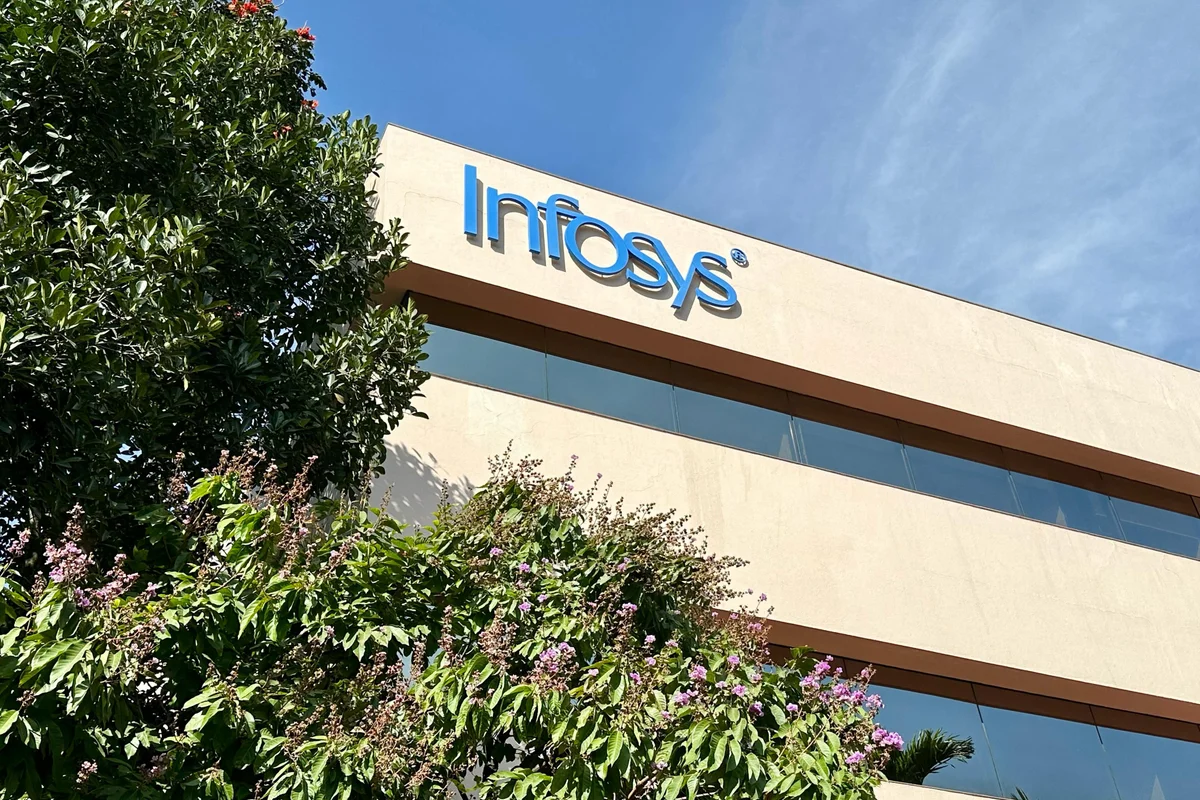
The fall of Infosys from India’s top 10 most valuable companies is not just a stock market event but a signal of a deeper structural shift in the IT services industry. After losing over ₹2 lakh crore in market capitalization and declining nearly 30 percent this year, Infosys is facing a sharp reassessment from investors who are questioning the predictability of growth that once defined the company.
What makes this development more important is the timing. The broader market has remained resilient in parts, yet IT stocks have seen consistent pressure. This divergence highlights a transition phase where traditional growth models are being challenged by new technological and economic realities.
At first glance, Infosys did not report weak numbers. The company delivered revenue of ₹46,402 crore in the March quarter, growing 13 percent year on year, while net profit came in at ₹8,501 crore, beating expectations.
However, the real issue lies in forward guidance.
| Metric | Value |
|---|---|
| Market Cap (Current) | ~₹4.9 lakh crore |
| Market Value Lost | ₹2 lakh crore+ |
| Q4 Revenue | ₹46,402 crore |
| Q4 Net Profit | ₹8,501 crore |
| FY27 Growth Guidance | 1.5% to 3.5% |
The guidance for FY27 revenue growth at 1.5 percent to 3.5 percent significantly disappointed the market. This indicates that the slowdown is not temporary but could persist for multiple quarters.
Data suggests weaker future growth expectations This leads to valuation compression Which results in sharp stock price correction
The exit of Infosys from the top 10 list also reflects a broader shift in market leadership.
Companies like Life Insurance Corporation of India have moved up the rankings, while even Tata Consultancy Services has seen pressure, slipping in relative positioning.
| Company | Approx Market Cap |
|---|---|
| LIC | ~₹5.1 lakh crore |
| Infosys | ~₹4.9 lakh crore |
Loading chart...
This indicates that capital is rotating away from IT services into sectors with stronger visibility such as insurance, banking, and domestic consumption.
The slowdown in Infosys is not company-specific. It reflects a broader shift in global IT spending patterns.
• Clients are prioritizing cost optimization over expansion
• Discretionary IT spending remains weak
• Vendor consolidation is increasing
• Large transformation deals are slowing
Financial services and energy sectors remain relatively stable, but manufacturing, retail, and telecom are still cautious due to global uncertainty.
Artificial intelligence is one of the biggest factors influencing Infosys’s valuation.
The company has actively invested in AI platforms and deployed tools across its workforce. Over 30,000 developers are already using AI-driven productivity systems.
However, the impact is complex.
| Positive Impact | Negative Impact |
|---|---|
| New deal opportunities | Pricing pressure |
| Higher productivity | Revenue compression |
| Automation-led services | Reduced billing hours |
AI is increasing efficiency, but those gains are being passed on to clients. This means traditional billing models are under pressure, limiting revenue growth.
One under-discussed factor is that IT companies are no longer being valued purely on revenue growth.
Instead, the focus is shifting toward:
• Revenue per employee
• Profitability per project
• Efficiency metrics
This transition changes how companies like Infosys are evaluated, leading to lower valuation multiples.
A common misconception is that strong deal wins guarantee growth.
Infosys signed deals worth $14.9 billion in FY26, a 24 percent increase year on year. However, execution timelines are stretching, and revenue realization is slower.
Another misunderstanding is that AI will automatically boost earnings. In reality, AI is reducing the need for traditional services, which offsets new revenue streams.
While the market reaction appears negative, this phase may actually be a long-term positive.
Lower valuations and realistic growth expectations can create:
• More sustainable earnings cycles
• Better capital allocation
• Stronger long-term returns
Historically, IT stocks have gone through similar de-rating phases before entering new growth cycles.
Several factors will determine whether Infosys regains its position:
• Recovery in global IT spending
• Monetization of AI-led services
• Improvement in deal execution timelines
• Stability in global macro conditions
If AI-led services start contributing meaningfully to revenue rather than just efficiency, growth could re-accelerate.
For short-term traders:
• Expect volatility due to weak guidance
• Avoid chasing rebounds without confirmation
For long-term investors:
• Track execution of large deals
• Focus on margin stability and AI monetization
• Accumulate gradually during corrections
The fall of Infosys from India’s top 10 companies is not just about one weak phase but about a structural shift in how the IT industry operates. Growth is slowing, business models are evolving, and valuation frameworks are changing. Investors who understand this transition rather than reacting to short-term declines are better positioned to benefit from the next phase of the sector.
Infosys stock declined mainly due to weak growth guidance for FY27, which indicated slower future revenue expansion despite stable current earnings.
Yes, global IT spending has slowed as companies focus on cost optimization, affecting demand across major IT service providers.
Recovery depends on AI monetization, global demand revival, and improved execution of large deals over the next few years.
Financial journalist specializing in market analysis, stock research, and investment trends. Dedicated to providing accurate, timely insights for informed decision-making.
Credentials: Experienced financial journalist with expertise in equity markets and economic analysis
The information provided in this article is for educational and informational purposes only and should not be construed as financial, investment, or legal advice. welomoney does not provide personalized investment recommendations.
For detailed terms and conditions, please read our Disclaimer and Terms of Service.
A leading renewable energy stock fell over 6% after reporting Q1 FY27 results. Despite 22.3% revenue growth, lower profit and shrinking operating...

A leading Indian airline's parent company has appointed Kiran Thadimarri as its new Chief Financial Officer, while former CFO Gaurav Negi moves into...
A leading PSU bank's shares slipped after a global brokerage cut its target price to ₹280 following a softer Q1 performance.
A leading Indian IT stock surged over 3% after reporting US$1.66 billion revenue, 14.4% EBIT margin, and US$1.078 billion in deal wins.

A leading PSU mining stock fell nearly 4% after reporting ₹8,850 crore Q1 profit, a 9% drop in EBITDA and margin pressure despite announcing a ₹5.