Loading market data...
Fri, 23 Oct 2026
05:06:00 pm
Fri, 23 Oct 2026
05:06:00 pm
Finscann Editorial
Published at: March 27, 2026, 6:19 AM
Synopsis
HPCL, BPCL, and IOC shares jump up to 4% after govt cuts fuel excise duty. Know reasons, impact on markets, and what lies ahead.
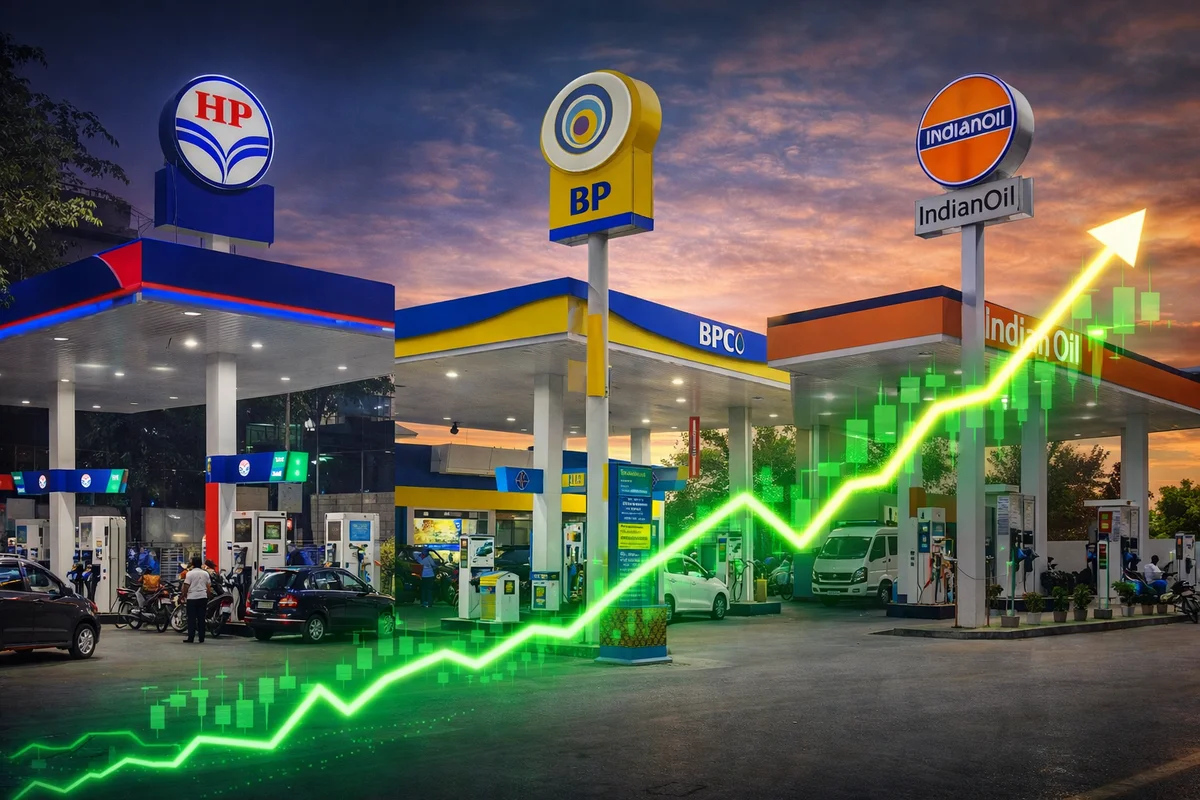
Shares of HPCL, BPCL, and IOC surged up to 4% after the Indian government announced a sharp cut in fuel excise duty. This move came as a major relief for oil marketing companies that were facing pressure due to rising global crude oil prices.
The government reduced the excise duty on petrol to ₹3 per litre and completely removed it on diesel. This effectively gives a ₹10 per litre cushion to oil companies, helping them manage losses without immediately increasing fuel prices.
For investors, this policy decision signals strong government support for PSU oil stocks during a time of global energy stress. When input costs rise sharply, such interventions can stabilize company earnings and improve market sentiment.
The key takeaway here is clear. Policy support can significantly influence stock movements, especially in regulated sectors like oil and gas.
Loading chart...
The excise duty cut is not just a consumer-focused move. It is primarily aimed at protecting oil marketing companies from heavy losses caused by soaring crude oil prices.
The government reduced:
This is one of the biggest tax cuts in recent years and comes at a time when crude oil prices are hovering above $100 per barrel due to geopolitical tensions.
This move ensures that the burden of rising global oil prices does not fully pass on to consumers.
Loading chart...
Despite the tax cut, fuel prices at petrol pumps may not fall immediately.
Instead, the benefit is being used to offset losses faced by oil companies, which were selling fuel below cost due to price controls.
This means:
The takeaway is simple. This move is more about stabilizing the energy sector than reducing fuel prices instantly.
Loading chart...
The excise duty cut did not happen in isolation. It is directly linked to global developments impacting oil supply and prices.
The ongoing geopolitical tensions in the Middle East, especially involving Iran, have disrupted global oil supply chains.
The Strait of Hormuz, a critical route for global oil transport, has been affected, leading to supply concerns and price spikes.
Since India imports a large portion of its crude oil, any disruption in this region directly impacts domestic fuel costs.
Crude oil prices have surged significantly in recent weeks, crossing $100 per barrel.
This creates multiple challenges:
To avoid a sharp increase in fuel prices for consumers, the government chose to absorb part of the impact through tax cuts.
The takeaway is clear. Global energy shocks often lead to domestic policy adjustments.
The rise in HPCL, BPCL, and IOC shares reflects improved investor confidence in the oil marketing sector.
With excise duty cuts absorbing part of the cost burden, oil companies can maintain better marketing margins.
Earlier, companies were facing significant under-recoveries on petrol and diesel sales. Now, these losses are expected to reduce substantially.
This improves:
Stocks often react positively when future earnings become more predictable.
While the immediate reaction has been positive, the long-term outlook depends on several factors:
Some analysts believe that if oil prices remain high for an extended period, pressure on oil companies could return.
The takeaway is balanced thinking. Short-term gains do not always translate into long-term growth.
While the excise duty cut supports oil companies and consumers, it also comes with a cost for the government.
Reducing fuel taxes means lower revenue for the government.
Estimates suggest that such a move could lead to a significant fiscal impact, potentially running into lakhs of crores annually.
This could:
However, the government appears to have prioritized economic stability over revenue collection.
By preventing a sharp rise in fuel prices, the government is indirectly controlling inflation.
Fuel prices impact:
Keeping these stable helps maintain economic momentum and consumer confidence.
The takeaway is strategic trade-off. The government sacrifices revenue to maintain economic stability.
The current rally in oil stocks is driven by policy support, but future performance will depend on multiple evolving factors.
Investors should closely track:
These factors will determine whether the rally sustains or fades.
For short-term traders, this rally may offer quick gains.
For long-term investors, the decision should depend on:
Oil marketing companies operate in a highly regulated environment, making them sensitive to policy changes.
The takeaway is cautious optimism. Opportunities exist, but risks remain.
The jump in HPCL, BPCL, and IOC shares highlights how quickly markets react to government policy decisions.
The excise duty cut has provided immediate relief to oil companies and boosted investor sentiment. However, the sustainability of this rally depends on global oil prices and future policy actions.
In volatile sectors like energy, staying informed and adaptable is key. Smart investors focus not just on headlines but on underlying trends and long-term implications.

Financial journalist specializing in market analysis, stock research, and investment trends. Dedicated to providing accurate, timely insights for informed decision-making.
Credentials: Experienced financial journalist with expertise in equity markets and economic analysis
The information provided in this article is for educational and informational purposes only and should not be construed as financial, investment, or legal advice. welomoney does not provide personalized investment recommendations.
For detailed terms and conditions, please read our Disclaimer and Terms of Service.
Vikram Solar plans to start production at its 9 GW solar cell plant in Tamil Nadu in December 2026.

BKT will make up to 800,000 Pirelli tyres by 2030, with supply starting in 2027. Nomura sees limited near term gains and retains its Rs 2,410 target.
Jyoti Structures shares rose 6.07% to Rs 8.56 after winning a Rs 689.93 crore Gujarat transmission line order.

UltraTech Cement shares are down 11% in a year, but InCred Equities retains an Add rating and ₹13,600 target.

eMudhra shares plunged 34% in three sessions, nearing a 52-week low after a TLS certificate security issue.