Loading market data...
Wed, 02 Sept 2026
07:04:45 am
Wed, 02 Sept 2026
07:04:45 am

Rudransh Sangwan
Published at: April 2, 2026, 8:49 AM
Synopsis
Sensex wipes out ₹11 lakh crore in a sharp selloff. Is it a crash or opportunity? Here’s a clear, professional analysis for investors.
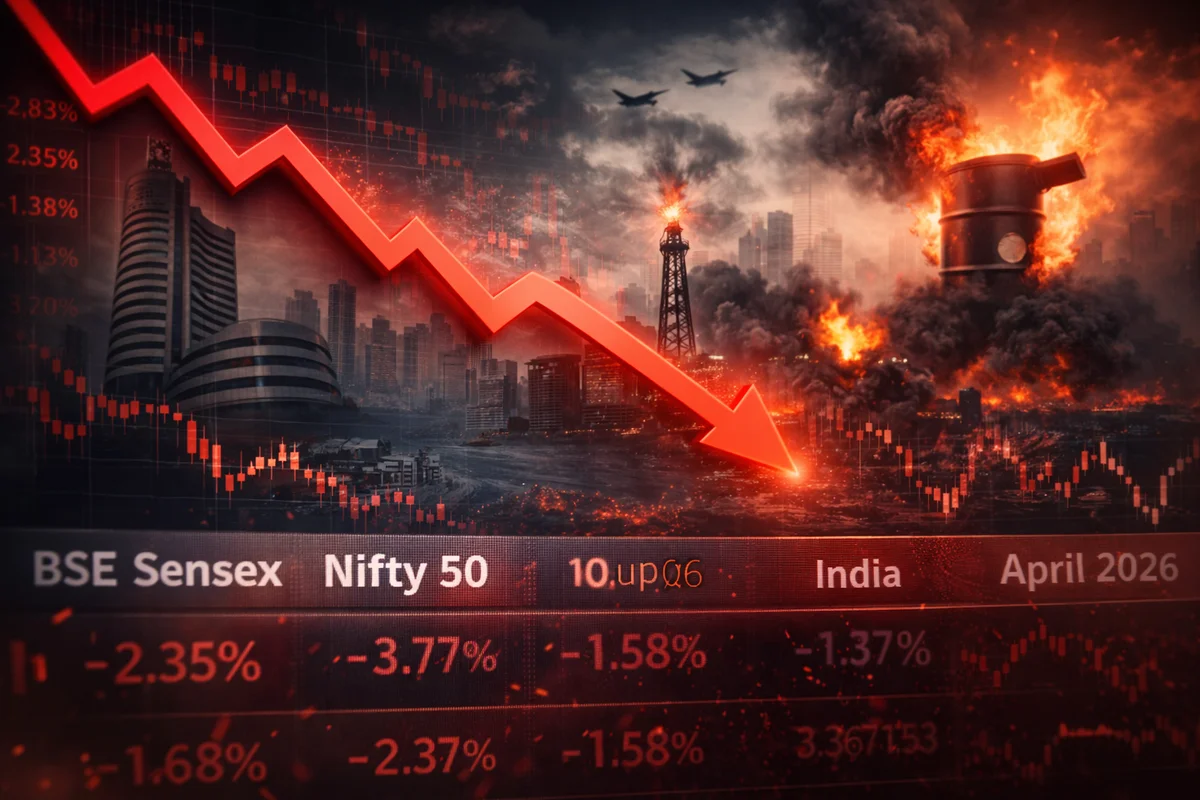
India’s stock market witnessed a sharp correction, with the Sensex falling over 1,500 points and the Nifty slipping below key levels, wiping out nearly ₹11 lakh crore in investor wealth in a single session.
This kind of fall may appear like a crash, but context is important.
The decline was broad-based:
For example, such sharp single-day declines are often triggered by global events rather than domestic economic weakness.
The key takeaway is that this was a macro-driven correction, not a structural breakdown of the Indian economy.
The selloff was driven by multiple global and domestic factors acting together.
Escalation fears in the Iran conflict created uncertainty across global markets, leading to widespread selling in equities.
Oil prices moved above $100 per barrel, which is negative for India due to its heavy dependence on imports.
Foreign institutional investors continued to sell aggressively, creating liquidity pressure and dragging indices lower.
Higher global bond yields made fixed-income investments more attractive compared to equities, reducing risk appetite.
Asian and US markets also declined, which amplified the negative sentiment in Indian equities.
The takeaway is that this was a macro-driven selloff rather than company-specific weakness.
This event does not yet qualify as a full market crash.
A true market crash typically involves:
What is currently visible:
Historically, corrections of this magnitude are common even in long-term bullish markets.
The takeaway is that this appears to be a correction phase within a broader trend.
After the recent correction, valuations in several sectors have become more reasonable compared to earlier levels.
This creates potential opportunities in:
For example, stocks that declined due to global sentiment rather than weak fundamentals may recover once conditions stabilize.
The key insight is that markets often react faster than underlying business fundamentals.
The takeaway is that corrections can provide entry points for long-term investors.
Despite potential opportunities, risks remain significant.
Key concerns include:
For instance, if oil prices remain elevated or geopolitical tensions escalate further, markets could see additional downside.
The takeaway is that risk management remains essential.
Investors should adopt a disciplined and structured approach instead of reacting emotionally.
For example, a staggered investment strategy helps reduce risk and improves long-term returns.
The takeaway is that strategy and discipline are more important than timing the market.
Future market direction will depend on key global and domestic triggers.
Important factors to watch:
If these factors improve, markets may recover quickly. If uncertainty persists, volatility is likely to continue.
The final takeaway is clear. This is a macro-driven correction, not a structural crash, but sustained recovery will depend on stability in global conditions.
Financial journalist specializing in market analysis, stock research, and investment trends. Dedicated to providing accurate, timely insights for informed decision-making.
Credentials: Experienced financial journalist with expertise in equity markets and economic analysis
The information provided in this article is for educational and informational purposes only and should not be construed as financial, investment, or legal advice. welomoney does not provide personalized investment recommendations.
For detailed terms and conditions, please read our Disclaimer and Terms of Service.

Oracle layoffs 2026: Employees brace for possible September 1 job cuts after 21,000 layoffs.

Mumbai warehouse raid uncovers tampered food labels on popular packaged food products, raising fresh concerns over food safety and export supply...

RBI plans polymer ₹10 and ₹20 notes with strict tender conditions. Check the latest on animal fat, China-Pakistan links, companies in the race and...
Indian stock markets fell on August 31, 2026, as renewed West Asia tensions pushed crude oil prices higher.

Indian stock market today saw sharp movements across key sectors, with major gainers and losers driving notable volatility on the NSE.