Loading market data...
Wed, 02 Sept 2026
07:02:22 am
Wed, 02 Sept 2026
07:02:22 am

Rudransh Sangwan
Published at: April 3, 2026, 6:09 AM
Synopsis
Asian stocks are rising on tech gains, but the real driver is deeper. Here’s what’s driving Japan and Korea markets now.
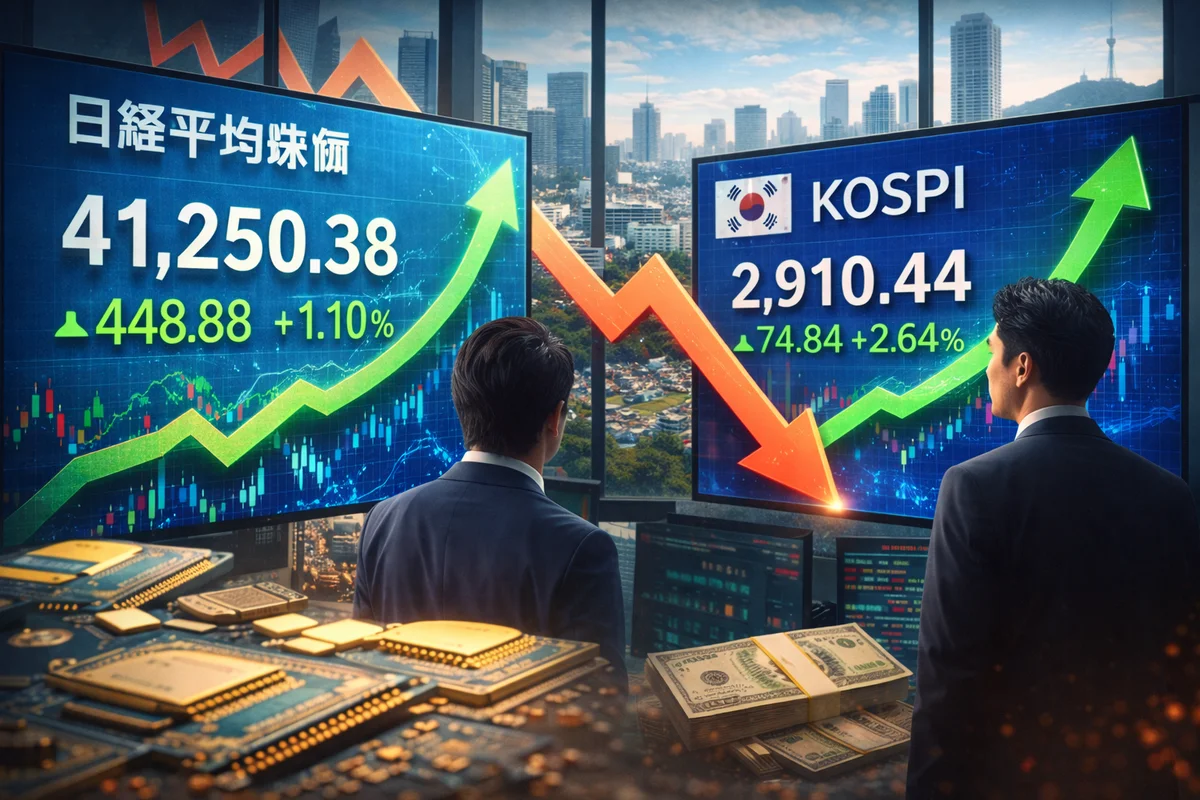
Japan’s Nikkei is hovering near multi-decade highs. South Korea’s Kospi has jumped roughly 2 to 3 percent in recent sessions. At the same time, US bond yields remain above 4 percent and crude oil is trading close to the 100 to 110 dollar range.
That combination should not support a clean rally.
Yet markets are rising.
This contradiction tells you the real story is not about growth. It is about capital movement. What we are seeing is not a traditional bull phase. It is a liquidity-driven rotation where global money is shifting toward markets with better earnings visibility and relatively lower valuations.
At the surface level, the rally is being driven by semiconductor and technology stocks. South Korea’s equity market is heavily concentrated in chipmakers, and semiconductor exports have surged more than 100 percent year on year in recent cycles due to AI infrastructure demand.
Japan is benefiting from a different macro advantage. The yen remains weak, which boosts export competitiveness. At the same time, global investors are allocating capital toward Japanese equities because valuations remain lower compared to US tech.
Key drivers:
Example: When global funds compare earnings growth versus valuation, even a small difference in multiples can shift billions in allocation.
Practical takeaway: This rally is supported by earnings, but amplified by valuation arbitrage.
The US nonfarm payroll report is currently the most important macro variable because it directly influences interest rate expectations.
US 10-year yields are holding near 4.1 to 4.3 percent. That keeps liquidity tight across global markets.
Here is the mechanism:
Strong jobs data:
Weak jobs data:
Here is the non-obvious reality. Markets do not want extremes.
Example: A payroll print significantly above expectations can push yields higher by 20 to 30 basis points within days, triggering global equity corrections.
Practical takeaway: Markets are reacting to policy expectations, not economic strength itself.
This is where most analysis stops short.
Asian markets are not rising because they are strong in isolation. They are rising because capital is rotating away from areas where risk-adjusted returns are deteriorating.
Right now:
This creates a three-layer model:
Asia currently leads on all three.
Example: If global funds reallocate just 2 percent of their portfolio toward Asia, that alone can drive multi-percentage index gains in markets like Kospi.
Practical takeaway: This is a capital flow event, not a pure economic expansion.
Most investors think this is a broad-based recovery across Asian economies.
It is not.
This rally is highly concentrated. Semiconductor and export-heavy companies are doing most of the lifting. That creates a structural risk.
Another key insight is timing. Markets are rising despite:
That means markets are prioritizing earnings visibility over macro risk.
More importantly, this is a positioning shift. Many global funds were underweight Asia. As they rebalance, prices move sharply.
Key insight:
Practical takeaway: Concentration increases upside speed but also downside risk.
Sustainability depends less on company performance and more on macro conditions.
Right now:
Historically, rallies during high-rate environments tend to be unstable, especially when driven by a narrow set of sectors.
Example: Similar setups in previous cycles have reversed when bond yields moved above key thresholds or when energy prices surged further.
Practical takeaway: Without broader participation and easing liquidity, sustainability remains limited.
If payroll growth slows and inflation moderates:
If jobs data remains strong:
If crude oil sustains above 110 dollars:
Practical takeaway: Market direction will be determined by macro triggers, not current momentum.
This is not a market to chase. It is a market to position strategically.
What to do:
What to avoid:
Example: Combining Asian tech exposure with defensive assets like gold or cash buffers can reduce volatility risk.
Practical takeaway: Positioning based on macro signals is more effective than short-term predictions.
Several factors could reverse the trend quickly:
These risks are interconnected and can trigger rapid capital outflows.
Practical takeaway: Monitor clusters of risk rather than individual indicators.
Asian stocks are rising, but this is not a clean, broad-based bull market.
This is a liquidity-driven move shaped by global capital flows, valuation gaps, and sector concentration.
The biggest mistake is assuming stability in a system that is still under macro pressure.
Markets right now reward positioning, not conviction.
And in this environment, understanding where money is moving is more important than predicting where prices will go.
Asian stocks are rising due to strong semiconductor demand, favorable currency conditions, and global capital rotation toward markets with better earnings visibility and lower valuations. The rally is also influenced by expectations around interest rates and macro stability.
US jobs data affects interest rate expectations. Strong data can keep rates high and pressure equities, while weaker data can improve liquidity and support markets globally. This makes it a key driver of short-term direction for Asian stocks.
It can be, but it requires caution. The rally is concentrated in specific sectors and depends heavily on macro conditions. Investors should focus on strong sectors, diversify exposure, and avoid chasing momentum-driven moves.
Financial journalist specializing in market analysis, stock research, and investment trends. Dedicated to providing accurate, timely insights for informed decision-making.
Credentials: Experienced financial journalist with expertise in equity markets and economic analysis
The information provided in this article is for educational and informational purposes only and should not be construed as financial, investment, or legal advice. welomoney does not provide personalized investment recommendations.
For detailed terms and conditions, please read our Disclaimer and Terms of Service.

Oracle layoffs 2026: Employees brace for possible September 1 job cuts after 21,000 layoffs.

Mumbai warehouse raid uncovers tampered food labels on popular packaged food products, raising fresh concerns over food safety and export supply...

RBI plans polymer ₹10 and ₹20 notes with strict tender conditions. Check the latest on animal fat, China-Pakistan links, companies in the race and...

Indian stock markets fell on August 31, 2026, as renewed West Asia tensions pushed crude oil prices higher.

Indian stock market today saw sharp movements across key sectors, with major gainers and losers driving notable volatility on the NSE.