Loading market data...
Sun, 19 Jul 2026
04:49:40 am
Sun, 19 Jul 2026
04:49:40 am

Rudransh Sangwan
Published at: March 29, 2026, 12:35 PM
Synopsis
₹1.75 lakh crore wiped out as 7 of India’s top firms lose value. Understand key losers, reasons, and market outlook.
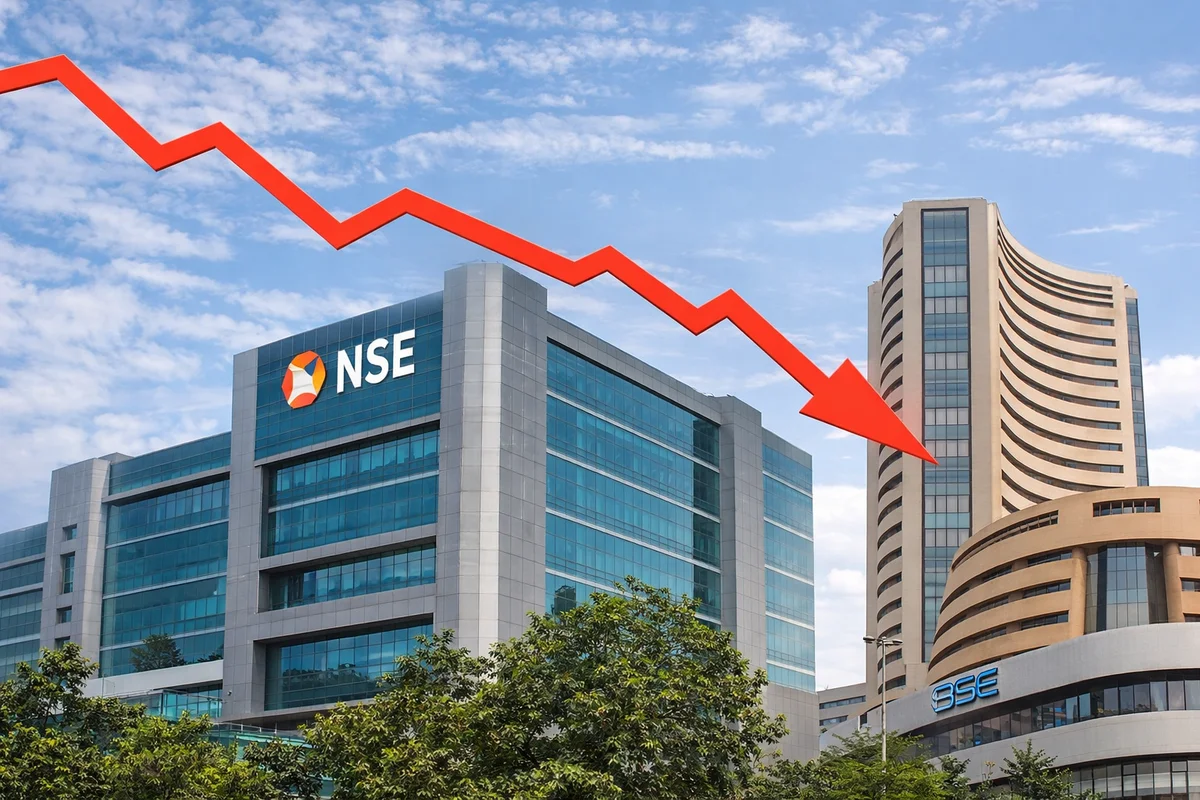
India’s equity markets witnessed a sharp erosion in value as seven of the top ten most valued companies collectively lost around ₹1.75 lakh crore in market capitalization during a volatile trading week. This decline reflects broader weakness in the stock market, driven by global uncertainty and cautious investor sentiment.
The selloff came during a holiday-shortened week, which often leads to lower liquidity and sharper market swings. Even fundamentally strong blue-chip companies were not spared, highlighting how widespread the selling pressure was.
This kind of correction is not unusual in uncertain market conditions. When global risks rise, investors tend to reduce exposure to equities, especially large-cap stocks that hold significant weight in indices.
The key takeaway is clear. Market-wide corrections often impact even the strongest companies, especially during periods of global uncertainty.
Among the top 10 most valuable firms, seven companies saw a decline in their market valuation.
Companies that faced notable losses include:
These companies experienced significant erosion in their market capitalization due to selling pressure across sectors like banking, IT, and FMCG.
Financial stocks, in particular, were among the biggest losers, as they are highly sensitive to interest rate expectations and foreign investor flows.
Reliance Industries, India’s most valued company, also played a major role in the overall market cap erosion.
It recorded one of the largest declines during the week, reflecting weakness in heavyweight stocks that have a high influence on index movements.
Since large-cap stocks carry significant weight in indices like Sensex and Nifty, their decline amplifies overall market losses.
The takeaway is concentration risk. When heavyweight stocks fall, the entire market feels the impact.
The erosion in market value is the result of multiple factors working together.
Rising geopolitical tensions and global economic concerns have pushed investors toward safer assets.
This leads to:
Emerging markets like India are often the first to see outflows during such periods.
Foreign Institutional Investors have been actively selling Indian equities in recent weeks.
When FIIs sell:
This has been one of the key drivers behind the decline in large-cap stocks.
The takeaway is global influence. Indian markets are closely linked to international capital flows.
The losses were not limited to a single sector. Multiple sectors were affected.
Banking stocks like HDFC Bank and ICICI Bank saw significant declines.
Reasons include:
Since banking stocks form a large part of indices, their decline has a major impact on the overall market.
IT giants like TCS and consumer companies like Hindustan Unilever also faced selling pressure.
This reflects:
The takeaway is broad-based weakness. Multiple sectors are contributing to the decline.
Market corrections can be unsettling, but they also provide important insights.
Short-term declines are often driven by sentiment rather than fundamentals.
Investors should remember:
Panic selling during such phases can lead to missed opportunities.
Market declines can create attractive entry points.
Investors can consider:
The key is to stay disciplined and avoid emotional decisions.
The takeaway is opportunity in volatility. Corrections often set the stage for future growth.
The market’s next move will depend on several key factors.
Investors should track:
These factors will determine market direction in the short term.
Markets often rebound after sharp corrections, especially if:
However, volatility may continue in the near term.
The takeaway is cautious optimism. Recovery is possible, but uncertainty remains.
The ₹1.75 lakh crore erosion in market value highlights the sensitivity of Indian markets to global and domestic factors.
Even the country’s biggest companies are not immune to volatility during uncertain times.
For investors, the focus should remain on long-term fundamentals, disciplined investing, and staying informed.
Market fluctuations are temporary, but strong investment strategies deliver over time.
Financial journalist specializing in market analysis, stock research, and investment trends. Dedicated to providing accurate, timely insights for informed decision-making.
Credentials: Experienced financial journalist with expertise in equity markets and economic analysis
The information provided in this article is for educational and informational purposes only and should not be construed as financial, investment, or legal advice. welomoney does not provide personalized investment recommendations.
For detailed terms and conditions, please read our Disclaimer and Terms of Service.

India has reportedly signed a $1.2 billion deal to acquire 300 Russian R-37M 'AWACS Killer' missiles for Su-30MKI fighter jets.

Royal Enfield launches the Shotgun 650 Limited Edition at ₹5.75 lakh in collaboration with Rough Crafts.
Q1 FY27 earnings season gathers pace as Reliance Industries, JSW Steel, Federal Bank, Havells, Tata Technologies and nearly 30 companies announce...

India is set to launch its first hydrogen-powered passenger train on July 17, marking a major milestone in green transportation.

Actor and entrepreneur Vivek Oberoi has revealed that his family office has invested in more than 30 companies, exited 11 investments, and generated...