Loading market data...
Sun, 19 Jul 2026
04:36:03 am
Sun, 19 Jul 2026
04:36:03 am

Rudransh Sangwan
Published at: March 28, 2026, 5:57 AM
Synopsis
Oil could hit $200 amid global tensions and supply disruptions. Explore key risks, economic impact, and what it means for markets and inflation.
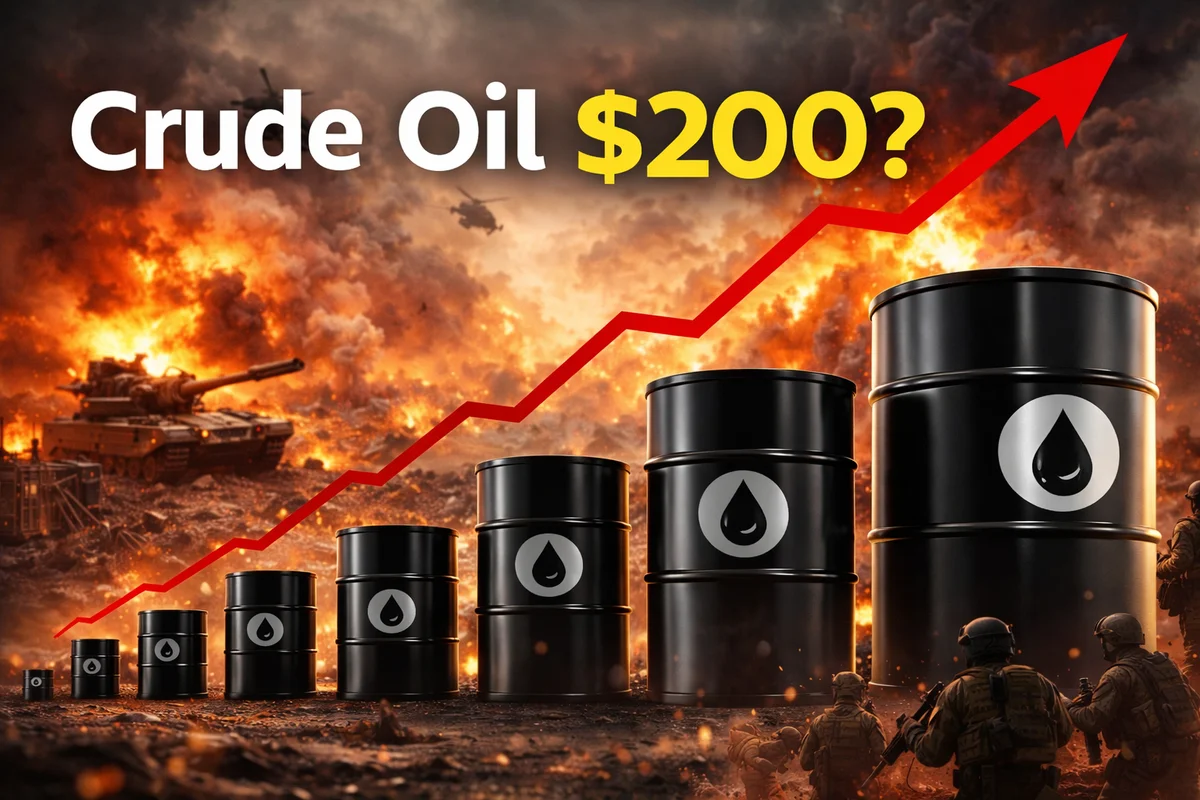
A new and alarming forecast is emerging in global markets. Oil prices could surge to $200 per barrel if current geopolitical tensions continue to escalate. This warning marks a sharp shift from earlier concerns of $100 or even $150 oil.
The biggest trigger behind this projection is the ongoing conflict involving the US, Israel, and Iran. Analysts believe that if the situation worsens or continues for a longer period, global oil supply could face severe disruptions.
A key concern is the Strait of Hormuz, one of the world’s most critical oil transit routes. Around 20 percent of global oil supply passes through this narrow waterway. Any prolonged disruption here can send prices skyrocketing.
For investors and policymakers, this is not just a theoretical risk. It represents a potential shock that could reshape global markets.
The takeaway is simple. Oil prices are no longer just about demand and supply. They are now deeply tied to geopolitical stability.
The ongoing conflict in the Middle East is at the center of this oil price surge scenario.
The Strait of Hormuz is a crucial chokepoint for global energy supply. Recent tensions have already disrupted shipping activity and reduced oil flows.
If the conflict intensifies or the strait remains closed:
Analysts estimate that such a disruption could remove millions of barrels per day from the market, creating a supply shock rarely seen in history.
This is why experts believe oil could jump to $150 or even $200 per barrel under extreme scenarios.
Earlier, $200 oil was considered an extreme or unlikely scenario. But current conditions have changed that perception.
Key factors include:
Analysts now assign a meaningful probability to this scenario if the war extends into the coming months.
The takeaway is clear. The risk of extreme oil prices is real and rising.
A surge in oil prices to $200 would have far-reaching consequences for the global economy.
Oil is a key input for almost every sector. When oil prices rise sharply:
This creates a widespread inflation shock across economies.
Countries already dealing with inflation could face even greater pressure, forcing central banks to take aggressive measures.
High oil prices can slow down economic growth significantly.
Historically, major oil shocks have been linked to economic downturns. A $200 oil scenario could:
Analysts warn that such a scenario could push several economies toward recession, especially those heavily dependent on energy imports.
The takeaway is serious. Oil shocks are not just energy issues, they are full-scale economic risks.
Emerging economies like India are particularly vulnerable to rising oil prices.
India imports a large portion of its crude oil needs, making it sensitive to global price movements.
Higher oil prices lead to:
This can create a chain reaction affecting inflation, fiscal stability, and economic growth.
A sharp rise in oil prices could:
Sectors like aviation, logistics, and manufacturing may face significant pressure, while oil producers could benefit.
The takeaway is clear. Oil price shocks tend to hit import-dependent economies the hardest.
With the risk of $200 oil rising, investors need to adapt their strategies.
Some sectors may perform better in a high oil price environment:
These sectors may see improved revenues and profitability.
At the same time, risks remain high:
Investors should focus on diversification and risk management rather than aggressive bets.
The takeaway is balance. Opportunities exist, but risks are equally significant.
The possibility of oil reaching $200 per barrel marks a major shift in global risk perception.
What was once considered an extreme scenario is now being discussed as a realistic outcome under certain conditions.
From geopolitical tensions to supply disruptions, multiple factors are aligning to create a high-risk environment for energy markets.
For investors, businesses, and governments, the message is clear. Prepare for volatility, stay informed, and adapt to a rapidly changing global landscape.
Financial journalist specializing in market analysis, stock research, and investment trends. Dedicated to providing accurate, timely insights for informed decision-making.
Credentials: Experienced financial journalist with expertise in equity markets and economic analysis
The information provided in this article is for educational and informational purposes only and should not be construed as financial, investment, or legal advice. welomoney does not provide personalized investment recommendations.
For detailed terms and conditions, please read our Disclaimer and Terms of Service.
The RBI has fixed the premature redemption price of Sovereign Gold Bond (SGB) 2020-21 Series IV at ₹14,307 per unit.
Petrol and Diesel Prices Today (14 July 2026): Check the latest state-wise and city-wise petrol and diesel rates across India, fuel price analysis,...

Gold and silver prices today, July 14, 2026: Check the latest MCX gold and silver rates, 22K and 24K gold prices across major Indian cities,...