Loading market data...
Mon, 05 Oct 2026
09:29:34 am
Mon, 05 Oct 2026
09:29:34 am

Rudransh Sangwan
Published at: August 21, 2026, 6:16 AM
Synopsis
Britannia Industries share price falls 3.29% to ₹5,365.50 today. Check why Britannia stock is falling, Q1 FY27 results, FMCG trends, input costs, valuation and share price outlook.
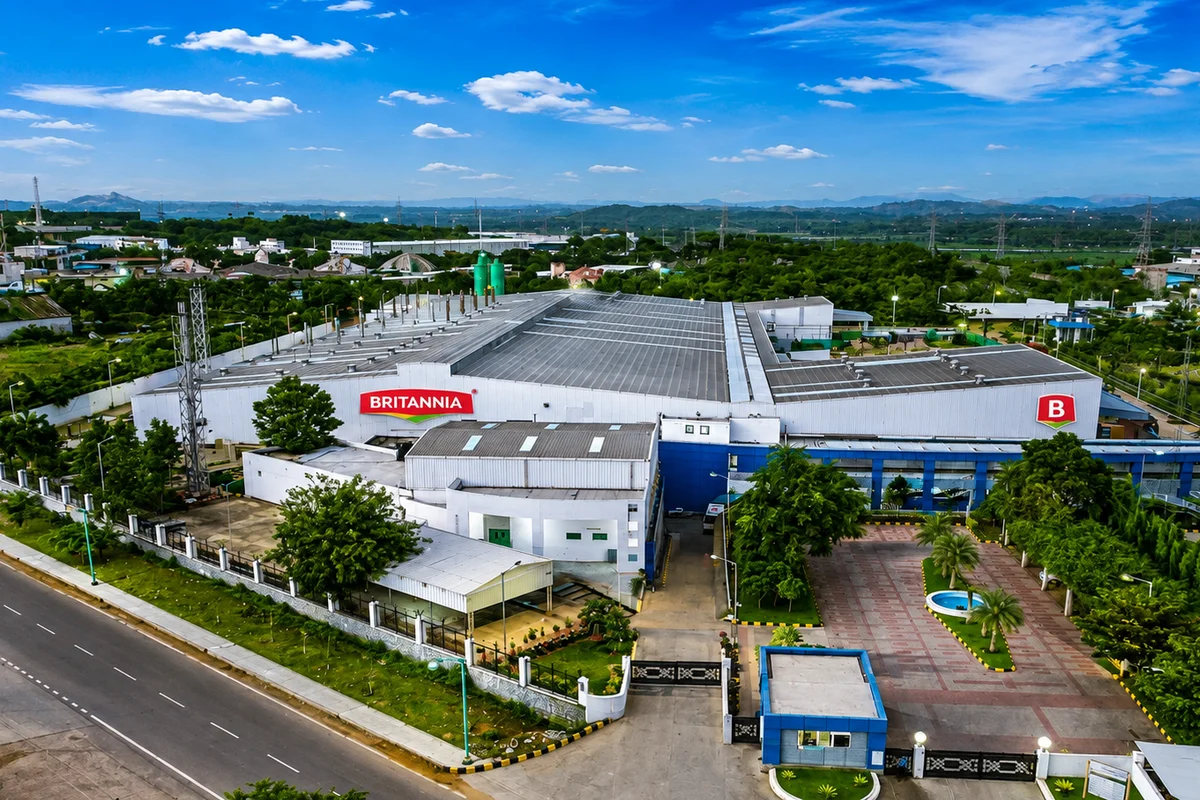
Britannia Industries shares fell around 3.3% on August 21, 2026, extending recent weakness in the FMCG counter. The stock declined to around ₹5,365.50 during the session, with selling pressure coming despite the company's relatively strong Q1 FY27 performance and recent recovery seen in the broader market.
The latest decline does not appear to be linked to a fresh company-specific negative announcement. Instead, the movement comes against a cautious backdrop for FMCG and consumer stocks, with investors weighing valuations, input-cost pressures, demand trends and the sustainability of earnings growth. The stock has also remained under pressure over the past several sessions, making the latest fall important for investors tracking the Britannia share price.
Loading chart...
Britannia Industries shares fell about 3.29% to ₹5,365.50 on August 21. Available market data indicates that there was no major new company-specific, sector-wide or macroeconomic catalyst identified during the session, suggesting that the decline may be driven more by market positioning, profit-taking and continued caution around FMCG valuations.
The fall also comes after the stock's recent rebound on August 20, when it gained 1.74% as the broader Indian market recovered. With the stock still below its recent highs, traders may be reassessing short-term positions while investors continue to evaluate whether earnings growth can justify its valuation.
| Particulars | Latest details |
|---|---|
| Stock | Britannia Industries |
| Current price | ₹5,365.50 |
| Today's change | -3.29% |
| 5-day return | -4.58% |
| 1-month return | -2.05% |
| 6-month return | -12.14% |
| 1-year return | -6.02% |
| 5-year return | +37.53% |
| 52-week range | ₹5,035–₹6,336 |
| Market capitalisation | Around ₹1.29 lakh crore |
The recent weakness in Britannia Industries shares comes despite a strong Q1 FY27 performance. The company reported consolidated revenue growth of around 8% to ₹5,000 crore, while net profit increased 14% year-on-year to ₹593 crore. Operating profit also grew faster than revenue, highlighting relatively strong execution during the quarter.
Investors had responded positively to the results earlier in August, with the stock gaining nearly 2% on August 7 and another 2% on August 10. However, the subsequent price action shows that strong quarterly numbers have not completely removed concerns around input costs, valuations and the broader consumption environment.
| Q1 FY27 metric | Performance |
|---|---|
| Revenue | Around ₹5,000 crore |
| Revenue growth | Around 8% YoY |
| Net profit | ₹593 crore |
| Net profit growth | 14% YoY |
| Operating profit growth | 12.7% |
| PAT margin | 11.9% |
The recent movement in Britannia stock needs to be viewed in the context of the broader FMCG environment. Consumer companies continue to face concerns around raw-material costs, crude oil prices, currency movements and the pace of consumption recovery. These factors can affect margins even when revenue growth remains healthy.
Valuation is another factor investors are watching. Britannia's market capitalisation is around ₹1.29 lakh crore, while the stock's trailing P/E is close to 50 based on the supplied market data. This means the market continues to assign a premium valuation to the company, increasing the importance of consistent earnings and margin delivery.
The Britannia share price has delivered mixed returns across different time periods. The stock is down 3.35% over one day, 4.58% over five days and 2.05% over one month. The six-month decline stands at 12.14%, while the one-year return is negative 6.02%.
Over a longer five-year period, however, the stock remains up 37.53%. This shows that the recent weakness is occurring after a longer period of wealth creation, although the stock is currently much closer to the lower end of its 52-week trading range than its yearly high.
| Period | Return |
|---|---|
| 1 Day | -3.35% |
| 5 Days | -4.58% |
| 1 Month | -2.05% |
| 6 Months | -12.14% |
| 1 Year | -6.02% |
| 5 Years | +37.53% |
The Q1 FY27 results remain one of the strongest fundamental factors supporting the Britannia Industries share price. Revenue increased around 8% year-on-year, while profit growth was stronger at 14%, suggesting that the company maintained reasonable operating leverage despite cost pressures.
The company also recorded strong general trade growth and continued momentum in e-commerce. Adjacency categories such as cakes, rusk and wafers delivered double-digit growth, providing additional avenues beyond its core biscuit business.
For Britannia Industries, input costs remain an important variable for future earnings. Packaged-food companies are sensitive to the prices of commodities, edible oils, energy, packaging materials and transportation. Higher crude prices can also indirectly increase logistics and packaging costs.
Recent market commentary has therefore focused on whether strong volume growth can offset potential cost inflation. If input costs rise faster than the company can pass them on through pricing or productivity improvements, margins could come under pressure.
The near-term Britannia share price outlook will depend on whether the stock can stabilise after its recent decline and regain buying interest. The 52-week range of ₹5,035 to ₹6,336 provides a useful reference for investors assessing the current price position, with the stock now considerably closer to its yearly low than its yearly high.
Investors may also watch upcoming earnings trends, volume growth, rural consumption, input costs and the company's ability to protect margins. A sustained improvement in FMCG sentiment could support the stock, while renewed cost inflation or weaker consumption could keep valuations under pressure.
The recent trading history shows considerable volatility. The stock gained 1.74% on August 20 following a broader market relief rally, while it had fallen on several earlier sessions amid weakness in FMCG stocks and concerns surrounding crude oil, the rupee and geopolitical developments.
The stock also gained strongly after its Q1 FY27 results on August 7, when investors focused on volume growth, revenue expansion and the demand outlook. However, the subsequent weakness indicates that the market is balancing these positive factors against valuation and margin concerns.
The latest Britannia Industries share price decline highlights the difference between strong company fundamentals and short-term stock-market performance. Q1 FY27 delivered healthy revenue and profit growth, but the stock continues to face pressure from broader FMCG sentiment, valuation concerns and uncertainty around input costs.
For investors, the key issue will be whether the company's earnings growth, volume momentum and brand strength can support its premium valuation. The stock's recent decline should therefore be assessed alongside its financial performance, future margin trajectory and broader market conditions rather than through a single day's price movement.
Britannia Industries is one of India's leading packaged-food companies and operates under the Wadia Group. Founded in 1892, the company has a broad portfolio spanning biscuits, breads, cakes, rusks and dairy products.
Its major brands include Good Day, Tiger, NutriChoice, Milk Bikis and Marie Gold. Biscuits remain the company's core business, while newer and adjacent categories such as cakes, rusk and wafers have become increasingly important contributors to growth. The company also exports its products to several international markets.
Britannia Industries shares fell around 3.3% on August 21, 2026. The available market information does not point to a major fresh company-specific catalyst, with the decline occurring amid continued caution around FMCG stocks, valuations and input-cost pressures.
Britannia Industries shares were trading around ₹5,365.50 during the August 21 session based on the supplied market data.
The stock's supplied 52-week range is ₹5,035 to ₹6,336. At around ₹5,365.50, the stock is relatively close to its 52-week low.
Britannia reported around 8% year-on-year revenue growth to ₹5,000 crore and a 14% increase in net profit to ₹593 crore in Q1 FY27.
Key risks include higher input costs, weaker consumption growth, elevated valuation, margin pressure and broader weakness in the FMCG sector.
Investors should monitor volume growth, rural consumption, commodity prices, margins, future earnings growth and whether the stock can recover from its recent weakness.
Based on the supplied data, Britannia Industries has delivered a 37.53% return over five years, despite being down over shorter periods.
Financial journalist specializing in market analysis, stock research, and investment trends. Dedicated to providing accurate, timely insights for informed decision-making.
Credentials: Experienced financial journalist with expertise in equity markets and economic analysis
The information provided in this article is for educational and informational purposes only and should not be construed as financial, investment, or legal advice. welomoney does not provide personalized investment recommendations.
For detailed terms and conditions, please read our Disclaimer and Terms of Service.
NSE shares fell after listing at Rs 1,800, dropping to 12th by market value. Experts identify Rs 1,760 support and Rs 1,795 resistance.

Goldman Sachs retains its Buy rating on IndiGo with a Rs 5,900 target, citing international growth, cost leadership and better FY28 profitability.

Kirloskar Oil Engines posted 16% Q1 FY27 revenue growth, while margins missed estimates. Motilal Oswal cut earnings estimates and raised its target...

Landmark Cars shares rose 12% to Rs 535.80 after adding BYD and M&M outlets, taking its network to 143 locations, with EV sales at 30% of Q1FY27 new...

Tata Motors’ subsidiary acquired 26,000 shares in Mateshwari E-Smart Mobility for ₹2.6 lakh.