Loading market data...
Tue, 29 Sept 2026
10:29:55 am
Tue, 29 Sept 2026
10:29:55 am

Rudransh Sangwan
Published at: September 29, 2026, 6:54 AM
Synopsis
PB Fintech faces revenue pressure from proposed IRDAI commission caps. HSBC, Motilal Oswal and Bernstein have set different target prices.
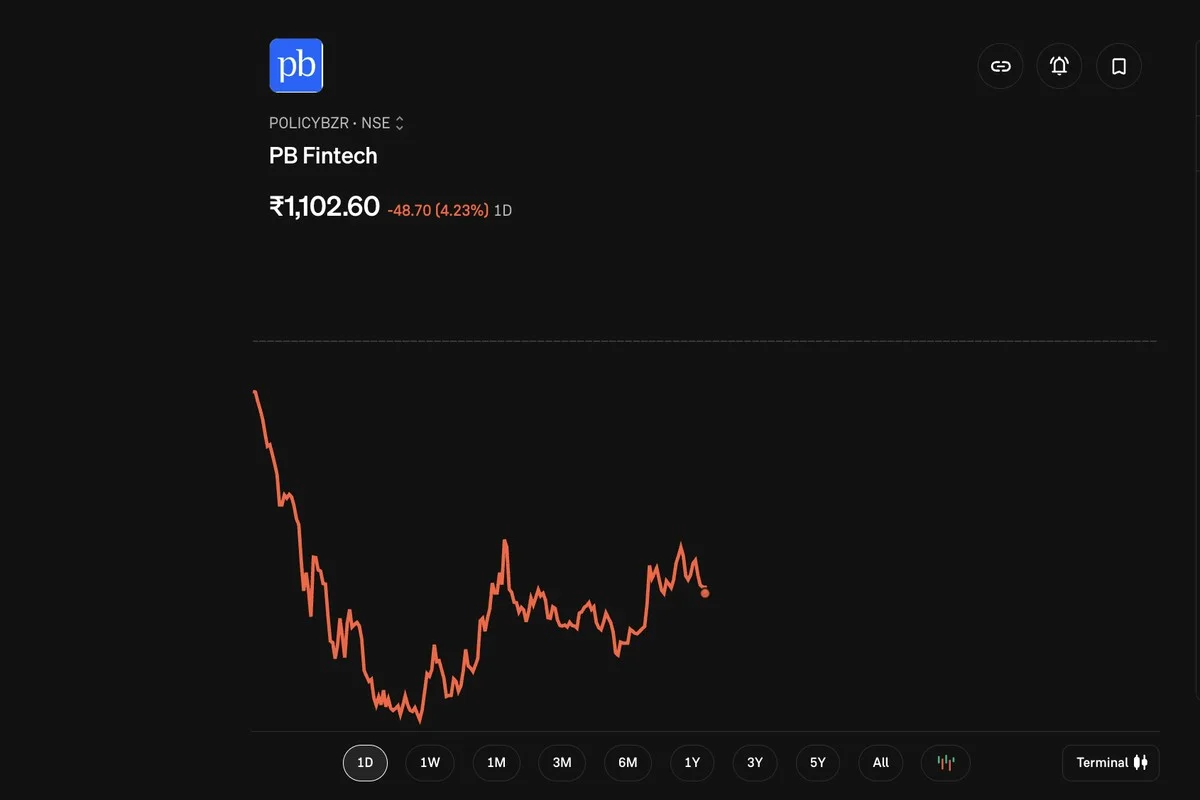
PB Fintech shares fell more than 6% on Tuesday, extending losses for a fourth straight session as concerns over proposed changes to insurance distribution continued to pressure the Policybazaar parent. The stock fell to around Rs 1,081 in morning trade, making it the top midcap loser.
PB Fintech has now lost about 43% in four sessions since the Insurance Regulatory and Development Authority of India, or IRDAI, released proposals aimed at changing the economics of insurance distribution. The company has warned that the proposals, in their current form, could affect its core revenue.
The fall came alongside a broader decline in Indian equities. At 10:15 am, the Sensex was down 637 points, or 0.88%, at 72,134, while the Nifty 50 was down 197 points at 22,583. Higher crude oil prices and rising US Treasury yields were cited as factors weighing on market sentiment.
Loading chart...
The latest decline extends a sharp fall in PB Fintech shares since the IRDAI consultation paper was released. The stock is now down around 40% in 2026, compared with a 13.3% fall in the Nifty 50 over the same period.
PB Fintech's market capitalisation has also fallen below Rs 50,100 crore. The sustained selling reflects concerns about how changes to insurance distribution economics could affect the company's revenue and profitability.
The stock had already come under pressure after HSBC lowered its view on PB Fintech and reduced its target price. WeloMoney had earlier covered the PB Fintech stock fall, including the brokerage changes that added to pressure on the shares.
| Particulars | Details |
|---|---|
| Latest stock decline | More than 6% |
| Stock price in morning trade | Around Rs 1,081 |
| Fall over four sessions | About 43% |
| Fall in 2026 | About 40% |
| PB Fintech market capitalisation | Below Rs 50,100 crore |
| Nifty 50 fall in 2026 | 13.3% |
The main concern for PB Fintech is the proposed change in insurance distribution economics. IRDAI's consultation paper includes proposed commission caps across health, motor and life insurance.
Policybazaar operates an online insurance distribution business, so changes to commissions and distribution economics could affect the amount of revenue generated from insurance policies.
PB Fintech management has indicated that the proposals, if implemented in their current form, could result in roughly a 30% hit to core revenue before offsets. The company said the pressure would be concentrated in general insurance.
The company has also identified several cost measures that could help reduce the impact. These include slower hiring, lower marketing spending and other cost adjustments. The extent to which these measures can offset lower revenue will depend on the final regulatory framework.
Brokerages have taken different views on the possible financial impact of the proposed changes. HSBC downgraded PB Fintech to "Hold" and cut its target price to Rs 1,150 from Rs 2,100.
Motilal Oswal retained its "Neutral" rating and a target price of Rs 1,150. Bernstein took a different view and retained its "Outperform" rating with a target price of Rs 2,310.
Bernstein estimated that the proposed framework could reduce insurance take rates by around 40% and potentially lower PB Fintech's FY28 profit by 34%.
These are brokerage estimates based on the proposed framework. They do not represent the final financial outcome for PB Fintech because the regulatory proposals are still under consultation.
| Brokerage | Rating | Target price |
|---|---|---|
| HSBC | Hold | Rs 1,150 |
| Motilal Oswal | Neutral | Rs 1,150 |
| Bernstein | Outperform | Rs 2,310 |
The potential impact is tied to the economics of selling insurance through online distribution channels. If commission limits reduce the revenue that distributors can earn from policies, PB Fintech could see pressure on its insurance related revenue.
Management's estimate of a roughly 30% reduction in core revenue before offsets gives an indication of the possible scale of the issue under the current proposal. General insurance is expected to face the most pressure, according to the company's assessment.
The company has pointed to lower hiring and marketing expenditure as possible ways to reduce the effect on profitability. This means the eventual earnings impact could depend on both the final commission rules and the cost response from PB Fintech.
The regulatory discussion also matters for the wider insurance technology sector. Another recent WeloMoney article covered Turtlemint's fintech IPO, highlighting the continuing investor interest in digital insurance and financial services businesses.
PB Fintech's fall has taken place during a broader weak session for Indian equities, but the stock's four session decline has been much sharper than the movement in the benchmark indices cited in the source.
The immediate issue for PB Fintech is the proposed insurance distribution framework. The stock's decline of about 43% over four sessions compares with a 13.3% fall in the Nifty 50 in 2026, showing that the pressure on PB Fintech has been closely linked to company specific concerns around the proposed insurance rules.
The proposals are not yet final. That distinction matters because the eventual commission structure could differ from the framework currently under consultation.
The regulatory process is the most immediate factor to follow. The consultation window remains open until October 25, after which the final framework will determine the actual rules governing insurance distribution economics.
Investors will also watch how PB Fintech responds if the proposals are implemented. Areas that could receive attention include:
The next stages of the regulatory process will therefore be important for assessing the eventual effect on PB Fintech's revenue and profitability.
PB Fintech is the parent company of Policybazaar, an online insurance distribution business. The company is exposed to changes in insurance distribution economics because its business depends on insurance transactions across areas including health, motor and life insurance.
The current pressure on the stock is linked to concerns about the proposed IRDAI framework and its possible effect on the company's revenue and earnings.
PB Fintech shares are falling because investors are concerned about the possible impact of proposed IRDAI changes on insurance distribution economics. The stock fell more than 6% on Tuesday and has lost about 43% over four sessions.
PB Fintech stock is down around 40% in 2026, compared with a 13.3% decline in the Nifty 50 over the same period. Its market capitalisation has fallen below Rs 50,100 crore.
IRDAI proposed changes to insurance distribution economics, including commission caps across health, motor and life insurance. The proposals are currently under consultation.
PB Fintech management has indicated that the proposals in their current form could result in roughly a 30% hit to core revenue before offsets. The pressure is expected to be concentrated in general insurance.
HSBC has a "Hold" rating with a Rs 1,150 target price, while Motilal Oswal has a "Neutral" rating with a Rs 1,150 target. Bernstein has retained an "Outperform" rating with a Rs 2,310 target price.
The IRDAI consultation window is open until October 25. The final framework will determine the eventual rules and their impact on insurance distribution economics.
Financial journalist specializing in market analysis, stock research, and investment trends. Dedicated to providing accurate, timely insights for informed decision-making.
Credentials: Experienced financial journalist with expertise in equity markets and economic analysis
The information provided in this article is for educational and informational purposes only and should not be construed as financial, investment, or legal advice. welomoney does not provide personalized investment recommendations.
For detailed terms and conditions, please read our Disclaimer and Terms of Service.
NSE shares fell after listing at Rs 1,800, dropping to 12th by market value. Experts identify Rs 1,760 support and Rs 1,795 resistance.
Goldman Sachs retains its Buy rating on IndiGo with a Rs 5,900 target, citing international growth, cost leadership and better FY28 profitability.
Kirloskar Oil Engines posted 16% Q1 FY27 revenue growth, while margins missed estimates. Motilal Oswal cut earnings estimates and raised its target...

Landmark Cars shares rose 12% to Rs 535.80 after adding BYD and M&M outlets, taking its network to 143 locations, with EV sales at 30% of Q1FY27 new...

Tata Motors’ subsidiary acquired 26,000 shares in Mateshwari E-Smart Mobility for ₹2.6 lakh.