Loading market data...
Thu, 17 Sept 2026
01:42:26 pm
Thu, 17 Sept 2026
01:42:26 pm

Rudransh Sangwan
Published at: May 4, 2026, 8:08 AM
Synopsis
Ather Energy Q4 FY26 results show strong growth with revenue rising 74% YoY to ₹1,175 crore and losses narrowing to ₹100 crore. Explore key metrics, margin improvement, EV growth trends, and future outlook.
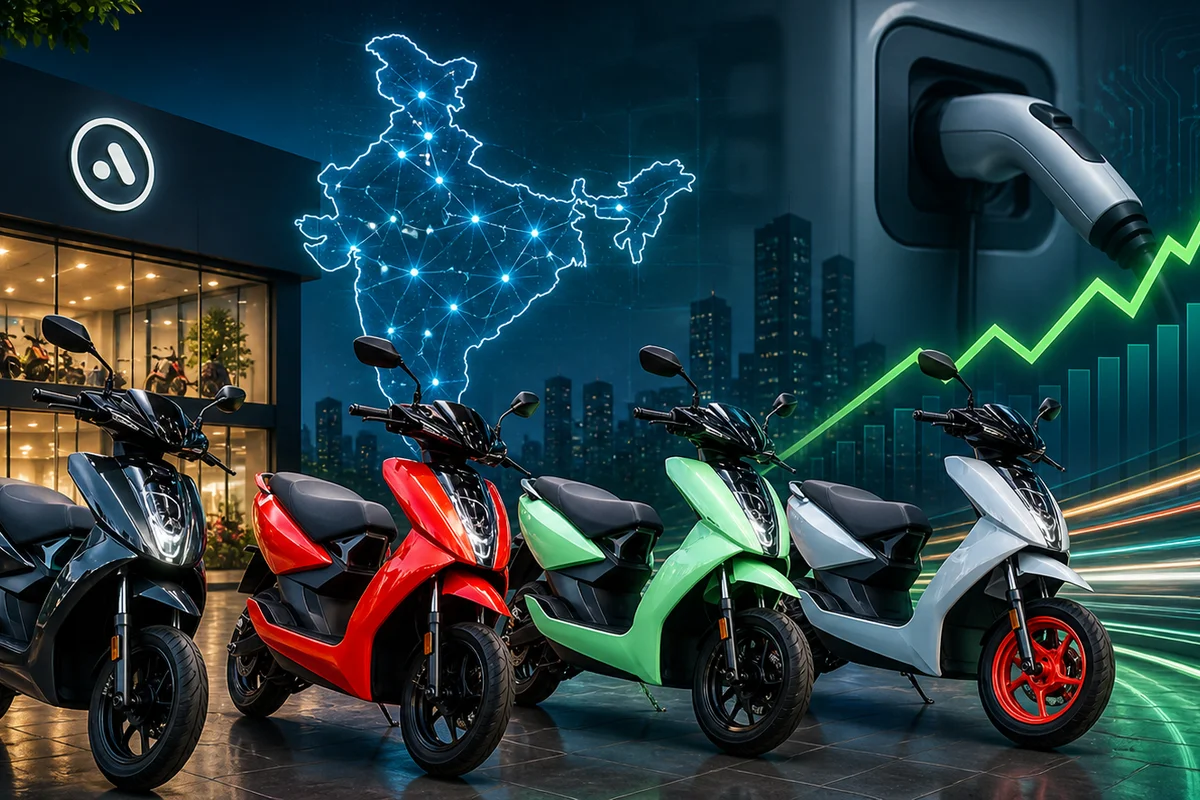
Electric vehicle player Ather Energy delivered a strong operational performance in Q4 FY26, reporting a sharp narrowing of losses alongside robust revenue growth. The company posted a net loss of ₹100 crore, down 57 percent year-on-year, while revenue jumped 74 percent to ₹1,175 crore, highlighting improving scale and better unit economics in India’s fast-growing EV market.
The results signal a key transition phase for Ather, where growth is no longer coming at the cost of widening losses. Instead, the company is moving toward operating efficiency, supported by rising volumes and deeper ecosystem monetisation.
Ather’s Q4 numbers reflect strong demand momentum and better cost control, even as total expenses increased due to expansion.
| Metric | Q4 FY26 | Q4 FY25 | Change |
|---|---|---|---|
| Revenue | ₹1,175 crore | ₹676 crore | +74% |
| Net Loss | ₹100 crore | ₹234 crore | -57% |
| EBITDA Loss | ₹70 crore | ₹173 crore | -60% |
| Expenses | ₹1,314 crore | ₹922 crore | +42.5% |
| Deliveries | 83,418 units | ~47,400 units | +76% |
Data suggests strong revenue growth alongside narrowing losses This leads to improved operating leverage Which results in a clearer path toward profitability
Ather delivered 83,418 electric scooters in Q4, marking a 76 percent year-on-year increase. This growth was supported by rapid expansion of its retail network, which reached 700 experience centres with 100 new additions during the quarter.
Higher volumes are critical for EV companies because they directly improve
This scale effect is now visible in Ather’s improving margins.
Ather’s EBITDA margin improved significantly to around negative 2.5 percent, reflecting a major improvement of over 2,000 basis points year-on-year.
This improvement was driven by
Although still in negative territory, this trend indicates that the company is approaching breakeven levels faster than expected.
A key shift in Ather’s business model is the growing contribution from non-vehicle revenue streams, including
These segments contributed around 13 percent of total income in FY26, signaling a move toward a more diversified and recurring revenue model.
This is important because
One under-discussed factor behind Ather’s growth is its aggressive retail and service network expansion.
By increasing its physical presence, the company is
This expansion directly translates into higher sales conversion rates, especially in Tier 2 and Tier 3 cities where EV adoption is accelerating.
Many investors focus only on net losses when evaluating EV companies.
This approach misses the bigger picture.
In high-growth sectors like electric mobility, early-stage losses are expected due to
The more important metric is whether losses are narrowing while revenue grows, which is exactly what Ather is demonstrating.
The common narrative is that EV companies will take many years to become profitable.
However, Ather’s improving margins suggest that
If current trends continue, the company could move toward breakeven earlier than market expectations.
| Metric | FY26 | Growth |
|---|---|---|
| Total Income | ₹3,823 crore | +66% |
| Non-Vehicle Revenue Share | 13% | Rising |
| Volume Growth | Strong | Expanding |
The strong full-year growth reflects sustained demand and increasing adoption of electric two-wheelers in India.
| Driver | Impact |
|---|---|
| EV adoption growth | Higher volumes |
| Charging infrastructure | Better usability |
| Cost reduction | Margin improvement |
| Software monetisation | Recurring revenue |
India’s push toward electrification, along with government incentives and rising fuel costs, continues to support long-term demand for EVs.
Short-term stock movement may remain volatile, but long-term value will depend on execution and scale.
Ather Energy’s Q4 FY26 results highlight a crucial shift from aggressive growth to disciplined scaling. The sharp reduction in losses alongside strong revenue growth indicates that the company is moving closer to a sustainable business model. While challenges remain, especially in a competitive EV landscape, the improving unit economics and ecosystem expansion position Ather as a serious contender in India’s electric mobility future.
Losses reduced due to strong volume growth, improved cost efficiencies, and better operating leverage.
The company is not yet profitable but is moving toward breakeven as margins improve and losses narrow significantly.
Revenue growth is driven by higher EV sales, expansion of retail network, and increasing contribution from software and services.
Financial journalist specializing in market analysis, stock research, and investment trends. Dedicated to providing accurate, timely insights for informed decision-making.
Credentials: Experienced financial journalist with expertise in equity markets and economic analysis
The information provided in this article is for educational and informational purposes only and should not be construed as financial, investment, or legal advice. welomoney does not provide personalized investment recommendations.
For detailed terms and conditions, please read our Disclaimer and Terms of Service.

ONGC shares fell as crude oil prices eased and energy stocks faced pressure. Check the key factors behind the decline, OPaL concerns and what...
Check the latest Tata truck prices, commercial vehicle price hike, ex-showroom rates and indicative prices for popular Tata truck models after the...

Tata Motors PV shares gained after reports of Chandrasekaran's fresh term at Tata Sons. See the leadership update, price hike and key stock factors.
DLF shares gained as realty stocks rallied, while investors tracked luxury housing demand, sales bookings and the company's premium projects.
CG Power shares gained as investors tracked its power equipment expansion, transformer capacity and growing semiconductor business through Axiro.