Loading market data...
Thu, 17 Sept 2026
03:39:52 pm
Thu, 17 Sept 2026
03:39:52 pm

Rudransh Sangwan
Published at: May 3, 2026, 3:29 AM
Synopsis
DMart delivered steady Q4 FY26 results with profit rising 19% to ₹656 crore and revenue growing 19%, supported by strong store expansion and improved same-store sales. While margins showed slight improvement, future growth will depend on cost control and sustained consumer demand.
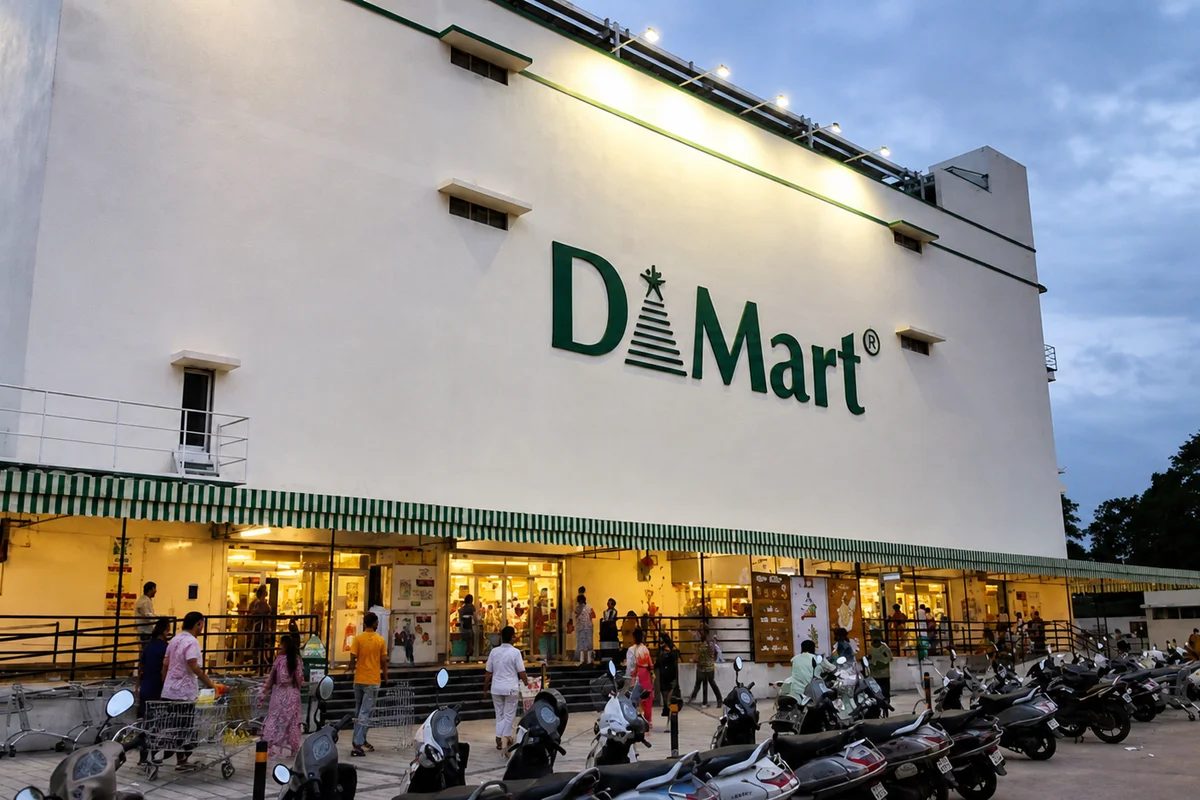
India’s retail sector continues to show resilience despite macro uncertainty, and Avenue Supermarts has once again reinforced its position as one of the most consistent performers in the space. The company’s Q4 FY26 results reflect steady demand, disciplined cost control, and continued expansion, but beneath the surface, there are subtle signals about margin sustainability and future growth trajectory that investors need to understand.
DMart reported a consolidated net profit of ₹656.6 crore in Q4 FY26, marking a 19 percent year-on-year increase. Revenue from operations also grew at the same pace to ₹17,684 crore.
At an operating level, EBITDA rose 26.7 percent to ₹1,210.5 crore, while margins expanded to 6.85 percent from 6.42 percent.
| Metric | Q4 FY26 | YoY Growth |
|---|---|---|
| Revenue | ₹17,684 Cr | +19% |
| Net Profit | ₹656 Cr | +19% |
| EBITDA | ₹1,210 Cr | +26.7% |
| EBITDA Margin | 6.85% | Up from 6.42% |
| PAT Margin | 3.7% | Stable |
| EPS | ₹10.09 | Up from ₹8.47 |
Data suggests revenue and profit are growing at a steady pace This leads to stable margins Which results in predictable earnings visibility
Unlike many retail players that struggle with cost pressures, DMart continues to maintain tight operational efficiency.
One of the biggest drivers of DMart’s growth remains its aggressive store expansion strategy.
The company added 58 stores in Q4 alone, crossing the milestone of 500 stores nationwide.
| Parameter | Value |
|---|---|
| Total Stores | 500+ |
| Stores Added (Q4) | 58 |
| Stores Added (FY26) | 85 |
This expansion directly contributes to revenue growth by increasing geographic reach and improving customer access.
However, rapid expansion also brings cost challenges, especially in the initial phase of new store operations.
Mature stores, defined as those operational for over two years, grew by 10.8 percent in Q4 FY26 compared to 8.1 percent in the same quarter last year.
This is an important signal because same-store growth reflects underlying demand rather than expansion-driven growth.
| Metric | Q4 FY26 | Q4 FY25 |
|---|---|---|
| Mature Store Growth | 10.8% | 8.1% |
The improvement indicates stronger consumer demand and better store productivity.
One of the lesser-discussed aspects of the quarter is the temporary spike in consumer demand during March 2026.
This was driven by geopolitical tensions, which led to precautionary buying by consumers.
This leads to
This means part of the revenue growth may not be entirely organic and could moderate in coming quarters.
Many investors assume DMart’s growth is purely volume-driven.
In reality, its success comes from
Another misconception is that rapid store expansion automatically leads to higher margins.
New stores typically operate at lower margins initially, which can dilute overall profitability.
While margins improved in Q4, sustaining this trend could be challenging.
Reasons include
This suggests that future growth may come more from scale rather than margin expansion.
For FY26, DMart reported strong overall performance.
| Metric | FY26 | YoY Growth |
|---|---|---|
| Revenue | ₹66,968 Cr | +15.9% |
| EBITDA | ₹5,255 Cr | +15.7% |
| Net Profit | ₹3,224 Cr | +10.1% |
| EPS | ₹49.54 | Up from ₹44.98 |
The slightly lower profit growth compared to revenue indicates margin pressures at the annual level.
Several factors will influence DMart’s performance going forward.
| Factor | Impact |
|---|---|
| Store expansion | Revenue growth |
| Consumption demand | Same-store growth |
| Cost control | Margin stability |
| Supply chain efficiency | Profitability |
If consumption demand remains strong and expansion continues efficiently, DMart is likely to maintain its growth trajectory.
DMart remains a high-quality retail play, but valuation discipline is critical.
DMart’s Q4 FY26 results reinforce its position as one of India’s most consistent retail growth stories, combining steady revenue expansion with disciplined execution. However, the subtle signals around temporary demand spikes and potential margin pressures suggest that future performance will depend more on operational efficiency than pure expansion. Investors who understand this balance between growth and sustainability will be better positioned to evaluate the stock going forward.
DMart reported a net profit of ₹656 crore in Q4 FY26, reflecting a 19 percent year-on-year increase.
Revenue growth was driven by store expansion, strong same-store sales, and temporary demand spikes due to geopolitical factors.
Yes, but future growth will depend on maintaining cost efficiency and managing expansion-related expenses rather than relying solely on demand spikes.
Financial journalist specializing in market analysis, stock research, and investment trends. Dedicated to providing accurate, timely insights for informed decision-making.
Credentials: Experienced financial journalist with expertise in equity markets and economic analysis
The information provided in this article is for educational and informational purposes only and should not be construed as financial, investment, or legal advice. welomoney does not provide personalized investment recommendations.
For detailed terms and conditions, please read our Disclaimer and Terms of Service.
ONGC shares fell as crude oil prices eased and energy stocks faced pressure. Check the key factors behind the decline, OPaL concerns and what...
Check the latest Tata truck prices, commercial vehicle price hike, ex-showroom rates and indicative prices for popular Tata truck models after the...

Tata Motors PV shares gained after reports of Chandrasekaran's fresh term at Tata Sons. See the leadership update, price hike and key stock factors.
DLF shares gained as realty stocks rallied, while investors tracked luxury housing demand, sales bookings and the company's premium projects.
CG Power shares gained as investors tracked its power equipment expansion, transformer capacity and growing semiconductor business through Axiro.