Loading market data...
Mon, 05 Oct 2026
12:20:07 pm
Mon, 05 Oct 2026
12:20:07 pm
Synopsis
Adani Group plans a ₹1.1 lakh crore aluminium project with IHC in Odisha. Learn how the investment could challenge Hindalco and Vedanta while benefiting from India's booming aluminium demand.
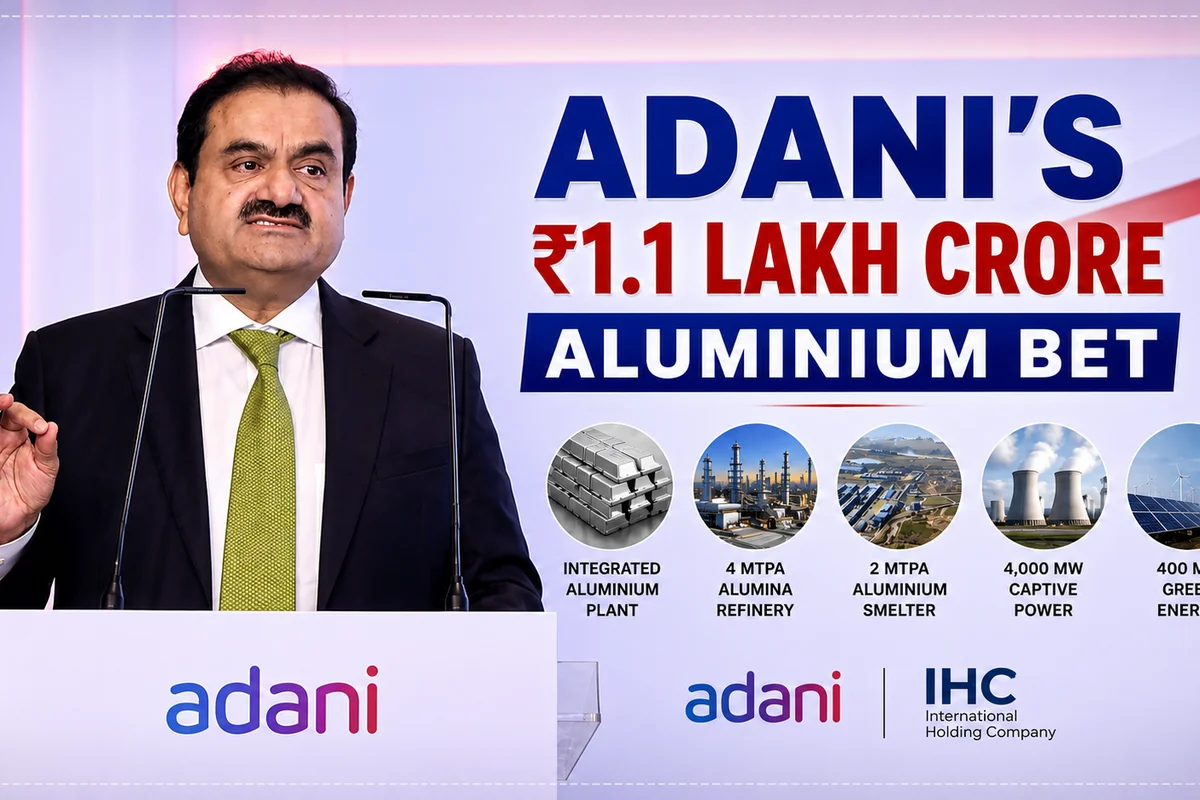
The Adani Group has unveiled one of the largest investments in India's metals sector, announcing a $11.5 billion (around ₹1.1 lakh crore) joint venture with Abu Dhabi-based International Holding Company (IHC) to establish a fully integrated aluminium business in Odisha. The ambitious project marks Adani's formal entry into a sector that has long been dominated by Hindalco Industries and Vedanta Aluminium.
Rather than directly competing for existing market share, Adani is positioning itself to benefit from India's rapidly expanding aluminium demand, driven by manufacturing, renewable energy, power transmission, electric vehicles, infrastructure development, and defence production.
With the country expected to witness a sharp increase in aluminium consumption over the next two decades, the investment could significantly reshape India's metals landscape while strengthening the country's ambitions of becoming a global aluminium powerhouse.
The proposed aluminium complex will be developed through a 50:50 joint venture between Adani Group and IHC and is expected to become one of India's largest integrated aluminium manufacturing facilities.
| Particulars | Details |
|---|---|
| Total Investment | ₹1.1 Lakh Crore ($11.5 Billion) |
| Joint Venture | Adani Group & IHC (50:50) |
| Project Location | Odisha |
| Alumina Refinery Capacity | 4 Million TPA |
| Aluminium Smelter Capacity | 2 Million TPA |
| Captive Power Plant | 4,000 MW |
| Green Energy Capacity | 400 MW |
| Downstream Manufacturing | 1 Million TPA |
| Estimated Completion | Around 5 Years |
The Adani Group continues to strengthen its presence across infrastructure, energy, mining, logistics, and manufacturing, with aluminium becoming another strategic pillar of its industrial expansion.
| Metric | Details |
|---|---|
| Investment Size | ₹1.1 Lakh Crore |
| Industry | Aluminium & Metals |
| Business Model | Fully Integrated Value Chain |
| Key Advantage | Captive Power + Logistics + Mining Access |
| Strategic Partner | International Holding Company (IHC) |
India's aluminium demand is expected to accelerate over the coming decades as several high-growth industries increasingly rely on lightweight and recyclable metals.
Government estimates project domestic aluminium consumption to increase from approximately 5.5 million tonnes in FY25 to 8.5 million tonnes by FY30, while long-term demand could reach nearly 28 million tonnes by FY47.
India's per capita aluminium consumption currently stands at just 3.4–3.9 kg, significantly below the global average of 8–12 kg, indicating substantial room for long-term growth.
Unlike mature markets where aluminium demand has stabilised, India's industrialisation, urbanisation and infrastructure expansion are expected to create sustained demand for the metal.
| Financial Year | Estimated Demand |
|---|---|
| FY25 | 5.5 Million Tonnes |
| FY30 | 8.5 Million Tonnes |
| FY40 | 18 Million Tonnes |
| FY47 | 28 Million Tonnes |
The scale of Adani's proposed investment is unprecedented for India's aluminium sector.
India currently produces nearly 4.2 million tonnes of aluminium annually, meaning Adani's proposed 2 million tonne smelter alone could increase the country's production capacity by almost 50% once fully operational.
The integrated project will include:
This would place Adani among India's largest aluminium producers alongside Hindalco and Vedanta.
One of the biggest advantages for the Adani Group lies in its integrated energy ecosystem.
Aluminium production is among the world's most electricity-intensive industrial processes, making power costs a key determinant of profitability.
By combining captive thermal generation with renewable energy, Adani aims to become one of the lowest-cost aluminium producers in India.
The project also complements the group's existing businesses across:
This integration could provide significant long-term cost advantages over many global competitors.
Odisha remains India's largest bauxite-rich state, accounting for more than half of the country's reserves.
The proposed refinery will be located near major bauxite deposits in Rayagada, while the smelter is planned for Sundargarh.
The project is also expected to benefit from Adani's logistics ecosystem, particularly Dhamra Port, which will play a crucial role in transporting raw materials and finished products.
The integrated location reduces transportation costs while improving supply chain efficiency.
For decades, India's aluminium industry has largely been controlled by Hindalco Industries and Vedanta Aluminium, together accounting for nearly 90% of domestic aluminium production.
Adani's entry introduces a strong third player into the sector.
However, the investment is unlikely to create immediate competitive pressure because commercial production is expected only after approximately five years.
By that time, domestic aluminium demand is projected to be significantly higher, allowing multiple producers to expand without aggressively competing for existing market share.
Instead of disrupting the market immediately, the project is expected to expand India's overall production capacity while strengthening downstream manufacturing.
The aluminium venture aligns closely with Adani Group's wider industrial expansion strategy.
Following its entry into cement through Ambuja Cements and ACC, followed by copper manufacturing via Kutch Copper, aluminium becomes another strategic commodity supporting multiple businesses within the conglomerate.
The metal is widely used in:
As Adani continues expanding across infrastructure and energy, internal demand for aluminium products is also expected to rise.
The ₹1.1 lakh crore aluminium project represents one of the most significant investments in India's metals industry in recent years. Rather than competing directly with Hindalco and Vedanta, Adani appears to be preparing for the next phase of India's industrial growth, where aluminium demand is expected to expand rapidly across infrastructure, manufacturing, renewable energy, and electric mobility.
If executed successfully, the project could substantially increase India's aluminium production capacity, strengthen domestic supply chains, reduce import dependence, and position the country as a larger player in the global aluminium market.
Investors should closely monitor regulatory approvals, project execution timelines, mine allocations, construction progress, downstream manufacturing plans, aluminium demand growth, and future capacity expansion by existing players such as Hindalco and Vedanta.
The pace of India's infrastructure spending, renewable energy investments, EV adoption, and manufacturing growth will also remain key long-term demand drivers for the aluminium industry.
| Highlights | Details |
|---|---|
| Investment Size | ₹1.1 Lakh Crore |
| Joint Venture | Adani Group & IHC |
| Project Location | Odisha |
| Alumina Capacity | 4 MTPA |
| Smelter Capacity | 2 MTPA |
| Captive Power | 4,000 MW |
| Green Energy | 400 MW |
| Downstream Capacity | 1 MTPA |
| India's FY30 Aluminium Demand | 8.5 Million Tonnes |
| Estimated Project Completion | Around 5 Years |
The Adani Group is targeting India's rapidly growing aluminium demand driven by manufacturing, renewable energy, infrastructure, and electric vehicles through a ₹1.1 lakh crore integrated aluminium project.
The project involves an investment of ₹1.1 lakh crore ($11.5 billion) through a 50:50 joint venture with Abu Dhabi-based International Holding Company (IHC).
While Adani will become a major producer, the company is primarily targeting future demand growth rather than taking market share from existing players.
The integrated aluminium complex will be developed in Odisha, with the refinery planned in Rayagada and the smelter in Sundargarh.
Demand is expected to rise due to expanding infrastructure, renewable energy, electric vehicles, power transmission, manufacturing, construction, and increasing domestic industrialisation.

Financial journalist specializing in market analysis, stock research, and investment trends. Dedicated to providing accurate, timely insights for informed decision-making.
Credentials: Experienced financial journalist with expertise in equity markets and economic analysis
The information provided in this article is for educational and informational purposes only and should not be construed as financial, investment, or legal advice. welomoney does not provide personalized investment recommendations.
For detailed terms and conditions, please read our Disclaimer and Terms of Service.
NSE shares fell after listing at Rs 1,800, dropping to 12th by market value. Experts identify Rs 1,760 support and Rs 1,795 resistance.
Goldman Sachs retains its Buy rating on IndiGo with a Rs 5,900 target, citing international growth, cost leadership and better FY28 profitability.
Kirloskar Oil Engines posted 16% Q1 FY27 revenue growth, while margins missed estimates. Motilal Oswal cut earnings estimates and raised its target...
Landmark Cars shares rose 12% to Rs 535.80 after adding BYD and M&M outlets, taking its network to 143 locations, with EV sales at 30% of Q1FY27 new...

Tata Motors’ subsidiary acquired 26,000 shares in Mateshwari E-Smart Mobility for ₹2.6 lakh.