Loading market data...
Fri, 25 Sept 2026
11:44:26 pm
Fri, 25 Sept 2026
11:44:26 pm

Rudransh Sangwan
Published at: September 25, 2026, 2:44 PM
Synopsis
Swiggy Instamart is testing Nectr in Bengaluru, with higher repurchase and retention in early trials. See its pricing and private label strategy.
Swiggy Instamart is testing Nectr, a fresh produce private label, in select Bengaluru pin codes as it looks to improve consistency in fruits and vegetables and give customers another reason to stay on the platform. The brand covers everyday vegetables such as onions and brinjals as well as imported produce such as blueberries and avocados.
The early pilot across five Bengaluru dark stores has shown a 12 percentage point increase in fruit and vegetable repurchase rates among Nectr buyers and a 7 percentage point rise in platform retention compared with regular fruit and vegetable buyers. Swiggy has said Nectr is focused on quality, consistency and everyday pricing, rather than positioning the brand as premium.
The move comes as quick commerce companies compete for the same customers and look for ways to improve both customer retention and order economics. For Instamart, the Nectr experiment also gives it greater control over sourcing, grading, packaging and inventory.
Loading chart...
Nectr is currently available in selected Bengaluru pin codes. The range includes common vegetables alongside products such as blueberries and avocados. Instamart describes the produce as "farm fresh selections" on its app.
Swiggy's Capital Markets Day presentation highlighted better produce quality, more consistent sizing and appearance, along with sourcing practices aimed at improving quality. The company is taking a measured approach instead of expanding Nectr across cities immediately. A former Instamart executive said the plan is to first see whether the model produces clear results in Bengaluru before expanding elsewhere.
That approach reflects the difficulty of selling fresh produce online. A customer buying vegetables from a local market can inspect the product before making a purchase. An online customer has to rely on the platform's selection and handling process.
Pratik Gupta, co founder and chief executive officer of fresh produce and clean label foods brand Pluckk, said quality checks include factors such as size, colour, shape and appearance. These checks determine which produce enters a particular pack and what eventually reaches the customer.
Nectr is also testing how much customers are willing to pay for greater consistency. The pricing shown on 21 September placed the brand above Instamart's unbranded produce but below Pluckk in the examples available in the source.
| Product | Nectr price | Instamart regular price | Pluckk price |
|---|---|---|---|
| Potatoes | Rs 34 per kg | Rs 26 per kg | Rs 63 per kg |
| Okra | Rs 15 for 200g | Rs 14 for 250g | Not stated |
The pricing matters because everyday vegetables such as potatoes, onions and tomatoes have familiar price points. Customers can compare prices across platforms and local markets. Niche fruits such as blueberries have fewer obvious price references, giving sellers more room to set prices, according to Rahul H. Saxena, founder of grocery startup Satvacart.
Aakash Agrawal of Anand Rathi Investment Banking said the economics of a private label also depend on sourcing, packaging, inventory, wastage and the cost of building the brand. Better packaging can communicate quality, but it cannot replace the quality of the produce itself.
The same issue applies to freshness. Produce such as cauliflower and spinach has a short shelf life. If Instamart owns more inventory, it also takes on more responsibility for demand forecasting and unsold stock.
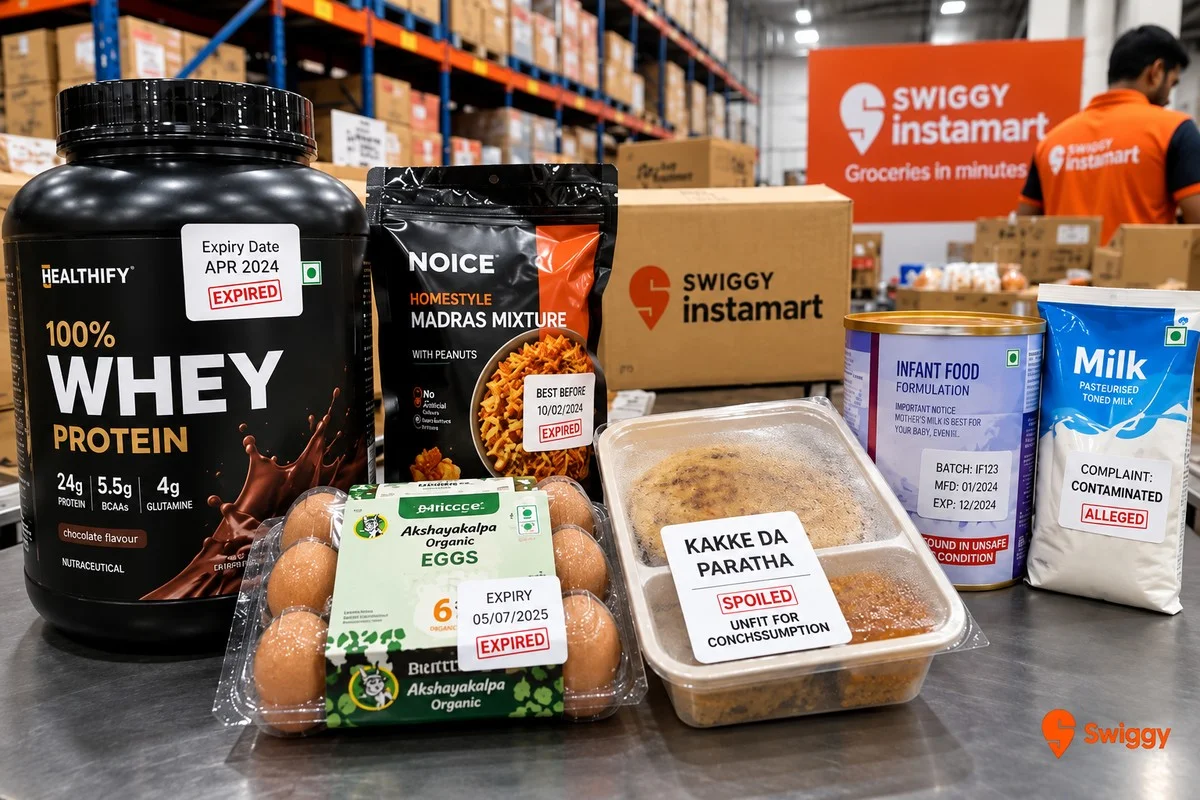
Nectr follows Noice, another private brand launched by Instamart as part of Swiggy's "Switch to Better" proposition. Swiggy said customers who bought Switch products showed 30% higher retention than benchmark cohorts.
Market data cited in the source showed that Noice had its strongest presence in paneer, where it accounted for 13% of Instamart's category in July, compared with 18% in January. Its share was 3.1% in baked goods and 0.33% in snacking.
Rivals have also built private labels across grocery categories. Blinkit's The Whole Farm had a presence across dry fruits, nuts and seeds, dals and pulses, salt and spices, rice, atta, flours and sooji in July. Zepto's Daily Good also had a sizable presence in categories including dry fruits, nuts and seeds and rice.
The difference is that Instamart is using Nectr to enter fresh produce, where quality and consistency can be harder to maintain than in packaged grocery. That gives the brand a different operating challenge.
Swiggy Instamart already operates more than 1,200 dark stores and serves more than 14 million monthly transacting users across more than 130 cities, according to its 2026 Capital Markets Day presentation. That gives it a large pool of purchase data that can be used to understand demand and repeat buying.
The same data advantage is available to competing platforms. Anand Rathi's Agrawal said a successful product launched by one quick commerce company can potentially be copied by competitors. Customer loyalty therefore depends on whether a private label can deliver consistent quality or products that customers cannot easily find elsewhere.
The wider quick commerce market has also become more competitive. Swiggy's position in quick commerce has become part of a broader competition involving Instamart, Zepto, Blinkit and newer entrants. Another quick commerce development involving Instamart shows the range of issues these platforms now face beyond delivery speed.
Nectr is connected to a larger change in how Instamart operates. In August, Swiggy shareholders approved a proposal to cap foreign ownership at 49.5%, allowing the company to qualify as an Indian owned and controlled company under the country's ecommerce rules. This gives Instamart the ability to move beyond its marketplace model and own inventory directly.
An inventory led model can give Instamart more control over procurement, pricing and availability. Buying in bulk can also improve supplier negotiations. But the model requires more working capital and leaves the platform with greater responsibility for forecasting demand and managing unsold inventory.
Swiggy said its shift towards an inventory led model and private brands such as Noice and Nectr could add Rs 4 to Rs 5 per order to contribution margin over time. Instamart's overall contribution margin was negative 0.2% of gross order value in the first quarter of FY27.
Instamart's revenue from operations rose nearly 53% year on year to Rs 1,232 crore in the June quarter. Its gross order value rose 39.8% to Rs 7,907 crore in the first quarter of FY27, while the company reported a Rs 778 crore loss for the quarter. More than 45% of its stores had turned contribution margin positive, compared with 30% in the previous quarter.
| Metric | Q1 FY27 |
|---|---|
| Revenue from operations | Rs 1,232 crore |
| Revenue growth | Nearly 53% year on year |
| Gross order value | Rs 7,907 crore |
| GOV growth | 39.8% year on year |
| Loss | Rs 778 crore |
| Stores with positive contribution margin | More than 45% |
| Overall contribution margin | Negative 0.2% of GOV |
Swiggy's longer term target is to cross Rs 1 trillion in annualised net order value with a 4% to 5% adjusted EBITDA margin. The company expects an inventory led model to potentially allow the business to reach break even at a lower scale.
For Swiggy, Nectr's progress will depend on whether the early improvement in repurchase and retention can continue as the brand expands. The economics will also depend on whether higher control over sourcing and inventory can offset packaging, handling and wastage costs.
The main factors to watch are:
The company's ability to use demand data for procurement will also matter. Fresh produce requires more accurate forecasting because unsold stock can lose value quickly.
Nectr is Swiggy Instamart's fresh produce private label, currently being tested in selected Bengaluru pin codes. The brand sells everyday vegetables as well as imported produce such as blueberries and avocados, with a focus on quality and consistency.
Nectr buyers recorded a 12 percentage point increase in fruit and vegetable repurchase rates and a 7 percentage point increase in platform retention compared with regular fruit and vegetable buyers. The early pilot covered five Bengaluru dark stores.
Nectr potatoes cost Rs 34 per kg on Instamart on 21 September, compared with Rs 26 per kg for unbranded Instamart potatoes. Pluckk potatoes were priced at Rs 63 per kg on the same day.
Instamart reported Rs 1,232 crore in revenue from operations and a Rs 778 crore loss in the June quarter. Gross order value reached Rs 7,907 crore, up 39.8% year on year.
Swiggy has set a longer term target of more than Rs 1 trillion in annualised net order value with a 4% to 5% adjusted EBITDA margin. The company has also said an inventory led model could help the business reach break even at a lower scale.
Inventory control gives Instamart more control over sourcing, pricing and availability, but it also means taking responsibility for demand forecasting and unsold stock. This matters more for fresh produce because products such as cauliflower and spinach have short shelf lives.
Financial journalist specializing in market analysis, stock research, and investment trends. Dedicated to providing accurate, timely insights for informed decision-making.
Credentials: Experienced financial journalist with expertise in equity markets and economic analysis
The information provided in this article is for educational and informational purposes only and should not be construed as financial, investment, or legal advice. welomoney does not provide personalized investment recommendations.
For detailed terms and conditions, please read our Disclaimer and Terms of Service.
No additional articles in this category yet.