Loading market data...
Mon, 05 Oct 2026
12:25:51 pm
Mon, 05 Oct 2026
12:25:51 pm
Synopsis
Why is Sri Lanka now an upper-middle-income country while India remains lower-middle income? Learn how the World Bank classifies economies, the role of GNI per capita, and what India needs to move up.
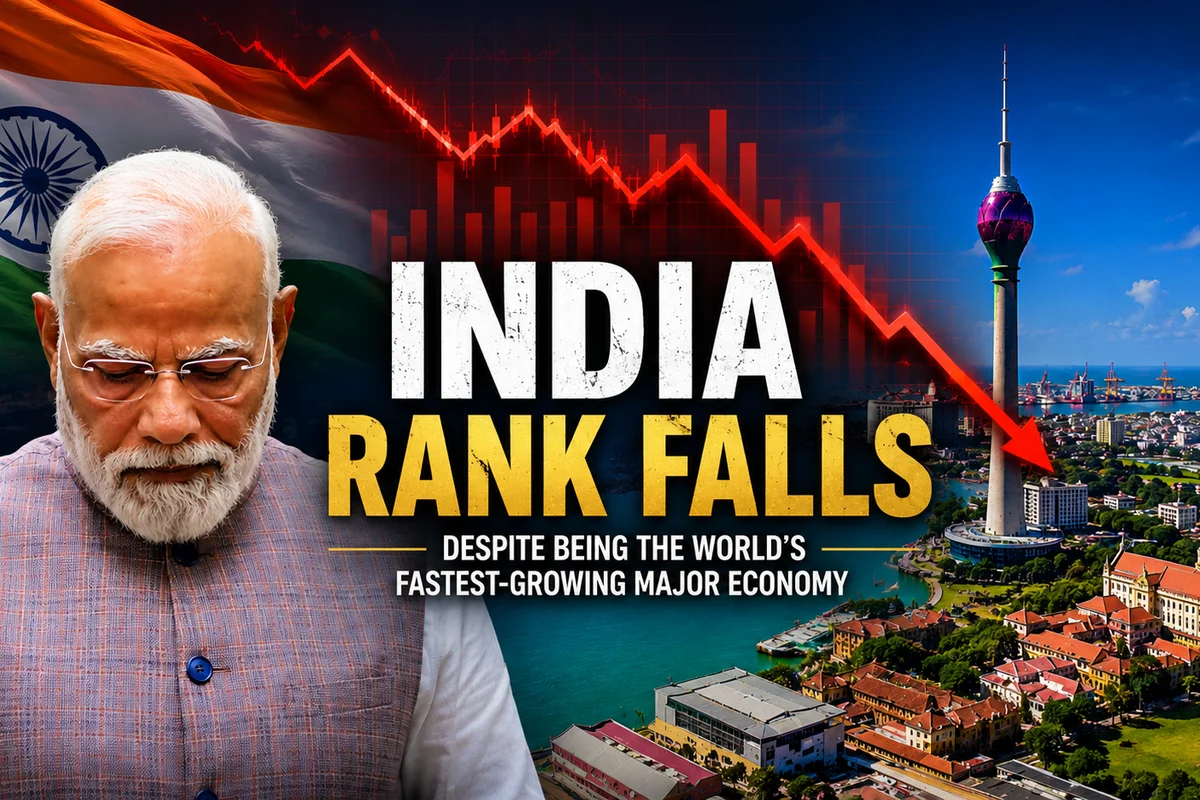
Sri Lanka has officially re-entered the World Bank's upper-middle-income economy category, marking a remarkable turnaround after its severe economic crisis in 2022. Meanwhile, despite being the world's fastest-growing major economy and the fourth-largest by GDP, India continues to remain in the lower-middle-income group, highlighting the difference between economic size and average income per person.
The World Bank's latest income classification also upgraded Vietnam and the Philippines to the upper-middle-income category. For India, however, the classification has remained unchanged since 2007, largely because the World Bank measures Gross National Income (GNI) per capita, not the overall size of an economy.
While India's economy continues to expand rapidly, its population of over 1.4 billion means average income per person remains well below the threshold required to move into the next income category.
The World Bank classifies countries based on Gross National Income (GNI) per capita, which measures the average income earned by residents and businesses after adjusting for exchange rate fluctuations using the Atlas method.
For the latest classification:
| Income Category | GNI Per Capita |
|---|---|
| Low Income | Up to $1,135 |
| Lower-Middle Income | $1,136 – $4,495 |
| Upper-Middle Income | $4,496 – $13,935 |
| High Income | Above $13,935 |
India's GNI per capita is estimated at around $2,500–$2,700, keeping it comfortably within the lower-middle-income category despite its strong GDP growth.
Sri Lanka's promotion to the upper-middle-income category reflects its strong recovery following the country's historic economic crisis and sovereign default in 2022.
According to the World Bank, Sri Lanka's economy expanded by 5% in 2025, supported by improvements across manufacturing, tourism, financial services, and other sectors. Although the country crossed the income threshold only marginally, the recovery was sufficient to regain its previous classification.
The upgrade is widely viewed as a significant milestone after Sri Lanka restructured its economy and stabilized public finances following one of the worst financial crises in its history.
India's classification often surprises investors because the country is among the world's largest economies.
However, the World Bank does not consider total GDP while assigning income groups.
Instead, it measures average income per person.
Although India's economy has expanded significantly over the last two decades, the gains are spread across a population exceeding 1.4 billion people. As a result, per capita income remains well below the $4,496 threshold required to qualify as an upper-middle-income economy.
In simple terms, a country can become one of the world's largest economies while still having relatively low average income per resident.
One of the biggest reasons behind the confusion is the difference between GDP and GNI per capita.
This means economic growth alone does not automatically improve a country's income classification unless average incomes rise significantly.
Apart from Sri Lanka, the World Bank also upgraded Vietnam and the Philippines to the upper-middle-income category.
Vietnam's promotion was driven by years of export-led growth, with exports growing by more than 15% during both 2024 and 2025, while GDP expanded by 7% and 8%, respectively.
The Philippines also achieved higher per capita income through sustained economic growth and improving domestic demand.
For India to move into the upper-middle-income category, its GNI per capita must rise above the World Bank's threshold, which is updated every year to account for inflation.
Apart from strong economic growth, several factors influence the classification, including:
Until average income per resident crosses the required level, India will continue to remain in the lower-middle-income category regardless of its rising global GDP ranking.
India's continued classification as a lower-middle-income economy should not be viewed as a sign of economic weakness. Rather, it reflects the challenge of raising average incomes across one of the world's largest populations. While India's economy continues to expand rapidly, improving productivity, creating high-paying jobs, increasing manufacturing, and sustaining long-term income growth will be critical for achieving upper-middle-income status.
Meanwhile, Sri Lanka's upgrade demonstrates how income classifications can change relatively quickly when per capita income rises above the prescribed threshold, even after a period of severe economic distress.
Investors should monitor India's per capita income growth, employment generation, manufacturing expansion, productivity gains, exchange rate movements, and future World Bank income classifications. Sustained improvements in these indicators will determine when India eventually transitions into the upper-middle-income category.
| Highlights | Details |
|---|---|
| India's Classification | Lower-Middle-Income |
| Sri Lanka's Classification | Upper-Middle-Income |
| India's GNI Per Capita | Around $2,500–$2,700 |
| Upper-Middle-Income Threshold | $4,496 |
| Classification Basis | GNI Per Capita |
| India's Status Since | 2007 |
| Sri Lanka GDP Growth (2025) | 5% |
The World Bank classifies countries based on GNI per capita, not total GDP. Sri Lanka's average income per person exceeds the upper-middle-income threshold, while India's does not.
No. A country's GDP size does not determine its World Bank income category. Average income per resident is the deciding factor.
India continues to be classified as a lower-middle-income economy, a category it has remained in since 2007.
India's GNI per capita must rise above $4,496, alongside sustained income growth, productivity improvements, and higher average earnings.
Sri Lanka's economic recovery, driven by stronger GDP growth, tourism, and financial services following the 2022 crisis, helped raise its per capita income above the World Bank threshold.

Financial journalist specializing in market analysis, stock research, and investment trends. Dedicated to providing accurate, timely insights for informed decision-making.
Credentials: Experienced financial journalist with expertise in equity markets and economic analysis
The information provided in this article is for educational and informational purposes only and should not be construed as financial, investment, or legal advice. welomoney does not provide personalized investment recommendations.
For detailed terms and conditions, please read our Disclaimer and Terms of Service.

Trump’s Canadian alcohol ban is in force, but bulk whisky and liqueurs are exempt. Learn why repackaging matters and what Section 338 means for trade.
Trump-Xi talks could shape US stocks as the tariff truce nears its November 10 deadline. See key market risks, sectors and outcomes for investors.
Iran’s Strait of Hormuz decision is deepening tensions with the US. Discover Tehran’s conditions for reopening the waterway and the risks to global...