Loading market data...
Tue, 28 Jul 2026
09:29:54 am
Tue, 28 Jul 2026
09:29:54 am

Rudransh Sangwan
Published at: April 28, 2026, 10:23 AM
Synopsis
Petrol and diesel prices in India on April 28, 2026 remain stable in the range of ₹94 to ₹110 per litre despite rising crude oil prices and a weak rupee, with significant variation across states due to VAT, logistics, and policy factors, indicating controlled pricing conditions with potential upward risks ahead.
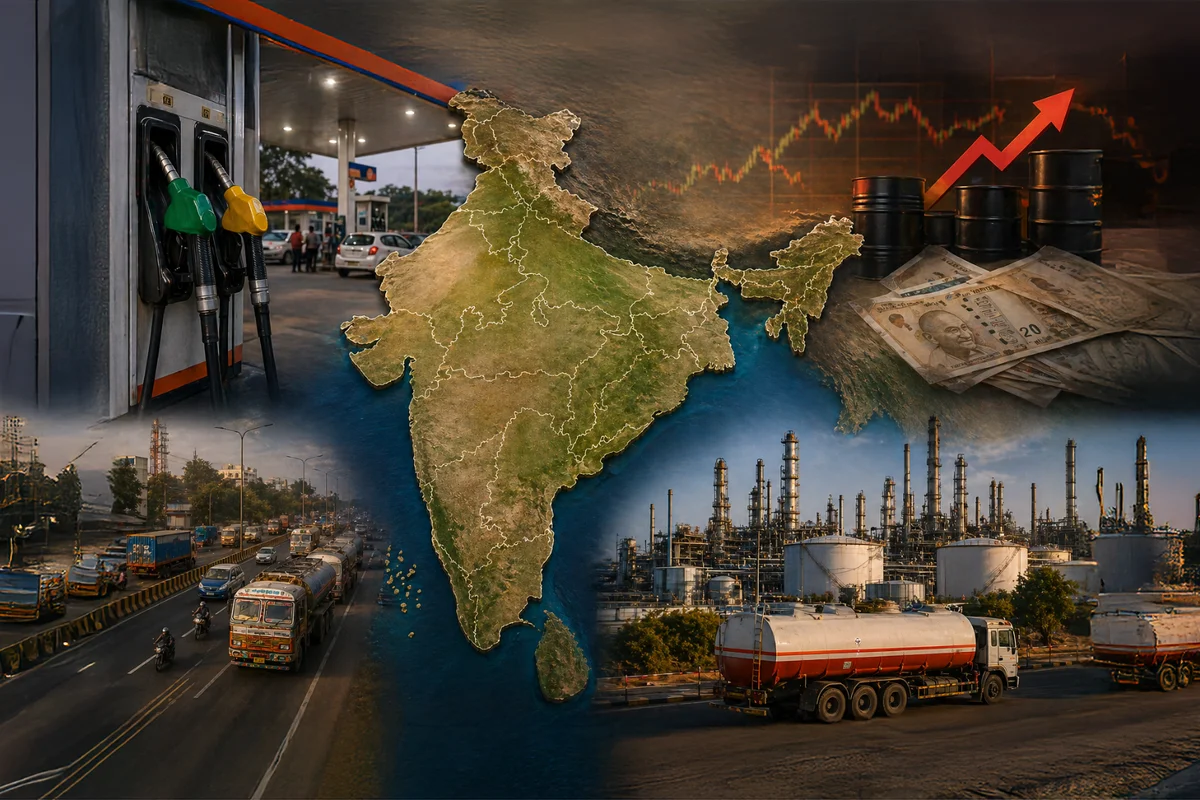
India’s fuel pricing landscape continues to reflect a complex mix of global crude oil trends, currency movements, and domestic tax structures. As of April 28, 2026, petrol and diesel prices remain largely stable across the country despite rising crude oil prices and a weakening rupee. This stability is not purely market-driven but influenced by policy decisions and oil marketing company strategies.
At a national level, fuel prices show a wide range depending on geography and taxation policies.
| Fuel Type | Price Range (₹/Litre) |
|---|---|
| Petrol | ₹94 → ₹110 |
| Diesel | ₹87 → ₹97 |
The current pricing trend indicates stability, even though underlying global factors suggest upward pressure.
Key Takeaways
Fuel prices across metro cities provide a clear benchmark for national trends while highlighting interstate differences.
| City | Petrol (₹/L) | Diesel (₹/L) |
|---|---|---|
| New Delhi | 94.77 | 87.67 |
| Mumbai | 103.54 | 90.03 |
| Kolkata | 105.41 | 92.02 |
| Chennai | 100.80 | 92.39 |
| Bengaluru | 102.9+ | 90.99 |
| Hyderabad | ~104 | 95.70 |
| Ahmedabad | ~94.6 | 90.16 |
| Lucknow | ~95.0 | 88.50 |
| Patna | ~105+ | 91.49 |
The variation across metro cities is largely driven by differences in state-level taxes and logistics costs.
Key Takeaways
Fuel prices in Tier 2 cities often reflect local tax structures more clearly than metros.
| City | Petrol | Diesel |
|---|---|---|
| Jaipur | ~₹104 | ~₹90 |
| Chandigarh | ₹94.30 | ₹82.45 |
| Bhopal | ~₹106+ | ~₹92 |
| Indore | ~₹106+ | ~₹92 |
| Kochi | ~₹107+ | ~₹95 |
| Guwahati | ~₹98 | ~₹89 |
| Ranchi | ~₹98 | ~₹93 |
| Bhubaneswar | ~₹101 | ~₹94 |
| Visakhapatnam | ~₹109 | ~₹97 |
These cities highlight how taxation and distance from refineries impact final consumer prices.
Key Takeaways
A broader look across states reveals the full extent of price variation in India.
| State | Petrol (₹/L) |
|---|---|
| Andhra Pradesh | ₹109.3–109.6 |
| Assam | ₹98–99 |
| Bihar | ₹105–107 |
| Delhi | ₹94.77 |
| Gujarat | ₹94–95 |
| Karnataka | ₹102–103 |
| Kerala | ₹106–107 |
| Madhya Pradesh | ₹106–107 |
| Maharashtra | ₹103–104 |
| Rajasthan | ₹104–105 |
| Tamil Nadu | ₹100–102 |
| Uttar Pradesh | ₹95–97 |
| West Bengal | ₹105+ |
The variation exceeds ₹15 per litre, making India one of the most regionally diverse fuel pricing markets.
Key Takeaways
Diesel prices follow a similar pattern, though the variation is slightly narrower.
| State | Diesel (₹/L) |
|---|---|
| Andhra Pradesh | ₹97+ |
| Assam | ₹89–90 |
| Bihar | ₹91–93 |
| Delhi | ₹87.67 |
| Gujarat | ₹90–91 |
| Karnataka | ₹91–92 |
| Kerala | ₹95–96 |
| Maharashtra | ₹90–91 |
| Rajasthan | ₹90–91 |
| Tamil Nadu | ₹92–93 |
| Uttar Pradesh | ₹88–89 |
| West Bengal | ₹92–93 |
Key Takeaways
Fuel prices can be broadly divided into regional clusters based on taxation and logistics.
The northern region, including Delhi and Chandigarh, remains the cheapest due to lower VAT and political sensitivity. Western states like Gujarat and Maharashtra fall into a mid-range category with balanced taxation. Southern states such as Karnataka and Kerala consistently report higher prices due to elevated VAT and infrastructure costs. Eastern and central regions, including Bihar and Madhya Pradesh, remain among the most expensive due to combined tax and supply chain factors.
Key Takeaways
Fuel pricing in India is influenced by multiple structural factors rather than just crude oil prices.
State VAT remains the biggest contributor, varying significantly from one state to another. Transportation costs also play a role, especially in regions far from refineries. Consumption patterns allow pricing flexibility in high-demand areas, while government intervention ensures that prices do not fully reflect global market movements.
Key Takeaways
Despite rising global crude oil prices and a weak rupee near ₹94 per dollar, fuel prices in India have remained unchanged. This indicates a phase of artificial stability where oil marketing companies may be absorbing costs instead of passing them to consumers.
This approach helps control inflation in the short term but creates pressure on margins and may lead to future price adjustments.
Key Takeaways
Looking ahead, the direction of fuel prices will depend heavily on crude oil trends and currency stability. If global oil prices continue to rise, states with already high taxation such as Kerala, Rajasthan, and Madhya Pradesh could see petrol prices move beyond ₹110 per litre.
On the other hand, regions like Delhi and Gujarat may experience relatively lower increases due to their lower tax base.
Key Takeaways
India’s fuel pricing structure is not uniform but deeply influenced by regional policies and global economic factors. While current prices appear stable, underlying pressures from crude oil and currency movements suggest that this stability may not last indefinitely.
The current situation reflects a balancing act between inflation control and market realities, making fuel pricing one of the most closely watched economic indicators in the country.
Fuel prices vary mainly due to different state VAT rates, transportation costs, and local government policies, which significantly impact the final retail price.
Prices are currently stable because oil marketing companies are absorbing part of the cost increase and the government is managing inflation pressures.
States like Kerala, Rajasthan, Madhya Pradesh, and West Bengal generally have the highest fuel prices due to higher taxes and logistics costs.
If crude oil prices remain high and the rupee stays weak, fuel prices may rise in the coming months, especially in high-tax states.
Diesel is taxed lower than petrol because it is widely used in transportation and agriculture, making it economically sensitive.
Financial journalist specializing in market analysis, stock research, and investment trends. Dedicated to providing accurate, timely insights for informed decision-making.
Credentials: Experienced financial journalist with expertise in equity markets and economic analysis
The information provided in this article is for educational and informational purposes only and should not be construed as financial, investment, or legal advice. welomoney does not provide personalized investment recommendations.
For detailed terms and conditions, please read our Disclaimer and Terms of Service.
No additional articles in this category yet.