Loading market data...
Tue, 20 Oct 2026
05:42:46 pm
Tue, 20 Oct 2026
05:42:46 pm

Rudransh Sangwan
Published at: March 21, 2026, 7:36 AM
Synopsis
US stocks fall sharply as Iran war drives oil prices and inflation fears higher. Dow drops 444 points, Nasdaq slides 2%. Full market analysis.
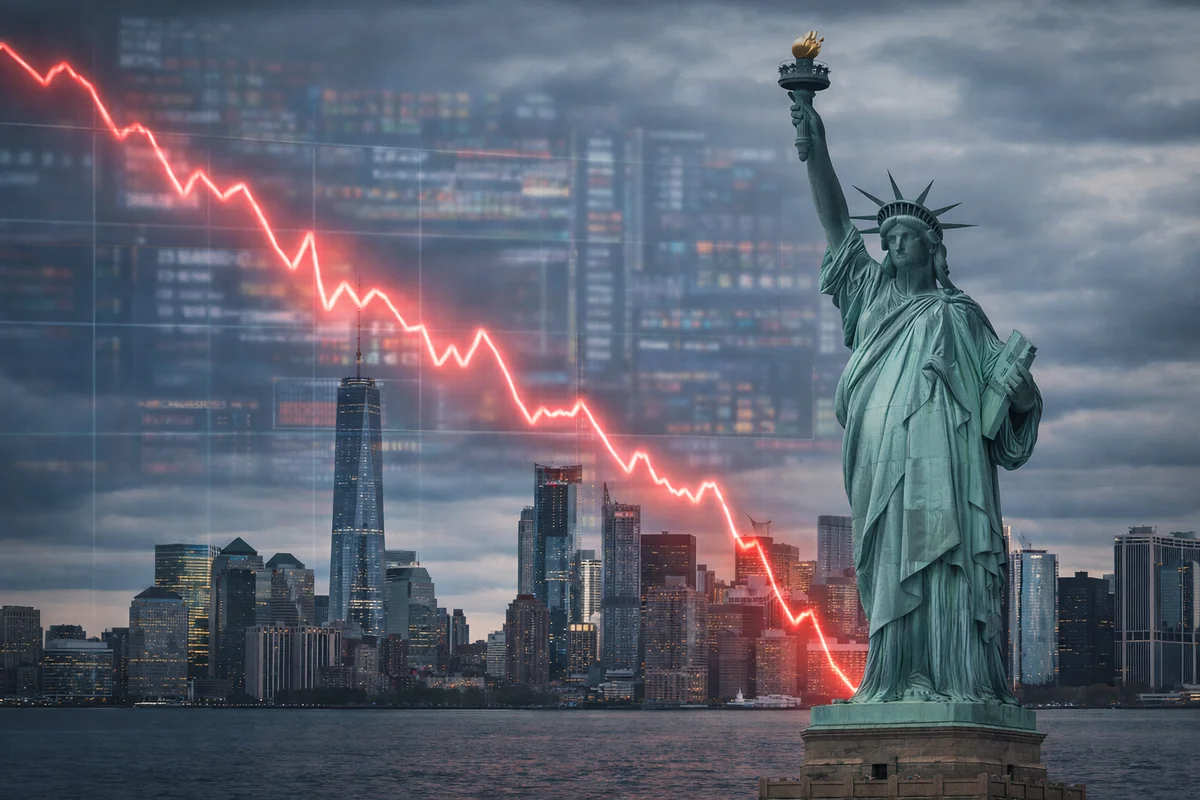
Wall Street witnessed a sharp and broad-based sell-off as escalating tensions in the US–Iran war triggered a wave of risk aversion across global financial markets. The Dow Jones Industrial Average plunged over 444 points, while the Nasdaq fell more than 2% and the S&P 500 dropped over 1%, marking the worst stretch for US equities in nearly four weeks. The downturn reflects growing investor anxiety over rising oil prices, persistent inflation risks, and the increasing likelihood that interest rates may remain elevated for longer than previously expected.
Key Market Snapshot
| Key Metric | Details |
|---|---|
| Dow Jones | -444 points (-0.97%) |
| S&P 500 | -1.5% |
| Nasdaq | -2.0% |
| 4-Week Trend | Worst performance in weeks |
| Core Trigger | Iran war escalation |
| Oil Prices | Above $110 per barrel |
Geopolitical Shock Becomes Primary Market Driver
The ongoing war in West Asia has fundamentally altered the dynamics of global financial markets, with geopolitical risk now overshadowing economic fundamentals. The conflict has entered its fourth week with no signs of de-escalation, prompting investors to reassess risk exposure and reduce positions in equities.
Market participants tracking Geopolitical risk analysis note that prolonged conflicts tend to create sustained uncertainty, discouraging capital investment and increasing volatility across asset classes. The deployment of additional US military forces and continued disruptions in the region have reinforced fears that the conflict could extend for months rather than weeks.
This shift in sentiment has resulted in a classic “risk-off” environment, where investors rotate capital into safer assets such as government bonds and the US dollar, while equities face sustained pressure.
Tech Giants Lead the Market Decline
The sell-off was led by major technology stocks, including Nvidia, Microsoft, Alphabet, Tesla, and Meta Platforms, all of which recorded significant losses during the session. These companies, often referred to as market leaders, have a disproportionate impact on index performance due to their large market capitalizations.
Analysts tracking Equity valuation models suggest that growth stocks are particularly vulnerable in environments where interest rate expectations rise. As inflation concerns intensify, the present value of future earnings declines, leading to sharp corrections in high-valuation sectors like technology.
Oil Price Surge Fuels Inflation and Market Stress
A major catalyst behind the market sell-off is the sharp rise in crude oil prices, driven by supply disruptions linked to the conflict. Brent crude has surged above $110 per barrel, with fears of further increases if the Strait of Hormuz remains constrained.
Experts following Global oil markets highlight that sustained supply shocks can have cascading effects across the global economy, increasing transportation costs, manufacturing expenses, and consumer prices. This has led to renewed concerns about inflation, which had previously shown signs of moderating.
The surge in oil prices has created a feedback loop, where higher energy costs lead to rising inflation expectations, which in turn influence central bank policy and equity valuations.
Bond Yields Rise as Rate Cut Expectations Fade
The sell-off in equities has been accompanied by a rise in bond yields, reflecting shifting expectations around monetary policy. Investors are increasingly pricing in the possibility that the Federal Reserve may delay or even reconsider planned rate cuts due to persistent inflationary pressures.
Market participants tracking Interest rate cycles indicate that geopolitical shocks often lead to tighter financial conditions, as central banks prioritize inflation control over growth support.
This evolving outlook has added another layer of pressure on equity markets, particularly in interest-rate-sensitive sectors.
Four-Week Market Decline Signals Structural Shift
The latest sell-off marks the fourth consecutive week of declines for major US indices, with cumulative losses becoming increasingly significant. Since the start of the conflict, the Dow, S&P 500, and Nasdaq have all recorded notable declines, reflecting sustained pressure on investor sentiment.
The Russell 2000 index has also entered correction territory, falling more than 10% from its recent highs, indicating that the impact of the sell-off is broad-based and not limited to large-cap stocks.
Analysts suggest that this sustained decline may signal a structural shift in market dynamics, where geopolitical risks and energy prices play a more dominant role in determining asset prices.
Global Spillover Intensifies Market Volatility
The impact of the US market sell-off has extended to global financial markets, with European and Asian equities also experiencing declines. Rising oil prices and geopolitical uncertainty have created a synchronized global reaction, amplifying volatility across asset classes.
Market observers tracking Global capital flows note that such environments often lead to sudden shifts in investment patterns, with capital moving away from riskier assets toward safer alternatives.
This interconnectedness means that developments in the Middle East are now directly influencing financial markets worldwide.
Outlook: Volatility to Persist as Conflict Continues
Looking ahead, the outlook for US equities remains uncertain, with geopolitical developments expected to remain the primary driver of market direction. If the conflict continues or escalates further, the pressure on equity markets is likely to persist.
Rising oil prices, elevated inflation expectations, and shifting monetary policy dynamics are creating a challenging environment for investors. While short-term rebounds are possible, the broader trend is expected to remain volatile.
For now, markets are adjusting to a new reality where geopolitical risk is a dominant force, and the path forward will depend heavily on how the US–Iran conflict evolves in the coming weeks.
Financial journalist specializing in market analysis, stock research, and investment trends. Dedicated to providing accurate, timely insights for informed decision-making.
Credentials: Experienced financial journalist with expertise in equity markets and economic analysis
The information provided in this article is for educational and informational purposes only and should not be construed as financial, investment, or legal advice. welomoney does not provide personalized investment recommendations.
For detailed terms and conditions, please read our Disclaimer and Terms of Service.

Zerodha launches US stock investing on Kite beta, with access to 2,000 companies and fractional shares from $1. See brokerage, fees and eligibility.
Indonesia’s stock market faces a potential MSCI downgrade over transparency concerns, triggering a sharp selloff and fears of foreign investor...