Loading market data...
Tue, 20 Oct 2026
05:46:04 pm
Tue, 20 Oct 2026
05:46:04 pm

Rudransh Sangwan
Published at: June 6, 2026, 3:23 AM
Synopsis
Nasdaq crashes 4.18% in its worst session since 2025 as AI and semiconductor stocks plunge. Read the complete analysis on Broadcom, AMD, Intel, Micron, rising Treasury yields, SpaceX IPO impact, Bitcoin decline, and what investors should expect next.
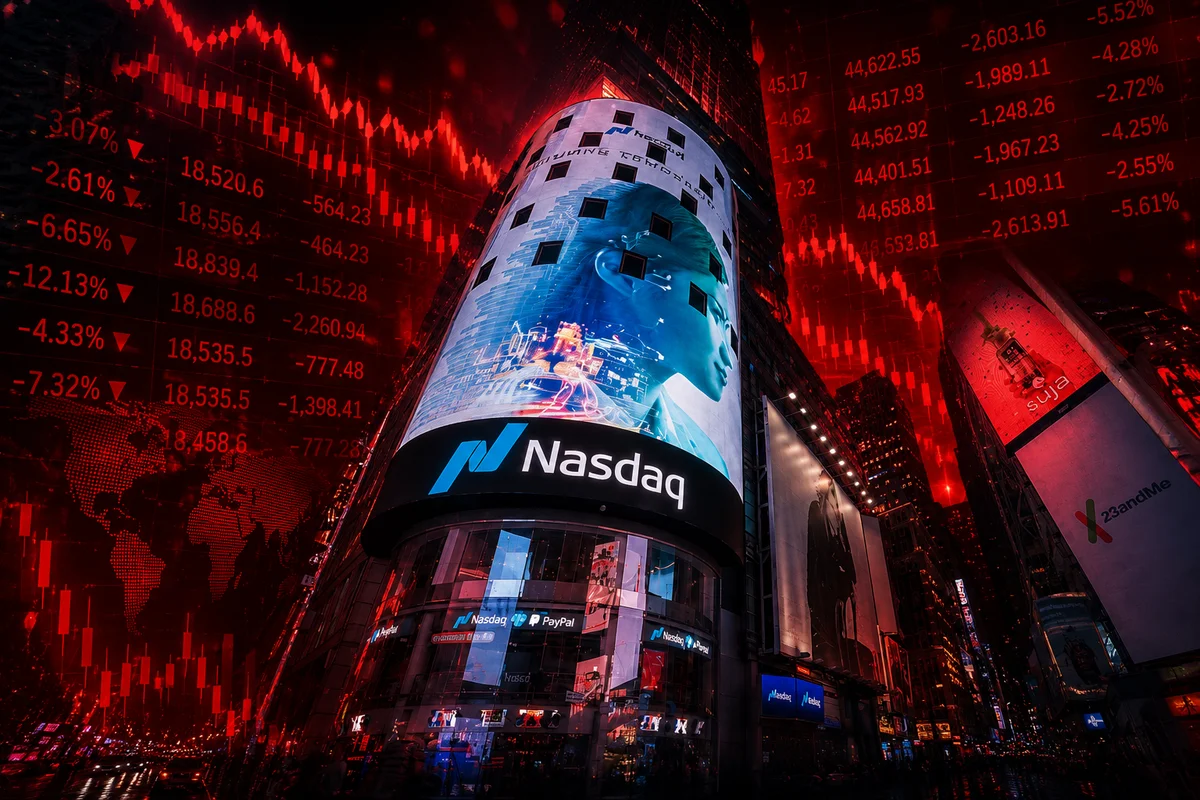
Global equity markets witnessed one of the most dramatic technology-led selloffs of 2026 after the Nasdaq Composite plunged more than 4%, recording its worst single-day decline since April 2025. The sharp correction was driven by a violent collapse in semiconductor and AI-related stocks, which had been among the strongest-performing sectors over the past year.
The selloff erased hundreds of billions of dollars in market value as investors rushed to lock in profits from some of the market's most crowded trades. Major semiconductor companies including Broadcom, Marvell Technology, Micron Technology, Intel, and Advanced Micro Devices experienced double-digit declines, while the broader semiconductor sector recorded its worst session since the COVID-19 market crash of March 2020.
The sudden reversal has reignited debates about whether the AI-driven stock market rally has become overheated and whether investors are beginning to rotate away from high-growth technology stocks into defensive sectors such as healthcare, consumer staples, and dividend-paying companies.
| Index | Closing Level | Change |
|---|---|---|
| Nasdaq Composite | 25,709.43 | -4.18% |
| S&P 500 | 7,383.74 | -2.64% |
| Dow Jones Industrial Average | 50,866.78 | -1.35% |
| iShares Semiconductor ETF | -10.00% | Worst Day Since March 2020 |
The Nasdaq's decline marked its biggest one-day fall in more than a year, while the S&P 500 recorded its first negative week in ten weeks.
Several factors combined to create the perfect environment for a sharp correction in technology and semiconductor stocks.
| Factor | Impact on Markets |
|---|---|
| Broadcom AI Outlook Disappointment | Negative |
| Rising Treasury Yields | Negative |
| Strong US Jobs Report | Negative |
| Profit Booking in AI Stocks | Negative |
| SpaceX IPO Capital Rotation | Negative |
| Bitcoin Collapse Below $60,000 | Risk-Off Signal |
Unlike previous corrections driven by macroeconomic fears, this selloff was largely concentrated in technology and AI-linked stocks that had experienced extraordinary gains over the past year.
The initial trigger emerged after Broadcom's earnings update failed to significantly raise expectations for AI chip demand.
Investors had become accustomed to technology companies continuously upgrading their AI-related growth forecasts. When Broadcom's guidance failed to exceed increasingly aggressive expectations, investors began questioning whether the AI spending cycle could maintain its current pace.
The reaction quickly spread across the semiconductor industry, leading to heavy selling pressure throughout the sector.
| Company | Daily Change |
|---|---|
| Marvell Technology | -16% |
| Micron Technology | -13% |
| Intel | -11% |
| AMD | -11% |
| Broadcom | -8% |
| Semiconductor ETF | -10% |
The speed of the decline reflects how heavily concentrated institutional portfolios had become in AI-related investments.
Another major catalyst was the surprisingly strong US labor market report.
The Bureau of Labor Statistics reported that nonfarm payrolls increased by 172,000 jobs in May, significantly above economist expectations of 80,000.
| Metric | Actual | Forecast |
|---|---|---|
| Nonfarm Payrolls | 172,000 | 80,000 |
| Surprise Factor | +92,000 | Positive |
At first glance, strong employment data appears positive for the economy. However, for technology stocks, stronger economic data can sometimes become a negative development.
Investors fear that a resilient labor market could force the Federal Reserve to maintain higher interest rates for longer, increasing borrowing costs and reducing the present value of future corporate earnings.
Following the report, Treasury yields surged sharply.
| Yield | Level |
|---|---|
| 10-Year Treasury | Above 4.5% |
| 30-Year Treasury | Above 5.0% |
Higher bond yields generally place pressure on growth-oriented technology companies because much of their valuation depends on future earnings growth.
The selloff comes after one of the strongest AI-driven rallies in stock market history.
Over the past year, companies connected to artificial intelligence, semiconductor manufacturing, cloud infrastructure, and advanced computing experienced extraordinary gains as investors poured capital into what many viewed as the next technological revolution.
| Sector | Performance Trend |
|---|---|
| AI Chips | Explosive Growth |
| Cloud Computing | Strong |
| Semiconductor Equipment | Strong |
| Data Centers | Strong |
| AI Software | Strong |
Despite Friday's decline, many semiconductor stocks remain significantly higher than they were at the beginning of the year.
For example, the iShares Semiconductor ETF remains up approximately 79% year-to-date even after the recent correction.
Another factor influencing investor behavior is the upcoming SpaceX IPO.
The offering is expected to become one of the largest IPOs in history, with an estimated valuation approaching $1.77 trillion.
Many analysts believe institutional investors are reallocating capital from existing AI and semiconductor positions to participate in the highly anticipated listing.
| Factor | Impact |
|---|---|
| Massive IPO Size | Portfolio Rebalancing |
| AI Exposure | Investor Interest |
| Space Technology Growth | Capital Attraction |
| High Valuation | Liquidity Demand |
Historically, major IPOs often lead investors to sell portions of existing positions to create room for new investments.
Adding to market concerns, Bitcoin fell below $60,000 for the first time since late 2024.
Cryptocurrency markets often act as an indicator of investor risk appetite.
| Asset Class | Trend |
|---|---|
| AI Stocks | Sharp Selling |
| Semiconductor Stocks | Sharp Selling |
| Bitcoin | Weakness |
| Growth Stocks | Selling Pressure |
| Defensive Stocks | Buying Interest |
The simultaneous decline across technology stocks and cryptocurrencies suggests investors are becoming more cautious about speculative assets.
As technology stocks fell, investors rotated capital into defensive sectors.
| Company | Gain |
|---|---|
| Colgate-Palmolive | +4% |
| Coca-Cola | +3% |
| Johnson & Johnson | +2% |
This type of sector rotation often occurs when investors seek stability during periods of market volatility.
Healthcare, consumer staples, and dividend-paying companies tend to outperform during risk-off environments because their earnings are generally less sensitive to economic cycles.
This remains the most important question facing investors.
While Friday's decline was severe, many analysts view the correction as a healthy profit-taking event rather than the beginning of a prolonged bear market.
| Positive Factors |
|---|
| Continued AI Adoption |
| Growing Data Center Investments |
| Strong Cloud Demand |
| Rising Enterprise AI Spending |
| Long-Term Semiconductor Demand |
| Risk Factors |
|---|
| High Valuations |
| Rising Interest Rates |
| Profit-Taking |
| Slowing Earnings Growth |
| Investor Rotation |
The AI investment theme remains fundamentally strong, but market participants may be entering a phase where earnings performance becomes more important than hype.
Several events could determine whether the selloff continues or stabilizes.
| Event | Importance |
|---|---|
| Federal Reserve Commentary | Very High |
| Treasury Yield Movements | Very High |
| AI Earnings Updates | High |
| SpaceX IPO Performance | High |
| Inflation Data | High |
| Semiconductor Demand Trends | Very High |
The behavior of Treasury yields will likely remain one of the most important indicators for technology investors over the coming weeks.
The recent Nasdaq decline appears to be driven by a combination of profit-taking, rising bond yields, and concerns about whether AI-related growth expectations have become too aggressive. The selloff was amplified because semiconductor and AI stocks had become some of the most crowded trades in global markets.
Despite the sharp correction, the long-term AI investment thesis remains intact. Artificial intelligence, cloud computing, semiconductor manufacturing, data centers, and advanced computing infrastructure continue to represent some of the fastest-growing areas of the global economy.
However, investors should expect higher volatility as markets transition from an environment driven primarily by AI enthusiasm to one increasingly focused on earnings growth, profitability, and valuation discipline.
The Nasdaq's 4.18% plunge marks the biggest technology selloff since April 2025 and highlights growing concerns surrounding valuations, rising Treasury yields, and the sustainability of the AI-driven stock market rally. Semiconductor giants including Broadcom, AMD, Intel, Micron, and Marvell suffered double-digit losses as investors rushed to take profits and prepare for the upcoming SpaceX IPO. While the AI growth story remains powerful, the market is entering a more selective phase where earnings delivery and execution will matter more than future promises.
The Nasdaq declined due to heavy selling in semiconductor and AI-related stocks, rising Treasury yields, stronger-than-expected US jobs data, and investor profit-taking after a massive AI-driven rally.
Marvell Technology fell more than 16%, Micron dropped around 13%, while AMD and Intel declined approximately 11% each.
Most analysts believe this is a correction rather than the end of the AI boom. Demand for AI infrastructure, chips, cloud computing, and data centers remains strong.
A stronger jobs report increased concerns that the Federal Reserve may keep interest rates elevated, causing Treasury yields to rise and putting pressure on growth-oriented technology stocks.
Some analysts believe investors are selling portions of their AI and semiconductor holdings to free up capital for the highly anticipated SpaceX IPO.
Financial journalist specializing in market analysis, stock research, and investment trends. Dedicated to providing accurate, timely insights for informed decision-making.
Credentials: Experienced financial journalist with expertise in equity markets and economic analysis
The information provided in this article is for educational and informational purposes only and should not be construed as financial, investment, or legal advice. welomoney does not provide personalized investment recommendations.
For detailed terms and conditions, please read our Disclaimer and Terms of Service.

Zerodha launches US stock investing on Kite beta, with access to 2,000 companies and fractional shares from $1. See brokerage, fees and eligibility.
Indonesia’s stock market faces a potential MSCI downgrade over transparency concerns, triggering a sharp selloff and fears of foreign investor...